Case study - Diabetic ketoacidosis (DKA): Nursing

1,434visualizaciones

Case study - Diabetic ketoacidosis (DKA): Nursing

Week 10 modules

Week 10 modules

Diabetes mellitus: Revisión de la patología
Diabetes mellitus
Diabetes mellitus (DM): Nursing process (ADPIE)
Hyperosmolar hyperglycemic state (HHS): Nursing process (ADPIE)
Diabetic ketoacidosis (DKA): Nursing process (ADPIE)
Case study - Diabetic ketoacidosis (DKA): Nursing
Medication administration - Insulin: Nursing pharmacology
Insulin: Nursing pharmacology
Anatomía de las vísceras abdominales: Esófago y estómago
Anatomía de las vísceras abdominales: Intestino grueso
Anatomía de las vísceras abdominales: Intestino delgado
Anatomía y fisiología del aparato urinario
Anatomía de los órganos urinarios de la pelvis
Malnutrition: Nursing
Diarrhea: Nursing
Assessment - Nutrition: Nursing
Urinary retention: Nursing
Case study - Constipation: Nursing
Obesity: Nursing
Glucagón
Metabolismo del glucógeno
Peripheral arterial disease (PAD): Nursing process (ADPIE)
Peripheral venous disease (PVD): Nursing process (ADPIE)
Non-insulin injectable antidiabetic drugs - GLP-1 agonists and amylinomimetics: Nursing pharmacology
Oral antidiabetic medications - Alpha-glucosidase inhibitors: Nursing pharmacology
Nutrition - Enteral: Nursing skills
Oral antidiabetic medications - DPP-4 inhibitors: Nursing pharmacology
Oral antidiabetic medications - Sulfonylureas and meglitinides: Nursing pharmacology
Oral antidiabetic medications - Sodium-glucose co-transporter-2 (SGLT-2) inhibitors: Nursing pharmacology
Hidratos de carbono y azúcares
Anatomía y fisiología del sistema digestivo
Proteínas
Grasas y lípidos
Vitamins and minerals
Urinary incontinence - Stress: Nursing process (ADPIE)
Hygiene - Ostomy care: Nursing skills
Routine ostomy care: Clinical skills notes
Urinary tract infections (UTIs): Nursing process (ADPIE)
GI/GU: Assisting with bowel elimination
Abordaje de la hipoglucemia: ciencias clínicas
Cetoacidosis diabética: ciencias clínicas
Estado hiperglucémico hiperosmolar: ciencias clínicas
Complications of Diabetes
Video Case Study - Bowel Elimination
Abordaje a la diarrea (crónica): ciencias clínicas
Nursing Care for Enteral Nutrition
Hidratación
Malnutrition
Obesity and Health Risks
Obesidad y síndrome metabólico: ciencias clínicas
Malnutrición proteico-energética: ciencias clínicas
Bladder and bowel training: Clinical skills notes
GI/GU: Bladder and bowel training
Infección de las vías urinarias inferiores

Notas

CASE STUDY - DIABETIC KETOACIDOSIS (DKA)

KEY POINTS
NOTES
INTRODUCTION
  • Medical-surgical unit
  • 32-year-old man
  • History: type 1 diabetes 
  • Admitted for DKA

RECOGNIZING AND ANALYZING CUES
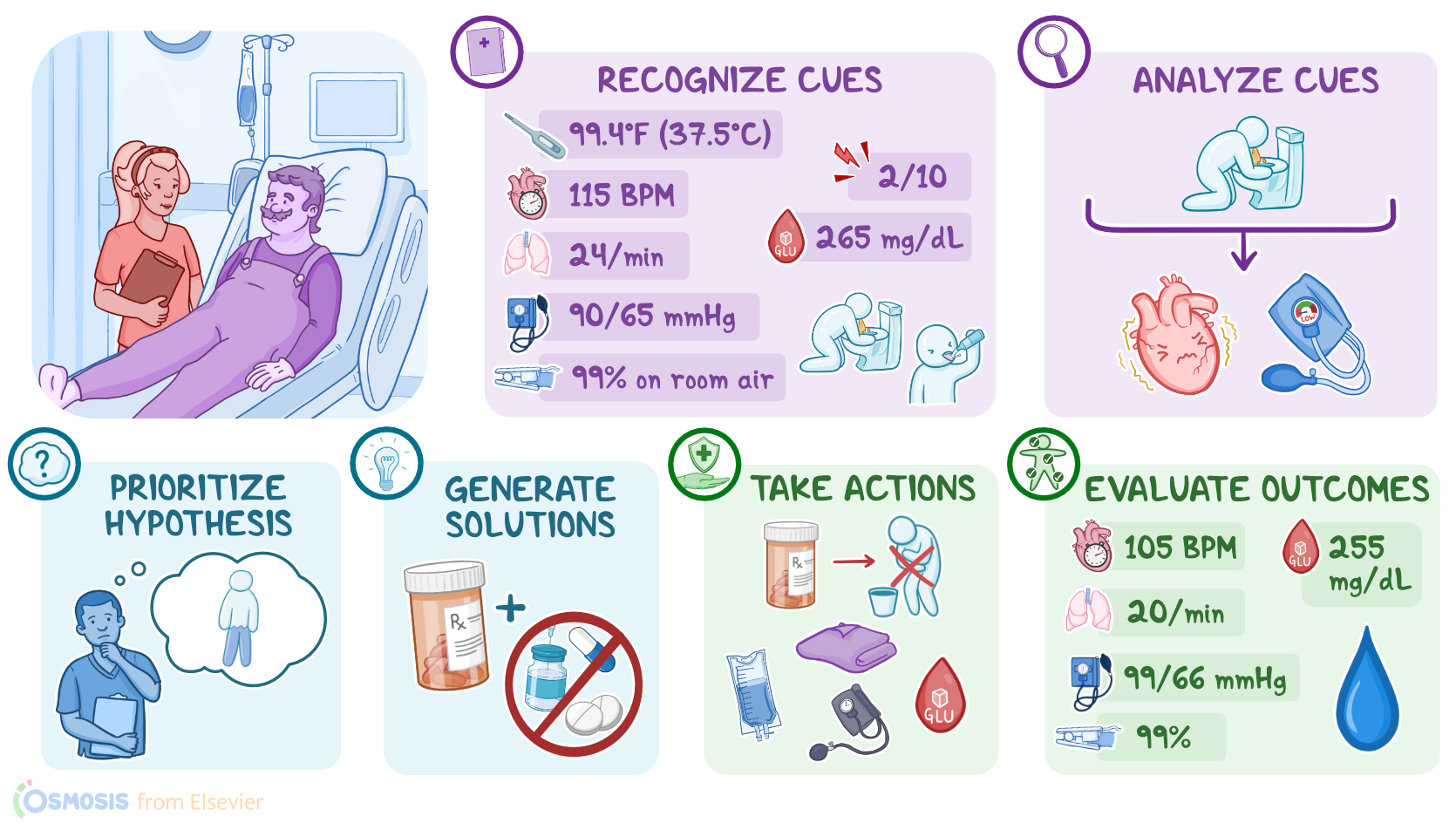
  • Recognize cues
    • Temperature: 99.4 F (37.5 C)
    • Heart rate: 115
    • Respirations: 24
    • Blood pressure: 90/65 mmHg
    • Oxygen saturation: 99% room air
    • Pain: 2/10
    • Alert, oriented
    • Dry mucous membranes
    • Nausea with emesis
    • Continuous insulin infusion with IV fluids
    • Glucose: 265 mg/dL (14.7 mmol/L)
  • Analyze cues
    • Verifies insulin and IV fluids
    • DKA causes osmotic diuresis and fluid loss
    • Acidosis leads to nausea and vomiting
    • Tachycardia and hypotension indicate dehydration

PRIORITIZING HYPOTHESES, GENERATING SOLUTIONS, AND TAKING ACTIONS
  • Priority hypothesis
    • Fluid volume deficit
  • Generate solutions
    • Systolic blood pressure will remain above 90 mmHg for duration of shift
  • Take action
    • 250 mL bolus of fluids
    • Increase IV fluid maintenance rate
    • Administers medications as prescribed
    • Strict intake and output
    • Set blood pressure cuff to run every 15 minutes

EVALUATING OUTCOMES
  • Blood pressure: 99/66 mmHg
  • Heart rate: 105
  • Respirations: 20
  • Oxygen saturation: 99% room air
  • Glucose: 255 mg/dL (14.2 mmol/L)
  • No nausea
  • Outcome met

Transcripción

Ver video solo

Nurse Andrea works on a medical-surgical unit and is caring for Mario, a 32-year-old male with a history of type 1 diabetes mellitus, who was recently admitted from the emergency department for diabetic ketoacidosis, or DKA. After settling Mario in his room, Nurse Andrea goes through the steps of the Clinical Judgment Measurement Model to make clinical decisions about Mario’s care by recognizing and analyzing cues, prioritizing hypotheses, generating solutions, taking action, and evaluating outcomes.   

First, Nurse Andrea recognizes important cues, including Mario’s vital signs which are temperature 99.4 F, or 37.5 C, heart rate 115 beats per minute, respirations 24 breaths per minute, blood pressure 90/65 mmHg, and oxygen saturation 99 percent on room air. His pain rating is 2 out of 10. Upon assessment, Nurse Andrea notes Mario is alert and oriented, his mucous membranes are dry, and he reports nausea with two episodes of emesis. Nurse Andrea also notes that he has a continuous insulin drip and IV fluids infusing into a peripheral IV, and his current blood glucose level is 265 mg/dL. 

Next, Nurse Andrea analyzes these cues. She reviews the electronic health record, or EHR, and verifies Mario is on the correct rate of insulin and IV fluids. She understands that the elevated  glucose levels in DKA cause osmotic diuresis and significant fluid loss, and that the acidosis is causing Mario’s nausea and vomiting, resulting in additional loss of fluid and electrolytes. She also knows that fluid loss will continue until Mario’s blood glucose level is stabilized, and that tachycardia and hypotension are signs of dehydration. Nurse Andrea recognizes that Mario needs fluid management

Now, using the information she's gathered, Nurse Andrea chooses a priority hypothesis of fluid volume deficit

Then, she generates solutions to address Mario’s fluid volume deficit, including pharmacologic and nonpharmacologic interventions; and she establishes the expected outcome that after intervening, Mario’s systolic blood pressure will remain above 90 mmHg for the duration of the shift.

Then, Nurse Andrea takes action to implement these solutions. First, she calls the health care provider to report her assessment findings. The health care provider orders a 250 mL bolus of isotonic fluids and an increase in Mario’s maintenance IV fluid rate. The health care provider also orders an antiemetic medication, oral fluids as tolerated, and strict intake and output. 
 Then, Nurse Andrea enters Mario’s room. 

Nurse Andrea: Hi Mario. I just spoke with your health care provider because I’m concerned that you’re dehydrated. I’d like to help with this by giving you some medication for your nausea.  

Mario: Okay. I’d really like to be able to drink something without feeling sick. My mouth is so dry. 

Fuentes

  1. "Lewis's medical-surgical nursing: Assessment and management of clinical problems. (12th ed.)" Elsevier (2022)
  2. "Medical-surgical nursing: Concepts for interprofessional and collaborative care. (10th ed.)" Elsevier (2021)
  3. "Lewis’s medical-surgical nursing in Canada: Assessment and management of clinical problems. (5th ed.)" Elsevier (2023)