Case study - Sexually transmitted infection (STI): Nursing
Nurse Sarah works in an urgent care clinic and is caring for Gia, a 24-year-old female who wants to be tested for sexually transmitted infections, or STIs, after her partner told her he tested positive for chlamydia.
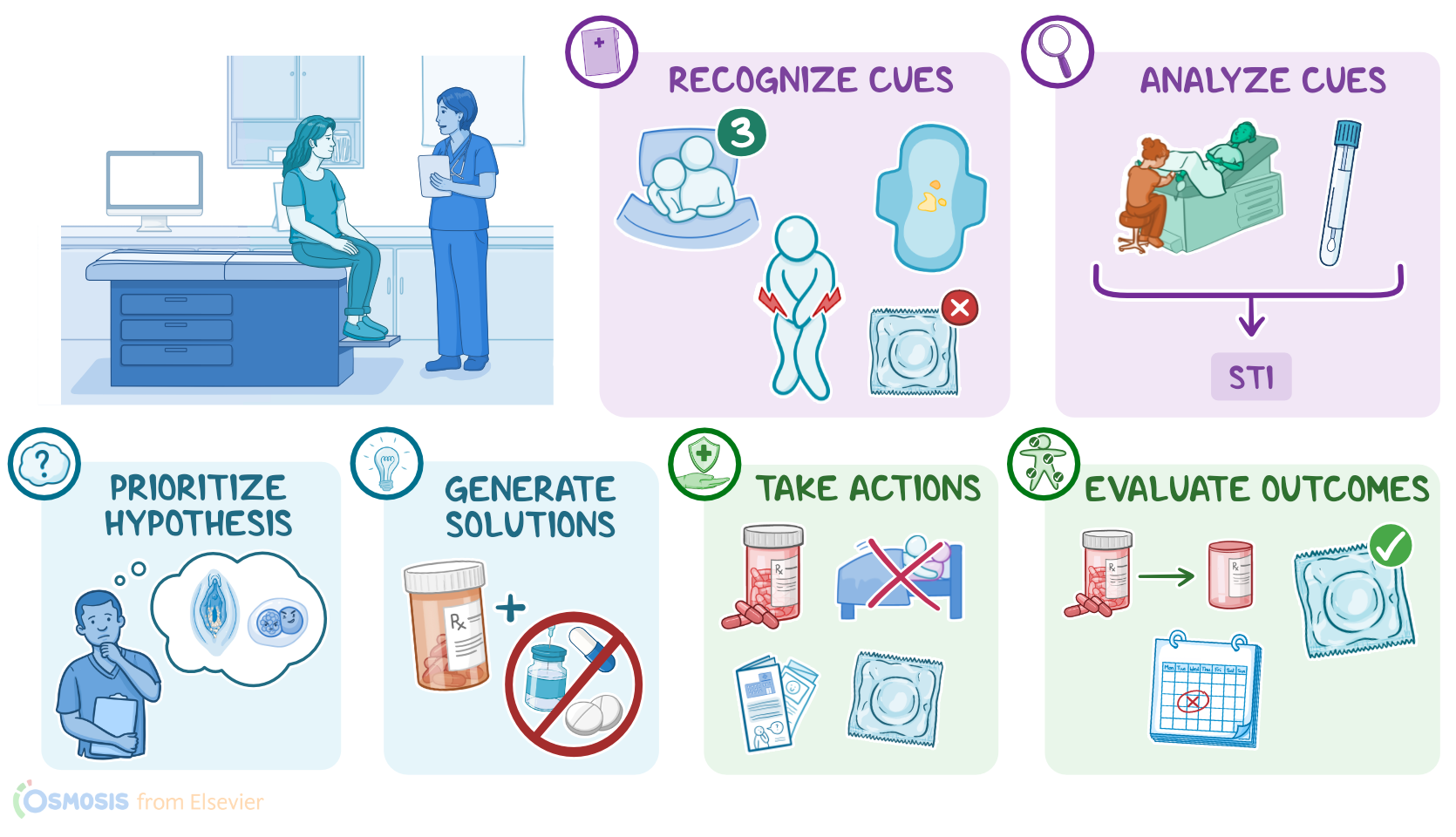
After settling Gia in the exam room, Nurse Sarah goes through the steps of the Clinical Judgment Measurement Model, or CJMM, to make clinical decisions about Gia’s care by recognizing and analyzing cues, prioritizing hypotheses, generating solutions, taking action, and evaluating outcomes.
To begin, Nurse Sarah recalls how sexual health encompasses a patient’s well-being related to their sexual orientation, gender identity, and intimacy with others. With this in mind, Nurse Sarah performs a sexual health assessment and recognizes important cues, including Gia’s report of increased vaginal discharge and dysuria over the past four days. She notes Gia has no previous history of STIs or pregnancies, has had three sexual partners in the last month, doesn’t use contraceptives, and reports feeling safe in her current relationship.
Nurse Sarah ensures Gia’s privacy and stays in the room while the health care provider performs Gia’s pelvic exam and collects specimens for testing.
Next, Nurse Sarah analyzes the cues. She notes the health care provider’s documentation of Gia’s exam, including the presence of copious vaginal discharge, with no signs of bruising or forced vaginal entry.
So, using the information she’s gathered, along with Gia’s social and medical history, Nurse Sarah selects the priority hypothesis of acute STI. Then, she generates solutions to address Gia’s STI which will include treatment with the prescribed antibiotics and education on STI treatment and prevention; and she establishes the expected outcomes that Gia will accurately describe how to complete her antibiotic prescription and choose a reliable method to prevent future STIs by the end of today’s visit.
Nurse Sarah then takes action to implement these solutions. First, she teaches Gia about the prescribed antibiotic. She underscores the importance of completing the full course of antibiotics even if she starts to feel better, while also abstaining from sexual intercourse until she has completed her course of antibiotics.
Then, she teaches Gia about reliable methods for STI prevention using open communication and a nonjudgmental approach.
Nurse Sarah: Gia, if it’s okay with you, I'd like to talk about ways to prevent sexually transmitted infections, or STIs, in the future.
Gia: Ugh, I feel so embarrassed, I hope this never happens again.
Nurse Sarah: It’s normal to feel embarrassed, and we’re here to help you. First, it’s important to talk openly with your sexual partners about their sexual history, including how many partners they’ve had and whether they’ve had any STIs in the past. Also, limiting the number of sexual partners you have can reduce your risk of transmission.
Gia: Okay, I understand.
| CASE STUDY - SEXUALLY TRANSMITTED INFECTION (STI) | ||
| KEY POINTS | NOTES | |
| INTRODUCTION |
| |
| RECOGNIZING AND ANALYZING CUES |
| |
| PRIORITIZING HYPOTHESES, GENERATING SOLUTIONS, AND TAKING ACTIONS |
| |
| EVALUATING OUTCOMES |
| |
- "Fundamentals of nursing (11th ed.)" Elsevier (2023)
- "Fundamentals of nursing (10th ed.)" Elsevier (2021)
- "Fundamentals of nursing: Active learning for collaborative practice. (3rd ed.)" Elsevier (2022)
- "Fundamentals of nursing: Active learning for collaborative practice. (3rd ed.)" Elsevier (2022)
Aún no hay notas para este video
Intenta agregar una nota a continuación