
Cephalgia · What Is It, Types, Causes, and More

Published: Sep 10, 2026
Author: Ali Syed, PharmD•
Editor: Ahaana Singh•
Editor: Ian Mannarino, MD, MBA•
Editor: Maria Giulia Boemi•
Editor: Arianna Succi, MD•
Editor: Mary Roberts, MSN, RN
Illustrator: Abbey Richard•
Copyeditor: Joy Mapes
7-day free trial

Go deeper with Osmosis

Osmosis is a learning platform with videos, questions, and AI tools to help you master topics like this.

4.8 · 12,000+ reviews
Watch quick, visual videos
Practice with Qbank-style questions
Use AI to explain, quiz, and review
Study anytime with the mobile app
Try Osmosis Free

No credit card required

What is cephalgia?

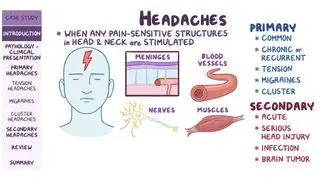
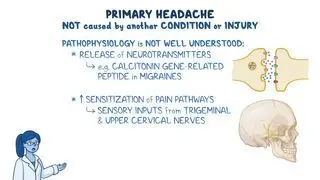
Cephalgia, more commonly known as a headache, refers to pain affecting the head, face, or neck, and can be classified as either primary or secondary. Primary headaches can be painful, but they typically do not result from underlying disease or structural problems and are usually harmless. The exact mechanism underlying primary cephalgia is unknown, but it is thought to involve abnormal activation of pain pathways and dysregulated neurovascular and inflammatory processes.  

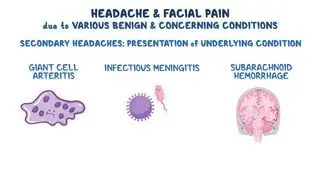
Secondary headaches typically have a sudden onset and are extremely painful. These often result from an underlying illness or trauma triggering pain-sensitive areas in the head, neck, or face. Secondary headaches are less common than primary headaches, but they are typically more serious and are accompanied by additional symptoms related to the underlying condition. 

In an acute setting, it is important to distinguish between primary and secondary headaches with thorough history and neurologic exam so as not to miss important diagnoses that may require imaging and potentially intervention (e.g., subarachnoid hemorrhage).

Learn deeper with Osmosis

Master this topic faster with videos, questions, and AI.

Used by 8M+ healthcare learners.

Try Osmosis Free

No credit card required

What causes cephalgia?

Cephalgia can have various causes, depending on whether it is classified as primary or secondary.  

Primary cephalgia has a wide range of risk factors, including family history, advanced age, and disorders of the head, neck, or face. Increased stress, poor diet, dehydration, consumption of certain kinds of alcohol, sleep disturbances, hormonal changes, and certain medications can also be triggering factors. Environmental factors that may induce or worsen a headache include changes in weather and exposure to bright, pulsating lights. The risk of certain types of primary cephalgia can vary depending on an individual’s age and sex.

Meanwhile, secondary cephalgia can be caused by brain tumors, infections, brain hemorrhages, injury or trauma to the neck or brain. Secondary cephalgia can also be a side effect of certain medications, or result from sleep apnea, carbon monoxide poisoning, oxygen deprivation (i.e., hypoxia), and recreational drug or alcohol usage.  

What is acute cephalgia?

Primary cephalgia is generally acute, occurring suddenly and lasting for a relatively short period of time. Among the several types of acute cephalgia, tension headaches and migraine headaches are the most common. Tension headaches are characterized by mild to moderate pain around the entire head, as if squeezed by a tight elastic band. Tension headaches may be treated with rest, hydration, and over-the-counter pain-relieving medications, such as acetaminophen or ibuprofen.  

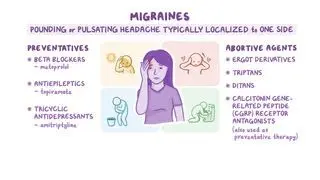
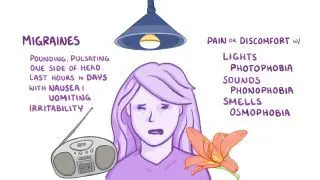
Migraine headaches result from an increased sensitivity to movement, light, or other triggers. In addition to pain, other symptoms of migraines include fatigue, nausea, dizziness, visual disturbances, and irritability. Resting in a dark, quiet space, massages, application of hot or cold compresses, and pain-relieving medications may help alleviate migraines. Over-the-counter medications, like nonsteroidal anti-inflammatory drugs, and prescription medications, such as triptans, help reduce migraine pain. Newer options, including calcitonin gene-related peptide (CGRP) receptor antagonists (gepants) and CGRP-targeting monoclonal antibodies, are now considered a first-line option for migraine prevention, and ditans, such as lasmiditan, offer an alternative acute treatment for individuals who cannot take triptans. However, frequent use of migraine medications can lead to an increase in migraine frequency. 

Other types of acute headaches include cough-related headaches, headaches due to physical activity, trigeminal autonomic cephalgia (TAC), trigeminal neuralgia, hypnic headaches, and cold stimulus headaches.  

TAC is a type of primary headache characterized by unilateral intense pain in the trigeminal nerve area (eye, temple, cheek, jaw), along with autonomic symptoms (watering eye, red eye, drooping eyelid, and leaking nose) on the same side. The duration and frequency of TAC episodes vary depending on the type. Types of TAC include cluster headaches, paroxysmal hemicrania, hemicrania continua, short-lasting unilateral neuralgiform headache attacks with conjunctival injection and tearing (SUNCT), and short-lasting unilateral neuralgiform headache attacks with cranial autonomic symptoms (SUNA). Cluster headaches, characterized by unilateral severe pain to the eye or temple, are the most commonly occurring TAC.

What are the most important facts to know about cephalgia?

Cephalgia, more commonly known as a headache, refers to pain affecting the head, face, or neck. Headaches may be classified as primary or secondary, with primary, acute headaches being the most common. Several types of primary headaches exist, but tension headaches and migraines are the most common. Trigeminal autonomic cephalgia (TAC) is a less common type of primary headache characterized by intense pain on one side of the head. 

Key Takeaways

Definition 

Cephalgia, more commonly known as a headache, refers to pain affecting the head, face, or neck.  

Primary vs Secondary cephalgia 

- Primary cephalgia (most common) 

- No underlying diseases or structural problems 

- Due to abnormal activation of pain pathways and dysregulated neurovascular and inflammatory processes 

- Secondary cephalgia  

- Sudden onset, extremely painful  

- Underlying illness or trauma  

- Often accompanying symptoms of underlying condition  

- Important to distinguish the two in acute setting 

Causes 

- Primary cephalgia (risk factors):  

- Family history 

- Advanced age 

- Disorders of the head, neck, face  

- Increased stress  

- Poor diet  

- Dehydration  

- Alcohol consumption  

- Sleep disturbances  

- Hormonal changes  

- Medications  

- Changes in weather 

- Exposure to bright, pulsating lights 

- Age and sex (depending on type)  

- Secondary cephalgia:  

- Brain tumors  

- Infections 

- Brain hemorrhages  

- Injury or trauma to neck or brain  

- Sleep apnea  

- Carbon monoxide poisoning  

- Oxygen deprivation  

- Recreational drug or alcohol use  

Acute cephalgia 

- Sudden and lasting for a short period of time  

- Most common types of primary acute cephalgia:  

- Tension headaches  

- Mild-moderate pain around the head 

- Rest, hydration, over-the-counter pain relief  

- Migraine headaches 

- Increased sensitivity to movement, light, or other triggers; fatigue, nausea, dizziness, visual disturbances, irritability  

- Rest in a dark, quiet space, massages, hot or cold compresses, pain-relief medications 

- Other types:  

- Cough-related headaches  

- Headaches due to physical activity  

- Trigeminal autonomic cephalgia (TAC)  

- Primary headache with intense pain on one side of the head (trigeminal nerve area) and autonomic symptoms (watering eye, red eye, drooping eyelid, and leaking nose) 

- Types:  

- Cluster headaches (most common)  

- Paroxysmal hemicrania 

- Hemicrania continua  

- Short-lasting unilateral neuralgiform headache attacks with conjunctival injection and tearing (SUNCT)  

- Short-lasting unilateral neuralgiform headache attacks with cranial autonomic symptoms (SUNA) 

- Trigeminal neuralgia  

- Hypnic headaches  

- Cold stimulus headache  

Students say Osmosis is 100% worth it

Because Osmosis saves them time. Lowers stress. And actually helps them remember when it counts.

I used Osmosis to prepare for my first medical school licensing exam! Super helpful and interactive for people who may not do great with just pages of text info!"

Cecilia Ruiz

Cecilia Ruiz

MD student

Sayan Misra

I have used Osmosis for about four years. Best thing I have ever used for my medical studies."

Sayan Misra

Sayan Misra

Med student

Osmosis videos are superior because they define simple concepts, tell a story with a clear progression, and provide context."

Jay Pate

Jay Pate

Dental student

References


Ailani J, Burch RC, Robbins MS; Board of Directors of the American Headache Society. The American Headache Society consensus statement: update on integrating new migraine treatments into clinical practice. Headache. 2021;61(7):1021-1039. https://doi.org/10.1111/head.14153 


Charles AC, Digre KB, Goadsby PJ, Robbins MS, Hershey A; American Headache Society. Calcitonin gene-related peptide-targeting therapies are a first-line option for the prevention of migraine: an American Headache Society position statement update. Headache. 2024;64(4):333-341. https://doi.org/10.1111/head.14692  


Fabregat i Fabra N, Obach Baurier V. Cephalalgia. PortalCLÍNIC. Published May 16, 2018. Updated March 20, 2025. Accessed August 14, 2026. https://www.clinicbarcelona.org/en/assistance/diseases/cephalalgia  


Forbes RB. Acute headache. Ulster Med J. 2014;83(1):3-9. https://pmc.ncbi.nlm.nih.gov/articles/PMC3992086/  


Headache Classification Committee of the International Headache Society (IHS). The International Classification of Headache Disorders, 3rd edition. Cephalalgia. 2018;38(1):1-211. https://doi.org/10.1177/0333102417738202 


Long D, Koyfman A, Long B. The thunderclap headache: approach and management in the emergency department. J Emerg Med. 2019;56(6):633-641. https://doi.org/10.1016/j.jemermed.2019.01.026  


Stanford Health Care. Headache. Stanford Health Care. Accessed December 13, 2025. https://stanfordhealthcare.org/medical-conditions/brain-and-nerves/headache.html  


Tabatabai RR, Swadron SP. Headache in the emergency department: avoiding misdiagnosis of dangerous secondary causes. Emerg Med Clin North Am. 2016;34(4):695-716. https://doi.org/10.1016/j.emc.2016.06.003  


Wang Z, Yang X, Zhao B, Li W. Primary headache disorders: from pathophysiology to neurostimulation therapies. Heliyon. 2023;9(4):e14786. https://doi.org/10.1016/j.heliyon.2023.e14786