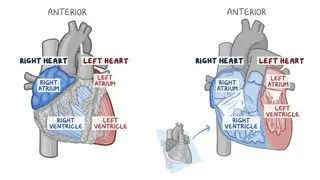
Dextrocardia results from abnormalities in the embryological development of the heart. Around day 22 to 23 of normal embryogenesis, or the process by which a fertilized egg becomes an embryo, the heart begins to develop. A straight, primitive heart tube develops first. The heart tube then undergoes elongation and a process called cardiac looping, which is what determines the position of the heart ventricles in relation to the atria. During normal cardiac looping, the cranial aspect of the tube bends to the right, then the caudal aspect of the tube bends to the left until it occupies a normal left thoracic position. Dextrocardia occurs when the caudal portion of the heart tube loops to the right instead of the left, which causes the heart base to reside on the right side of the thorax rather than the left side. Dextrocardia may occur in isolation or accompanied by situs inversus totalis, which refers to the mirror-image reversal of the other thoracic and abdominal organs.
While the circumstances leading to the abnormal looping of the heart during development are unclear, there is an association between dextrocardia and defects in ciliary motility (e.g., primary ciliary dysfunction). Kartagener syndrome is a primary ciliary dysfunction disorder characterized by a triad of chronic sinusitis, situs inversus, and bronchiectasis, a form of chronic obstructive pulmonary disease defined by the abnormal widening of bronchi. Heterotaxy is also a condition in which the thoracic and abdominal organs and vessels are positioned abnormally across the left-right axis of the body. Heterotaxy occurs secondary to a lateralization defect during embryonic development and may result in highly complex cardiac lesions or accompanied by other congenital disorders which can lead to intestinal malrotation, venous abnormalities, and asplenia.