Incarcerated Inguinal Hernia · What Is It, Diagnosis, and More

Published: Oct 09, 2025
Author: Corinne Tarantino, MPH
Editor: Ahaana Singh
Editor: Lisa Miklush, PhD, RN, CNS
Editor: Anna Hernández, MD
Illustrator: Jillian Dunbar
7-day free trial

Go deeper with Osmosis

Osmosis is a learning platform with videos, questions, and AI tools to help you master topics like this.

4.8 · 12,000+ reviews
Watch quick, visual videos
Practice with Qbank-style questions
Use AI to explain, quiz, and review
Study anytime with the mobile app
Start free trial

No credit card · Cancel anytime

What is an incarcerated inguinal hernia?

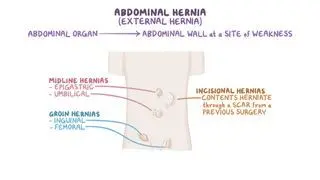
An inguinal hernia is a defect or weakness in the abdominal wall that allows the passage of abdominal contents through the lower abdominal wall into the inguinal region. In uncomplicated hernias, the content can be reduced back into the abdomen by pressing on the hernial sac. However, sometimes the contents cannot be pushed back in, leading to incarceration, since the contents are “locked out” of the abdomen. This results in decreased venous and lymphatic flow and, as a consequence, swelling of the incarcerated tissue. 

Inguinal hernias can be classified anatomically as either direct or indirect. A direct inguinal hernia protrudes medially to the inferior epigastric vessels within Hesselbach’s triangle, which is a weak area in the lower abdominal wall formed inferiorly by the inguinal ligament, laterally by the inferior epigastric vessels, and medially by the rectus abdominis muscle. On the other hand, indirect inguinal hernias occur in the internal inguinal ring, lateral to the inferior epigastric vessels. In males, this is the site where the spermatic cord exits, while in females it’s the site where the round ligament exits the abdomen.  

Indirect inguinal hernias are the most common type of hernia, and they occur more frequently on the right side of the abdomen. Males are more prone to this type of hernias because their inguinal canal is wider due to the descent of the testicles during fetal development, which leaves a natural weak point. Both direct and indirect hernias can present as either asymptomatic, symptomatic, incarcerated, or strangulated. 
Learn deeper with Osmosis

Master this topic faster with videos, questions, and AI.

Used by 8M+ healthcare learners.

Start free trial

No credit card · Cancel anytime

How do you tell if a hernia is incarcerated?

A hernia is considered incarcerated if it cannot be massaged back into the original cavity. Incarcerated inguinal hernias usually cause swelling and firmness in the groin region, and some may show redness. Individuals may experience pressure and constant sharp pain in the groin area that radiates to the scrotum or inner thigh. 

What is the difference between incarcerated and strangulated hernias?

An incarcerated hernia can lead to strangulation, which occurs when blood stops flowing in the herniated tissue due to restricted circulation. Signs and symptoms of strangulation include fever, severe sharp pain in the groin, and possible signs of bowel obstruction such as abdominal pain, nausea, vomiting, and absent bowel movements and flatus.  The hernia itself may be warm, very tender to palpation, or discolored due to the lack of blood supply. With strangulated hernias, one should not attempt to reduce the hernial contents back into the abdominal cavity, since the hernia sac may contain necrotic bowel. 

Is an incarcerated inguinal hernia an emergency?

Yes, an incarcerated inguinal hernia is usually considered a medical emergency and almost always requires immediate surgery due to the risk of strangulation. Strangulation, or the interruption of blood flow to the bowel, can lead to necrosis, or tissue death, as well as increased risk of infection. Promptly treating an incarcerated hernia minimizes the risk of complications. 

What causes an incarcerated inguinal hernia?

An incarcerated inguinal hernia occurs when a hernia becomes trapped and cannot be reduced or pushed back into the abdomen. This occurs because the opening in the abdominal wall is too tight, preventing the herniated tissue from sliding back into place. 

Incarceration is more likely to occur with increased abdominal pressure, which can happen from activities like heavy lifting, straining during bowel movements, chronic coughing, or pregnancy. Over time, increased abdominal pressure can force more tissue into the hernia, making it more difficult to return. Additionally, untreated hernias can enlarge and become more difficult to reduce, leading to incarceration.  

How is an incarcerated inguinal hernia diagnosed?

Diagnosis of an incarcerated hernia is made clinically through a review of the signs and symptoms and physical examination. Incarceration is considered when the hernia cannot be reduced manually and there are no signs of strangulation. An ultrasound may be used to confirm the diagnosis and to clarify whether the hernia is on only one side. If an ultrasound is inconclusive, a computed tomography (CT) scan or magnetic resonance imaging (MRI) may be used. Laboratory studies, such as a complete blood count and inflammatory blood markers may be conducted to assess the presence of any complications 

How is an incarcerated inguinal hernia treated?

Treatment of incarcerated inguinal hernias depends on the onset of the symptoms. Individuals with an acutely incarcerated inguinal hernia will usually require urgent surgical repair, whereas in individuals with chronically incarcerated hernias, a clinician might attempt to reduce the hernia first. Manual reduction is performed by placing the individual in a Trendelenburg position, lying on their back with the table tilted downwards so the feet are raised, and the head is lowered. This lowers pressure within the abdominal cavity, making it easier to reduce the hernia. Reduction will then be attempted, in which a clinician will put gentle pressure on the hernia to guide its contents back into the abdominal cavity. Sedation and pain medications are usually administered to reduce pain during this process. Reducible incarcerated hernias require elective repair.  

If reduction is not successful, individuals may require consultation with the surgical team to decide further management. Children often require referrals for emergency surgery even before incarceration occurs because they have a high risk of recurrence. Surgical approaches to repair a hernia may vary and are generally categorized as open or laparoscopic repairs.  

What are the most important facts to know about an incarcerated inguinal hernia?

An incarcerated inguinal hernia occurs when the contents of the abdominal cavity, usually fat or part of the small intestine, protrude through the inguinal canal and cannot be massaged back into the abdominal cavity. Incarcerated hernias are often a surgical emergency, and prompt treatment is necessary to avoid complications such as strangulation. Unlike uncomplicated inguinal hernias, incarcerated hernias are not easily reducible, and typically present with pain in the groin area, tenderness, and swelling upon palpation. After a physical exam, an ultrasound is usually performed to confirm the diagnosis. Acute inguinal hernias require urgent surgical repair, whereas chronic incarcerated hernias may be attempted to reduced manually. Reducible incarcerated hernias require elective repair, while the ones that cannot be reduced should be repaired urgently.
Students say Osmosis is 100% worth it

Because Osmosis saves them time. Lowers stress. And actually helps them remember when it counts.

I used Osmosis to prepare for my first medical school licensing exam! Super helpful and interactive for people who may not do great with just pages of text info!

Cecilia Ruiz

Cecilia Ruiz

MD student

Sayan Misra

I have used Osmosis for about four years. Best thing I have ever used for my medical studies.

Sayan Misra

Sayan Misra

Med student

Osmosis videos are superior because they define simple concepts, tell a story with a clear progression, and provide context.

Jay Pate

Jay Pate

Dental student

References


Itani KMF, Fitzgibbons R. Approach to groin hernias. JAMA Surg. 2019;154(6):551-552. doi:10.1001/jamasurg.2018.5564 


Pawlak M, East B, de Beaux AC. Algorithm for management of an incarcerated inguinal hernia in the emergency settings with manual reduction. Taxis, the technique and its safety. Hernia. 2021;25(5):1253-1258. doi:10.1007/s10029-021-02429-1 


Shakil A, Aparicio K, Barta E, Munez K. Inguinal hernias: Diagnosis and management. Am Fam Physician. 2020;102(8):487-492. Accessed March 8, 2025. https://www.aafp.org/pubs/afp/issues/2020/1015/p487.pdf 


Townsend CM Jr, ed. Sabiston Textbook of Surgery International Edition: The Biological Basis of Modern Surgical Practice. 21st ed. Elsevier - Health Sciences Division; 2021.