McRoberts Position · What It Is, Uses, and More

Published: Feb 13, 2026
Author: Georgina Tiarks
Editor: Alyssa Haag, MD
Editor: Emily Miao, PharmD
Editor: Kelsey LaFayette, DNP
Illustrator: Jung Hee Lee, MScBMC
7-day free trial

Go deeper with Osmosis

Osmosis is a learning platform with videos, questions, and AI tools to help you master topics like this.

4.8 · 12,000+ reviews
Watch quick, visual videos
Practice with Qbank-style questions
Use AI to explain, quiz, and review
Study anytime with the mobile app
Start free trial

No credit card · Cancel anytime

What is McRoberts position?

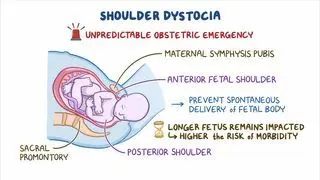
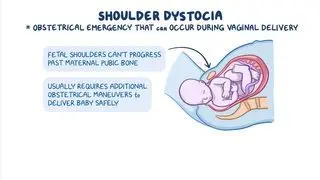
The McRoberts position is used to resolve shoulder dystocia, a common complication during childbirth. Shoulder dystocia occurs when the fetus’ anterior (i.e., situated in the front of the body) shoulder gets trapped behind the pregnant individual’s pubic symphysis (i.e., pubic bone). This can also occur less commonly when the posterior (i.e., situated towards the rear) shoulder gets caught behind the pregnant individual’s sacral promontory (i.e., superior part of the sacrum). Shoulder dystocia is an emergency that needs to be resolved quickly as it can lead to complications in the fetus such as asphyxia (i.e., restricted oxygen), brachial plexus injury (i.e., injury to the nerves that supply the shoulders), clavicle fracture, humerus (i.e., the long bone in the upper arm) fracture, or death. In the pregnant individual, it can result in postpartum hemorrhaging or perineal (i.e., vaginal or rectal) lacerations. McRoberts maneuver is the most common method used to relieve shoulder dystocia. 

Although McRoberts maneuver is a successful and widely used practice, it can cause complications from over-use. Hyperflexion of the hips can compress the femoral nerve leading to lower extremity neuropathy, and in rarer cases, after an excessive amount of time in this position, it can also cause symphyseal (i.e., the connection of the pelvic bone at the pubic symphysis) separation or sacroiliac joint (i.e., joint connecting the sacrum and ilium of the pelvic bone) dislocation. 

Learn deeper with Osmosis

Master this topic faster with videos, questions, and AI.

Used by 8M+ healthcare learners.

Start free trial

No credit card · Cancel anytime

When is McRoberts position used?

The McRoberts position is used to facilitate delivery during shoulder dystocia. There are four pelvic shapes: gynecoid, android, anthropoid, and platypelloid. The gynecoid shape has the largest anterior-to-posterior diameter providing a large, circular internal space, which allows for the fetal head to descend inferiorly for a smooth delivery. The android pelvis is heart-shaped with a narrow cavity. Anthropoid shape is oval-shaped and narrow. Finally, a platypelloid shape is flat with a small anterior-posterior diameter. A narrower anterior-to-posterior diameter can increase the risk of shoulder dystocia, specifically in those with an android, anthropoid, or platypelloid pelvic shape.  

Other risk factors for shoulder dystocia include diabetes in the pregnant individual, macrosomia (i.e., elevated birth weight), obesity in the pregnant individual, and weight gain in the pregnant individual. These conditions can lead to a larger infant, which may increase the risk of shoulder dystocia, especially if the fetus is passing through a narrow pelvic space. 

A risk assessment may be conducted before delivery to assess the likelihood of shoulder dystocia. This is done by measuring the abdominal and fetal head circumference with an ultrasound. A healthcare professional can then calculate the risk by using the equation:  

(abdominal circumference / pi) – head circumference 

If the result is greater than 2.6, there is a higher risk for shoulder dystocia and the McRoberts maneuver may be required. Indications of a trapped shoulder may include a prolonged second stage of labor (i.e., when fully dilated) and the turtle sign which is when the fetal head retracts back into the pelvis. 
How is McRoberts position performed?

The McRoberts position is performed by having two individuals each holding a separate leg at a 135-degree angle. This causes hyperflexion at the hip and knees and abduction at the hip (i.e., movement away from the center), which moves the pubic symphysis superiorly (i.e., elevated) and extends the sacrum. In the case of shoulder dystocia, these movements can widen the internal cavity, relieving the shoulder from its trapped position. McRoberts maneuver may be performed in conjunction with applying suprapubic pressure 

If the McRoberts position and suprapubic pressure does not work, a healthcare professional may attempt to deliver the free shoulder, which can dislodge the trapped shoulder. Additionally, there are other maneuvers that one may perform. Rotational maneuvers (e.g., Rubin or Woods screw) are aimed at rotating the fetus in an attempt to free the trapped shoulder. The Gaskin maneuver recommends placing the pregnant individual on all fours and applying downward pressure on the posterior fetal shoulder. If these maneuvers are not successful, last resort options include intentionally fracturing the fetal clavicle, performing an emergent cesarean section, or performing a symphysiotomy (i.e., surgically dividing the cartilage of the  pubic symphysis).  

What are the most important facts to know about McRoberts position?

The McRoberts position is used in obstetrics during a complication of childbirth called shoulder dystocia. Shoulder dystocia occurs when the fetal shoulder gets trapped, preventing delivery of the fetal head. Indications of McRoberts position include prolonged labor and the turtle sign (i.e., when the fetal head retracts back into the pelvis), which is suggestive of shoulder dystocia. 
Students say Osmosis is 100% worth it

Because Osmosis saves them time. Lowers stress. And actually helps them remember when it counts.

I used Osmosis to prepare for my first medical school licensing exam! Super helpful and interactive for people who may not do great with just pages of text info!

Cecilia Ruiz

Cecilia Ruiz

MD student

Sayan Misra

I have used Osmosis for about four years. Best thing I have ever used for my medical studies.

Sayan Misra

Sayan Misra

Med student

Osmosis videos are superior because they define simple concepts, tell a story with a clear progression, and provide context.

Jay Pate

Jay Pate

Dental student

References


Buhimschi CS, Buhimschi IA, Malinow A, Weiner CP. Use of McRoberts’ position during delivery and increase in pushing efficiency. Lancet. 2001;358(9280):470-471. doi:10.1016/S0140-6736(01)05632-X


Davis DD, Roshan A, Varacallo M. Shoulder dystocia. In: StatPearls. StatPearls Publishing; 2024. Accessed April 18, 2024. http://www.ncbi.nlm.nih.gov/books/NBK470427/ 


Gesner T, Toncar A, Griggs J. McRoberts maneuver. In: StatPearls. StatPearls Publishing; 2024. Accessed April 18, 2024. http://www.ncbi.nlm.nih.gov/books/NBK537280/ 


Gurewitsch ED, Johnson TL, Allen RH. After shoulder dystocia: managing the subsequent pregnancy and delivery. Semin Perinatol. 2007;31(3):185-195. doi:10.1053/j.semperi.2007.03.009