
Today’s USMLE® Step 2 CK question of the day features a 52 -year-old man with worsening abdominal pain and distension over the past 3 days. What’s his diagnosismand the best next steps? Let’s find out!
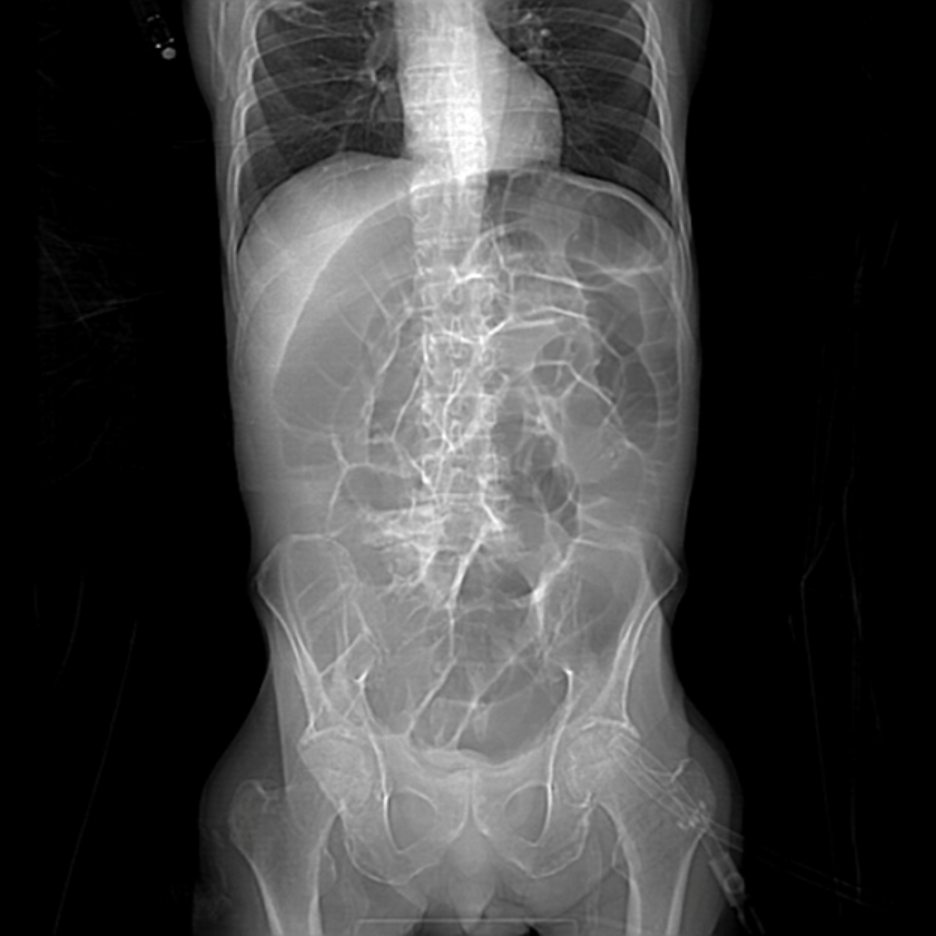
A 52-year-old man presents to the emergency department for evaluation of worsening abdominal pain and distension over the past 3 days. He has not had a bowel movement over this period of time. He had a severe lumbar sprain 2 weeks ago and was prescribed medications for pain control. Temperature is 37 °C (98.6 °F), heart rate is 82/min, respiratory rate is 16/min, blood pressure is 120/80 mmHg, and oxygen saturation is 98% on room air. On examination, the abdomen is distended and tympanic to percussion with decreased bowel sounds on auscultation. The patient’s scout CT image is displayed below.
Which of the following would be most consistent with the suspected diagnosis?
A. Recent traumatic abdominal injury
B. History of chronic constipation
C. Use of opioid analgesics
D. Positive Murphy’s sign on abdominal examination
E. Heavy alcohol consumption
Scroll down for the correct answer!
The correct answer to today’s USMLE® Step 2 CK Question is…
C. Use of opioid analgesics
Correct: See Main Explanation.
Incorrect Answer Explanations
A. Recent traumatic abdominal injury
Incorrect: Traumatic abdominal injury, such as blunt force trauma, can cause intra-abdominal adhesions and mechanical small bowel obstruction. This patient’s imaging and likely opioid use are more consistent with ileus.
B. History of chronic constipation
Incorrect: Chronic constipation can cause abdominal distension and discomfort, but it would not likely precipitate the acute presentation seen in this patient and findings of ileus on imaging.
D. Positive Murphy’s sign on abdominal examination
Incorrect: A positive Murphy’s sign (pain upon deep inspiration while the examiner’s fingers are placed under the right costal margin) suggests acute cholecystitis or inflammation of the gallbladder and not ileus.
E. Heavy alcohol consumption
Incorrect: A history of heavy alcohol consumption would not typically be associated with causing generalized abdominal distension, lack of bowel movements, and ileus.
Main Explanation
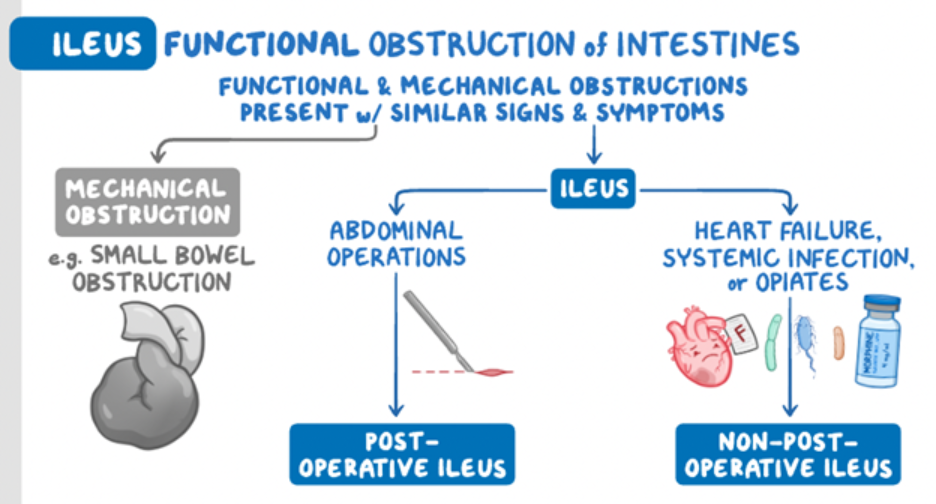
This patient presents with symptoms (e.g., abdominal pain, inability to pass stool) and signs (e.g., abdominal distention, tympany, decreased bowel sounds) of ileus in the setting of recent analgesia use. His scout CT demonstrates diffuse dilation of the intestines without a clear transition point, consistent with ileus. Recent use of opiate analgesics is most likely to have caused this condition.
Ileus refers to a functional obstruction of the intestines that may arise due to reduced or absent peristalsis without an underlying mechanical blockage. This is a common postoperative complication, particularly following abdominal surgeries. Non-postoperative causes of ileus include medications that slow peristalsis (e.g., opiates, anticholinergics), systemic conditions (e.g., metabolic abnormalities, sepsis), intra-abdominal pathology (e.g., diverticulitis, appendicitis), and radiation. For a nonsurgical ileus, the etiology can usually be elucidated by taking a careful patient history.
Patients presenting with ileus will often have signs and symptoms similar to small bowel obstruction. This can include abdominal pain, bloating, obstipation, nausea, and vomiting. Physical examination may demonstrate abdominal distention, tenderness to palpation, tympany to percussion, and diminished or absent bowel sounds. Abdominal imaging, such as an X-ray or CT, can help differentiate ileus from small bowel obstruction. Radiographic findings of ileus include small bowel dilation without evidence of a transition point.
Major Takeaway
Medications that slow peristalsis, such as opiate analgesics, are a potential cause of non-postoperative ileus. Imaging findings of ileus include small bowel dilation without evidence of a transition point.
Want to learn more about this topic?
Watch the Osmosis video: Ileus: Clinical sciences
References
- Vilz, T.O., et al. (2017). Ileus in adults. Deutsches Arzteblatt International, 114:29–30. https://www.ncbi.nlm.nih.gov/pmc/articles/PMC5569564/
- Weledji, E.P. (2020). Perspectives on paralytic ileus. Acute Medicine & Surgery, 7(1):e573. https://onlinelibrary.wiley.com/doi/full/10.1002/ams2.573
- Cuete, D. (n.d.). Paralytic ileus [Image]. Radiopaedia. https://radiopaedia.org/cases/paralytic-ileus-1?lang=us

Get your free trial of Osmosis from Elsevier today to discover why millions of clinicians and caregivers love learning by Osmosis.
Leave a Reply