
Today’s NCLEX-RN® question of the day focuses on a patient exhibiting signs of an altered level of consciousness. Do you know the terms to describe which smptoms the patient is exhibiting? Let’s find out!
A patient is prescribed patient-controlled analgesia (PCA) following a total colectomy. When the nurse assesses the patient at 0700, the patient is awake, alert, and responsive. When the nurse checks the patient again at 0930, the patient appears sleepy, unable to state the date and time, and is talking to a person who is not in the room.
Which sign(s) and symptom(s) of altered level of consciousness is this patient exhibiting? Select all that apply.
A. Coma
B. Stupor
C. Confusion
D. Hyperactivity
E. Disorientation
Scroll down for the correct answer!
The correct answers to today’s NCLEX® Question is…
C. Confusion
Rationale: This patient is demonstrating confusion, as evidenced by an inability to correctly state the date and time and talking to someone who is not in the room. Confusion is a common manifestation of an altered level of consciousness.
E. Disorientation
Rationale: This patient is demonstrating disorientation because they are unable to correctly identify the date and time. Disorientation is a common manifestation of an altered level of consciousness.
Main Takeaway
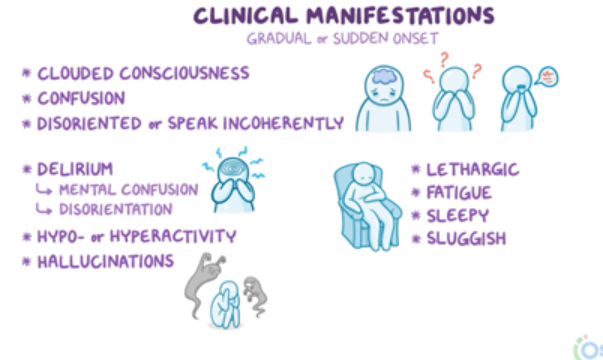
This patient is demonstrating signs and symptoms of an altered level of consciousness (LOC). Patients on patient-controlled analgesia (PCA) are at risk for altered LOC due to the sedative effects of opioid analgesics. Typical clinical manifestations of altered LOC may have a gradual or sudden onset, including clouded consciousness, confusion, and disorientation. Additional findings may include incoherent speech, hallucinations, lethargy, fatigue, sleepiness, or sluggishness. Some patients may develop delirium, which can be characterized by confusion, disorientation, perceptual disturbances, and hypoactivity or hyperactivity. As LOC worsens, patients may progress from lethargy to obtundation, in which responsiveness and awareness of the environment decrease. More severe impairment may lead to stupor, where the patient responds only to vigorous or repeated stimulation, and ultimately to coma, characterized by unresponsiveness and inability to be aroused.
Incorrect Answer Explanations
A. Coma
Rationale: Coma is a state of prolonged unresponsiveness, in which the patient cannot be aroused. Because this patient remains awake and responsive, they are not experiencing a coma.
B. Stupor
Rationale: Stupor is a state in which the patient can be aroused only with vigorous or repeated stimulation. Because this patient is awake and responsive, they are not experiencing stupor.
D. Hyperactivity
Rationale: Hyperactivity describes a state of abnormally increased neurological activity. Because this patient appears sleepy, hyperactivity is not present.
Want to learn more about this topic?
Watch the Osmosis video: Altered level of consciousness (LOC): Nursing

Get your free trial now to find out why future clinicians and caregivers love learning by Osmosis!
Leave a Reply