

Getting involved in research as a medical student feels like an impossible paradox: opportunities feel difficult to access, and yet research publications are an essential part of many specialty training or residency applications globally. I know exactly how disheartening that can feel. But you’re not alone. In this article, I want to share practical strategies for navigating the world of research as a medical student.
Why does getting involved in research feel so difficult as a medical student?
As a medical student, you may struggle to get involved in research for any number of reasons, ranging from feeling that you don’t know how to navigate research projects, to being worried about choosing the right project, to staying motivated.

Many students think that getting involved with research projects is all about knowing statistics and research methods. But these are things you can easily learn from journal articles or research textbooks. In this article, I’m going to explore with you the unspoken skills that no one teaches you about but are essential to research projects: knowing your why, finding the right research mentor, building research relationships through positionless leadership, and tackling imposter syndrome.
Step 1: Knowing Your Why
Why do you want to get involved with research?
It might seem like a simple question, but have you really thought about your answer? Knowing your “why” is a key first step for any project because it helps you choose projects that genuinely interest you and stay motivated when challenges arise. Research projects often take months or years to complete, so having a clear sense of purpose can help you remain engaged when progress is slow or setbacks occur. As Friedrich Nietzsche said, “If we possess our why of life, we can put up with almost any how.”
Knowing your “why” also helps you to determine if a research opportunity aligns with your values and interests. For example, if you are offered an opportunity to support a clinical trial investigating the impact of placebo versus the best available treatment for migraines, you would consider whether this aligns with your “why.” You might ask yourself: Am I interested in helping with a clinical trial and interacting with patients, or would I prefer a lab-based or literature-based project? Are migraines a potential area of interest for me? Do I want to get involved with this project, and if so, why – is it to do with the subject area, the opportunities, the team, the ability to make a difference to patients, or something else?
Being able to express your “why” also helps you to excite and engage others with the project. Simon Sinek, in his famous TED talk “Start with Why – How Great Leaders Inspire Action,” expresses that “People don’t buy what you do; they buy why you do it. And what you do simply proves what you believe” (1). He highlights the importance of starting with why using the Golden Circle.

You can use the Golden Circle to present a proposed project to a potential research mentor, or discuss your project at conferences. For example:
“Engaging in research inspires me to create, dream, and discover. I love challenging the boundaries of what we currently know. To me, it is also an opportunity to build meaningful connections with some of the best and brightest minds.” (Why)
“For this reason, I am currently working on a multicentre, randomized controlled trial involving five institutions from across the country.” (How)
“Our research aims to explore the use of a new device in orthopedic hip surgery, and we hope to show that this device is superior when compared against the current industry standard.” (What)
This gives a much more powerful message than if you started with the “what” and ended with the “why.”
Step 2: Finding The Right Research Mentor
Once you know your “why” for research, the next step is to find the right research mentor. Finding the right mentor is crucial and can often make or break a project, so choose carefully!
In our book, we discuss six different types of mentors. While a mentor may have traits from more than one category, look for those who fit the more helpful categories and do your best to avoid mentors who are unlikely to contribute to your overall success. Knowing the characteristics of each mentor type can make it easier to identify which mentors are most likely to support your growth.
The best type of mentor is the selfless mentor – those supervisors who genuinely care about you and will support you along the way without wanting something in return. Ambitious mentors are also supportive, but they are driven by opportunities to wield their influence over others, where doing favors for others (including you) is seen as a savvy political move rather than a purely selfless act. Matcher mentors seek to help you, depending on what you can offer in return. They can be powerful allies if your goals align with theirs, but be careful if your interests no longer align, as they may no longer be as supportive.
The mentors to avoid include the busy mentor, who has no time to support you during the project. They often do not respond to emails, even when chased up, because they are too busy with their other projects. The perfunctory mentors are those who have no passion for or interest in mentoring, but do it because they have to. As a result, they don’t put time or energy into getting to know you and will rarely complete research projects because they are not motivated (their “why” may be to obtain research publications, but they themselves have no passion for research or mentoring). Finally, be sure to avoid the narcissistic mentors who have no interest in supporting you but will use your knowledge and hardworking ability to their own advantage, even when this is to your detriment.
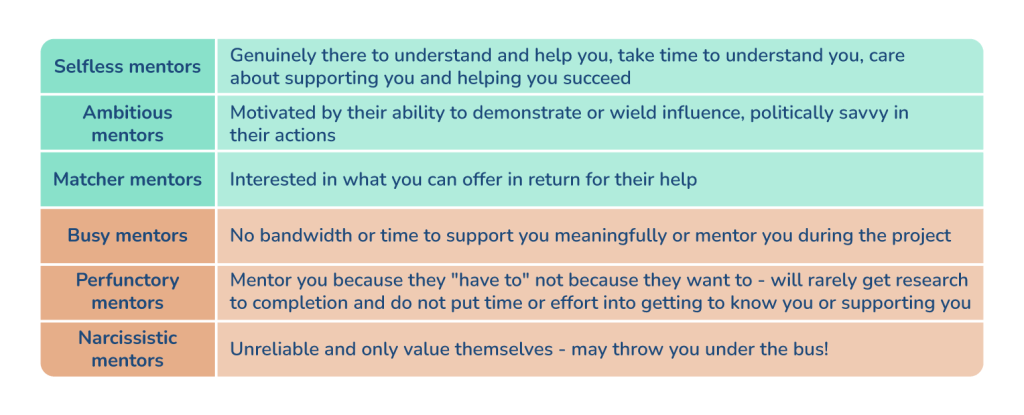
It can be helpful to speak with other students who have worked with supervisors you are considering to better understand which mentor category they fit into.
Once you have a research mentor in mind, email them with details of your research project with a focus on your “why,” explain why you would like to work with them, and attach your CV.
Where Can Medical Students Find Research Opportunities?
Finding research opportunities can feel daunting, but there are often more opportunities available than you might think. Start by speaking to faculty members whose work interests you, as many research projects recruit students through direct approaches. You can also explore opportunities through your medical school, student research societies, academic departments, summer research programs, and conference networks.
Don’t overlook smaller projects such as audits, quality improvement projects, case reports, and systematic reviews. These can be excellent ways to develop research skills, build relationships with mentors, and gain experience before progressing to larger studies.
If you’re interested in a particular specialty, consider reaching out to clinicians or researchers working in that field. A short, professional email expressing your interest, highlighting your motivation, and attaching your CV can sometimes open doors to opportunities that are never formally advertised.
Step 3: Building Research Relationships Through Positionless Leadership
You’re excited to start your research project and start working with your research supervisor/mentor. But how does your supervisor know they can trust you with key project tasks? How can you build strong research relationships with the rest of the team to drive the project forward? The answer is positionless leadership.
We tend to think that most of the leadership in a research project comes from the top, from the supervisors and clinical leads. But actually, most of the leadership comes from the middle of the team – where you are right now. The concept of positionless leadership is the idea that you can lead effectively without a formal leadership position by influencing others. Two important groups whom we can lead positionlessly during research projects are: those above us in the hierarchy, such as research mentors (leading up), and those at the same level as us, such as other medical students (leading across) (2).
Practical Strategies for Leading Up
You can influence your research seniors by leading up effectively.
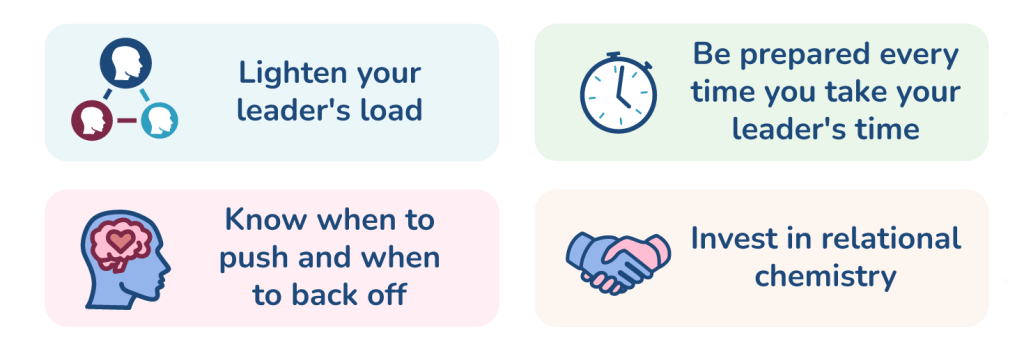
A key strategy for leading up includes lightening your leader’s load. This means considering how you can support your busy supervisors. An example in the research context would be ensuring that you check and comply with the word count and author guidelines before sending the first draft of your research paper to your supervisors for review. This helps lighten their load, as they can focus on reviewing the paper’s content without wading through lengthy author guidelines to ensure it meets the journal’s criteria.
Similarly, when leading your seniors, make sure you’re prepared every time you take your leader’s time. This shows that you respect how busy they are and that you can provide them with all the key information they may want. For example, when proposing a research project to a supervisor, make sure to come prepared. This might include putting together a rough plan for the project and conducting a brief literature review to explore how your project adds to the literature before presenting your project plan to your supervisor.
Thirdly, invest in relational chemistry. This means making an effort to get to know your seniors, including their values, likes, dislikes, and ways of working. This helps you build trust in the relationship, which is important as your seniors are more likely to trust you with responsibilities when they know you better.
Finally, use emotional intelligence to read the room and decide when to push or back off on a specific issue in a research project. For example, you may decide to back off if there is a heated discussion about the best journal to submit to, you don’t feel strongly about submitting to a specific journal, and you don’t want to impact the relationship with your senior about something that is not important to you.
Practical Strategies for Leading Across
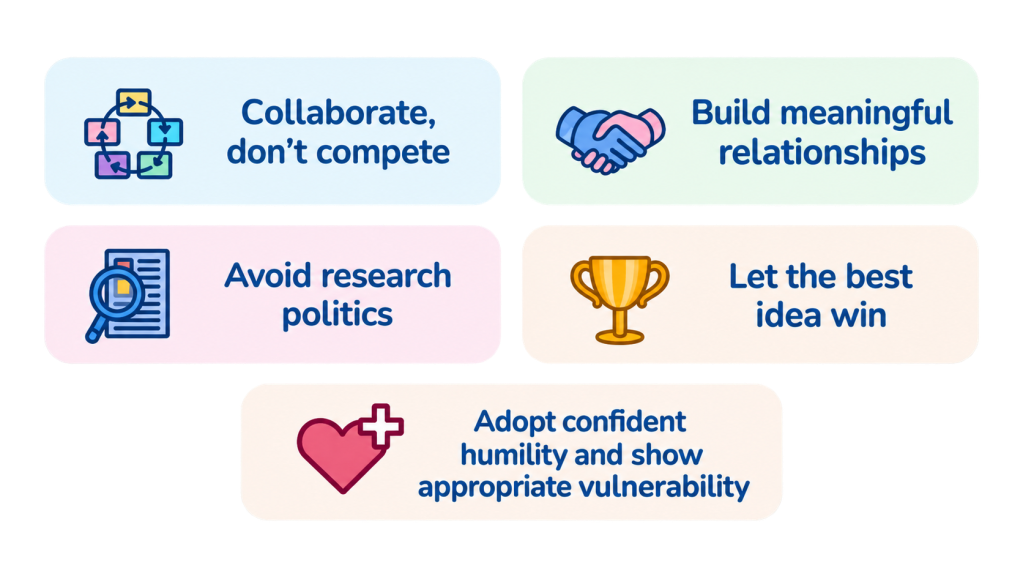
When leading across, for example, to other medical students on the same project, make sure to collaborate rather than compete. Be a “giver” where possible; give your time to support others and work with others rather than competing to be “the best.” Similarly, let the best idea win. We tend to like our own ideas because we have come up with them. But it’s important to recognize that your idea isn’t always the best way forward, so consider all the ideas presented and select the best one on its merits.
Often, when working on a large research project, there may be research politics at play. These lead to a toxic workplace environment and are best avoided. Instead, work to build meaningful relationships with your team. This helps you build rapport with the team and benefit from others’ knowledge, experiences, and networks. Additionally, adopt confident humility. Confident humility is the balance between imposter syndrome and overconfidence. It means having the guts to ask when you’re unsure, the courage to be wrong, and the humility to learn from those experiences. Confident humility engenders trust from others, as they can see that you seek help when unsure and share your vulnerabilities and mistakes so everyone can learn.
Step 4: Tackling Imposter Syndrome
Finally, you’re working on your dream research project with a wonderful supervisor and team. You should be happy, but all you can think is: I barely know anything; am I even good enough to work on this project? How long until someone notices I’m winging it? Do I even belong here? This whole thing is just a lucky fluke; I didn’t earn this…
This is imposter syndrome – a collection of feelings of inadequacy that persist despite evident success (3). The crippling self-doubt can impact your self-confidence, your mental health, the research project, your relationships with others, and your patients. You might feel like you are alone in experiencing these feelings, but imposter syndrome is incredibly common, affecting up to 97% of medical students (4).
Some Strategies to Tackle Imposter Syndrome
Focus On Your Successes
Make a list of your successes and achievements so that, when you feel like an imposter, you can remind yourself that you are capable of so much more. Reward yourself for the small wins along the journey.
Adopt a Growth Mindset
A person with a fixed mindset believes they’re either good at something or not. But someone with a growth mindset recognizes that they can learn and develop skills along the way, and that doesn’t mean they don’t deserve to be where they are right now. A growth mindset helps you tackle the inner imposter by reminding yourself that you will learn and improve over time and with experience.
Open Up
Speak to trusted others about how you’re feeling. This not only helps you process what you’re experiencing but also shows you that many of your colleagues and seniors feel the same way you do.
Analyze Your Internal Rule Book and Reframe Your Thoughts
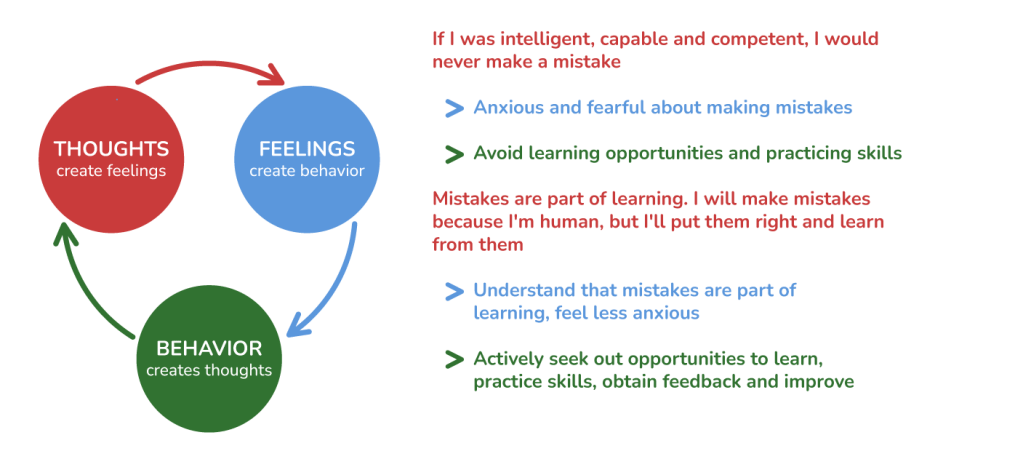
Each of us has an internal “rule book” that we hold ourselves to; the rules by which we lead our lives. But when we examine these rules closely, we realize that they are often unrealistic. For example, we might have the expectation “if I were really intelligent, capable, and competent, I would never make a mistake.” But holding this belief affects how we feel and act. It makes us feel like impostors, instills fear and worry about making mistakes, and, in turn, leads us to avoid seeking opportunities to get involved in research and learn.
Let’s reframe this thought to “mistakes are part of learning. I will make mistakes, and that’s normal, but I will put them right and learn from them.” This new belief helps us feel less worried and anxious about taking risks and making mistakes, which means we actively seek out opportunities to practice our research skills, learn, and improve.
Additional Tips
Here are some additional practical tips from my experience of research as a medical student:
Conduct a Literature Review
This helps you understand what has already been explored in your area of research, what remaining questions the literature hasn’t answered, and where your idea fits into the gap in the literature.
Get Ethical Approval Early, If Needed
Make sure to plan your project before diving in headfirst. One key step that students often forget is ethical approval. If you need it, make sure to apply early, because it can take months to be approved.
Discuss Authorship Early
You don’t want to reach the end of the project having done all the work, only to have your supervisor demand first authorship. Make sure you discuss authorship expectations early on, so every team member knows their role on the project and their authorship position.
Schedule Protected Research Time Into Your Weekly Schedule
This helps you work on the project consistently over time, making it feel more doable. You can also more easily see the progress you are making.
Check Author Guidelines
Before starting to write a paper, review the author guidelines on the website for the journal you want to submit to, and ensure you follow the guidelines on word count, style, subheadings, and more.
Look Out for Conferences
There are so many opportunities to submit your research to conferences, so keep an eye out and submit your abstracts. Even if you think it’s unlikely your abstract will be accepted, you never know if you don’t try!
Rejection Is Normal; Don’t Be Afraid to Try Again
It’s very common for authors to receive rejections from journals before an acceptance in another journal later down the line. Make sure to act on the feedback you receive, but don’t be afraid to try again.
Summary
Together, we’ve explored the four steps to succeeding in research as a medical student.
Firstly, make sure you know your “why”; why you want to get involved in research. This is what will drive you and keep you motivated throughout the project. This will also help you to get research mentors on board, as they can see your clear motivation and passion for research.
Secondly, find the right research mentor – ideally a selfless, ambitious, or matcher mentor. They are the mentors who will support and advise you throughout your research journey. Equally, make sure to avoid unhelpful mentors – the busy, perfunctory, and narcissistic mentors.
Thirdly, build research relationships through positionless leadership. Lead up to your seniors by lightening their load, investing in relational chemistry, being prepared every time you take their time, and knowing when to push and back off. Lead across to fellow students on the project by collaborating, building meaningful relationships, letting the best idea win, and demonstrating confident humility.
Finally, tackle the voice inside telling you that you don’t belong here – your imposter syndrome – by reframing your thoughts, adopting a growth mindset, focusing on your successes, and speaking to others.
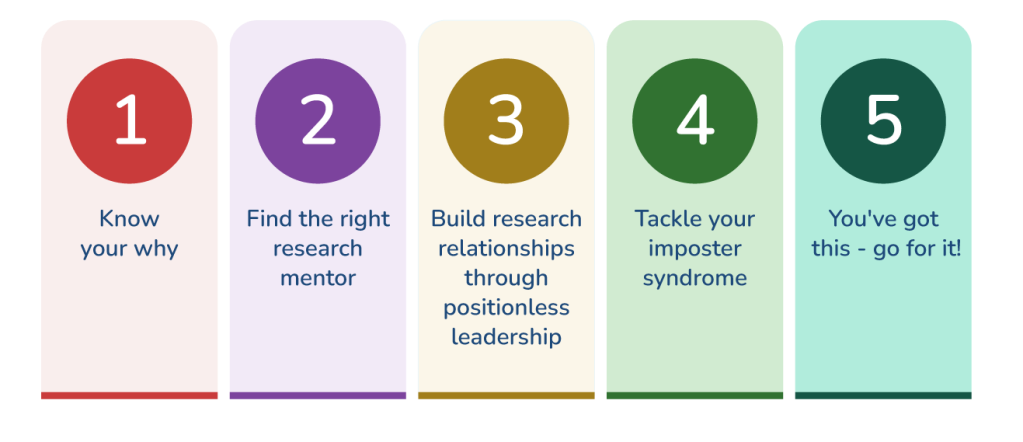
Now, it’s over to you! It’s time to start your research journey. I know you will be brilliant, and wish you every success on the journey!
If you’d like to learn more about the skills discussed in this article, feel free to check out the additional resources below, as well as our book (available in both paperback and ebook format), Unlocking The Leader Within: A Medical Student’s Guide to Practical Leadership, where we cover the essential unspoken skills that no one teaches you and that you need to succeed at medical school…but we make it fun and relatable!
Key Takeaways
- Identifying your motivation for pursuing research can help you select projects that align with your interests and stay engaged through setbacks.
- Finding a supportive research mentor is a critical step, and speaking with previous mentees can help you evaluate potential supervisors.
- Research opportunities can come from faculty, academic departments, student societies, summer programs, conferences, and smaller projects such as audits or systematic reviews.
- Positionless leadership helps medical students strengthen research teams by collaborating effectively, preparing thoroughly, building relationships, and contributing without needing a formal leadership title.
- Practical habits such as conducting literature reviews, discussing authorship early, protecting research time, and learning from rejection can help projects progress more effectively.
Additional Resources
- Dweck CS. Mindset: The New Psychology of Success. New York: Ballantine Books; 2007.
- Sinek S. Start With Why: How Great Leaders Inspire Everyone to Take Action. London, UK: Portfolio/Penguin; 2009.
- Maxwell JC. The 360 Degree Leader: Developing Your Influence From Anywhere in the Organization. Nashville: HarperCollins Leadership; 2011.
- Young V. The Secret Thoughts of Successful Women: Why Capable People Suffer from the Imposter Syndrome and How to Thrive in Spite of it. Currency; 2011.
- Wilding MJ. 5 Different types of imposter syndrome (and 5 ways to battle each one). The Muse. Updated March 8, 2022. https://www.themuse.com/advice/5-different-types-of-imposter-syndrome-and-5-ways-to-battle-each-one
References
- Sinek S. How great leaders inspire action . YouTube. May 4, 2010. https://www.youtube.com/watch?v=qp0HIF3SfI4 [Accessed 7th June 2026]
- Wu, HH., Ahmad M., Goh A., Wu HK. Unlocking The Leader Within: A Medical Student’s Guide to Practical Leadership. Elsevier; 2026.
- Corkindale G. Overcoming imposter syndrome. Harvard Business School. Published May 7, 2008. https://hbr.org/2008/05/overcoming-impostor-syndrome [Accessed 10th June 2026]
- Maqsood H, Shakeel HA, Hussain H, et al. The descriptive study of imposter syndrome in medical students. Int J Res Med Sci. 2018;6(10):3431-3434.

Get your free trial now to discover why millions of clinicians and caregivers love learning by Osmosis.
Leave a Reply