
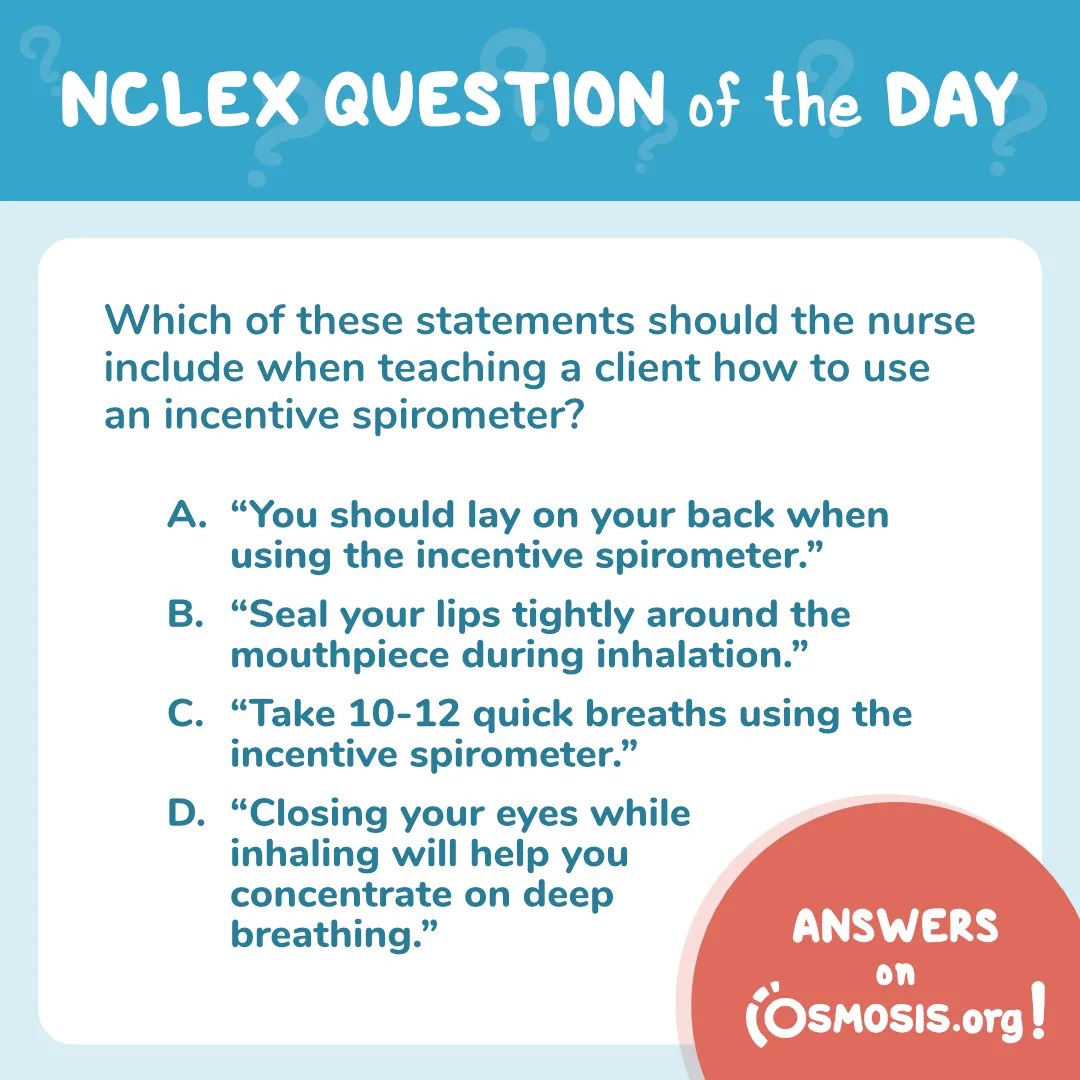
Today’s NCLEX-RN® question of the day focuses on a client using a spirometer.
Which of these statements should the nurse include when teaching a client how to use an incentive spirometer?
A. “You should lay on your back when using the incentive spirometer.”
B. “Seal your lips tightly around the mouthpiece during inhalation.”
C. “Take 10-12 quick breaths using the incentive spirometer.”
D. “Closing your eyes while inhaling will help you concentrate on deep breathing.”Scroll down for the correct answer!
Check out our NCLEX-RN Study Plan Guide!
The correct answer to today’s NCLEX-RN® Question is…
B. “Seal your lips tightly around the mouthpiece during inhalation.”
Rationale: A tight seal around the mouthpiece during inhalation prevents leakage of air around the mouthpiece.
Ready to put your nursing knowledge to the test?
Explore the NCLEX® Question of the Day: Smarter Prep, Better Results page to practice with NCLEX-style questions and boost your confidence before exam day.
Main Takeaway
Incentive spirometry is used to help expand the lungs and prevent lung problems such as atelectasis and pneumonia. If the client is able to sit in the high Fowler’s position, lung inflation can be optimized. The client is instructed to exhale normally, then inhale slowly and deeply, and then hold their breath for 3-5 seconds before exhaling slowly. A tight seal around the mouthpiece during inhalation prevents leakage of air. The client should be instructed to take deep, slow breaths with breaks in between to help prevent hyperventilation.

Incorrect answer explanations
A. “You should lay on your back when using the incentive spirometer.”
Rationale: Lying supine will not allow for maximum lung inflation. The high Fowler’s position facilitates optimal lung expansion.
C. “Take 10-12 quick breaths using the incentive spirometer.”
Rationale: To help prevent hyperventilation, clients should be encouraged to take deep, slow breaths with breaks in between breaths.
D. “Closing your eyes while inhaling will help you concentrate on deep breathing.”
Rationale: Watching the progress on the meter during inspiration provides visual feedback and can help motivate the client to take deep breaths.
References
- Potter, P.A., Perry, A.G., Stockert, P.A., Hall, A.M. (2017). Fundamentals of nursing (9th ed.). St. Louis, MO: Elsevier.

Want more NCLEX®-style practice questions? Try Osmosis today! Access your free trial and find out why millions of current and future clinicians and caregivers love learning with us.
Leave a Reply