
Medical and health professions students increasingly rely on digital learning tools to supplement classroom instruction, reinforce foundational concepts, and prepare for exams. As curricula become more complex and learners demand greater flexibility, institutions have an opportunity to support student success by providing access to trusted, evidence-based educational resources. By offering institution-wide access to high-quality digital platforms, medical schools can help reduce students’ reliance on multiple subscription services, improve learning outcomes, and create a more cohesive educational experience.
Why Provide Digital Learning Resources?
Today’s health care learners expect educational content to be available whenever and wherever they need it. Digital resources support a variety of learning preferences while enabling students to engage with content through videos, visualizations, adaptive learning, self-assessment, and AI-powered study support.
Providing institution-supported resources can benefit both students and faculty by:
- Supporting independent and self-directed learning
- Enhancing engagement in flipped classroom and active learning environments
- Improving accessibility and flexibility for diverse learners
- Reducing the financial burden of purchasing multiple study tools
- Providing faculty with ready-to-use educational content that complements their teaching
- Helping students build confidence for coursework, clinical rotations, and licensing examinations
Research has consistently shown that interactive digital learning experiences, including practice questions, repetition, feedback, and multimedia instruction, can positively impact learning outcomes and knowledge retention.
Building a Connected Learning Ecosystem with Elsevier
Rather than asking students and faculty to navigate a fragmented landscape of educational tools, institutions can provide an integrated ecosystem that supports learners throughout their educational journey. Watch the following presentation to discover practical strategies you can start applying immediately!
Osmosis: Visual Learning & Exam Preparation
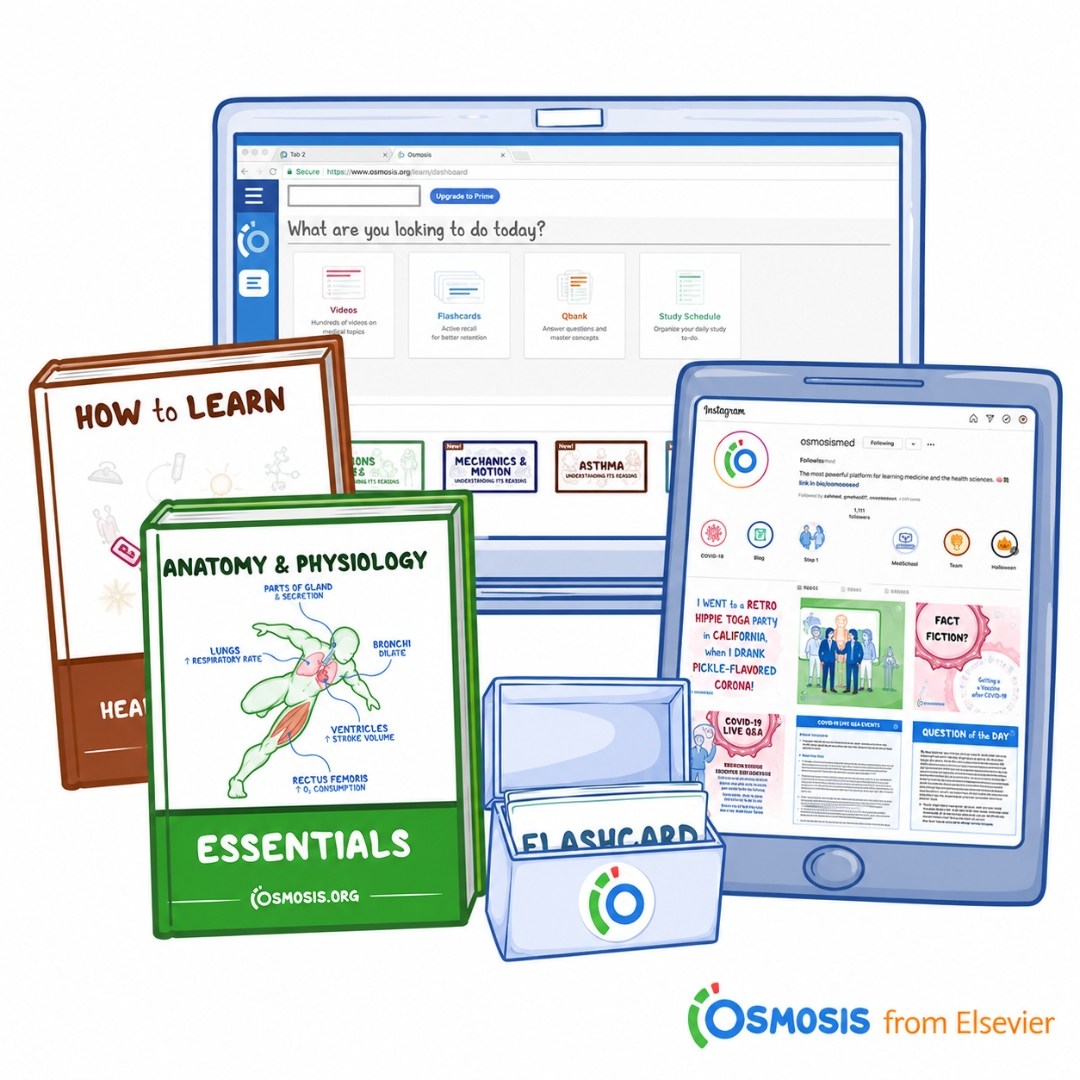
Osmosis provides students with a comprehensive learning platform featuring concise educational videos, flashcards, practice questions, high-yield notes, and personalized study tools. Designed for medical, nursing, and health sciences education, Osmosis helps learners master foundational sciences while connecting concepts to clinical practice.
Recent innovations such as Osmosis AI combine conversational AI with trusted Elsevier content, enabling students to ask questions, generate study materials, receive evidence-based explanations, and connect directly to relevant learning resources. All responses are grounded in verified educational content and include transparent citations to support learning and confidence.
Benefits include:
- Short, high-yield educational videos
- Adaptive learning and spaced repetition
- Practice questions and self-assessment tools
- AI-powered study support
- Board and licensing exam preparation support
- Faculty resources for lesson planning and content integration
Complete Anatomy: Interactive 3D Anatomy Education
Complete Anatomy by 3D4Medical provides an immersive anatomy learning experience through highly detailed 3D anatomical models, interactive dissections, and dynamic educational tools.
Students can explore structures layer by layer, visualize physiological processes, and develop a deeper understanding of anatomy through active engagement rather than passive memorization. Faculty can use Complete Anatomy to enhance lectures, demonstrations, and small-group teaching sessions.
Benefits include:
- Detailed interactive 3D anatomy models
- Virtual dissections and anatomical simulations
- Clinical correlations and pathology visualizations
- Collaborative teaching and learning tools
- Cross-platform access for learning anytime, anywhere
ClinicalKey AI: Evidence-Based Clinical Learning & Decision Support
ClinicalKey AI helps bridge the gap between classroom learning and clinical practice by providing access to trusted medical knowledge from Elsevier’s extensive content portfolio.
Students and educators can quickly find evidence-based answers, summarize complex topics, explore clinical guidance, and access authoritative medical references through an AI-powered interface grounded in trusted content.
Benefits include:
- Rapid access to trusted medical knowledge
- AI-assisted search and summarization
- Evidence-based clinical content
- Integration of textbooks, journals, and reference materials
- Support for clinical reasoning and lifelong learning
Choosing & Implementing Digital Resources
Successful adoption depends on more than simply purchasing a platform. Effective implementation requires stakeholder engagement, training, communication, technical integration, and ongoing assessment to ensure each learning resource delivers measurable value and achieves intended outcomes. Institutions should consider the following:
Understanding Current Student & Faculty Needs
Before selecting resources, gather feedback on:
- Which tools students already use
- Areas where learners struggle most
- Faculty priorities and teaching objectives
- Gaps in the current curriculum
Understanding existing workflows helps ensure that new resources complement rather than disrupt learning.
Creating an Implementation Strategy
Institutions that achieve the highest levels of adoption often:
- Introduce resources during orientation
- Provide faculty training and onboarding
- Align content with curricular objectives
- Embed resources directly into learning management systems
- Encourage consistent use across courses and clerkships
A thoughtful implementation plan helps maximize value for both learners and educators.
Supporting Success Across the Educational Journey
The most effective educational technologies do more than help students pass exams. They support learning throughout the entire continuum of medical education. By combining visual learning through Osmosis, immersive anatomy education with Complete Anatomy, and evidence-based clinical knowledge through ClinicalKey AI, institutions can create a comprehensive digital learning environment that supports students from foundational sciences through clinical practice. As medical education continues to evolve, providing trusted, integrated resources can help institutions improve learner outcomes, support faculty efficiency, and prepare future healthcare professionals for success.
Key Takeaways
- Institution-supported digital learning tools can improve accessibility, engagement, and learning outcomes.
- Integrated educational ecosystems reduce reliance on multiple disconnected platforms and subscriptions.
- Osmosis supports foundational learning, exam preparation, and AI-powered study assistance.
- Complete Anatomy enhances understanding through interactive 3D visualization and virtual dissection.
- ClinicalKey AI helps connect classroom knowledge to evidence-based clinical reasoning and practice.
Learn how Osmosis empowers active, personalized learning that supports academic performance & student engagement. Schedule a call today!
Leave a Reply