
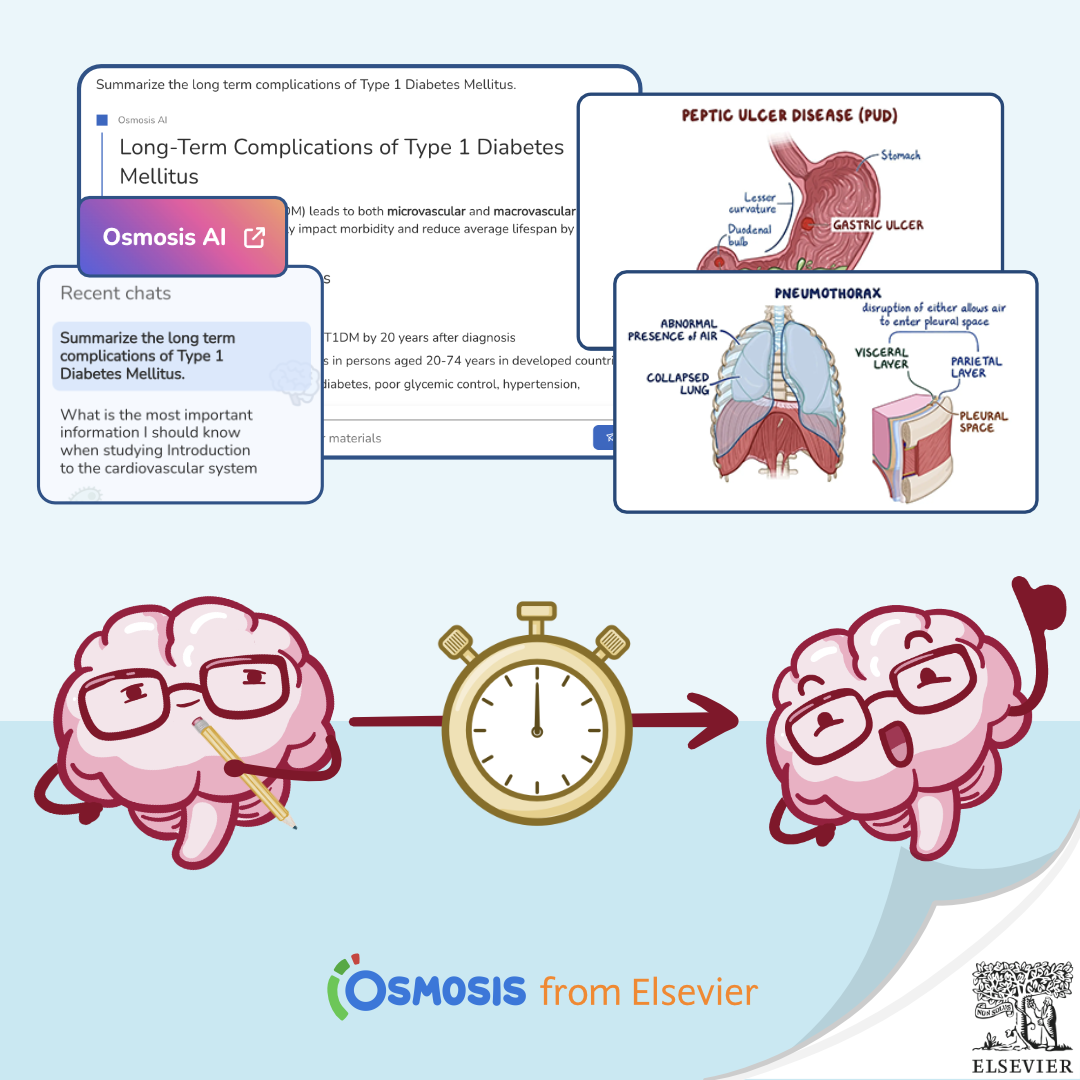
If you’re a healthcare learner, you probably relate to this feeling: you’re studying, you hit a confusing concept, and you think, “I’ll just look this up quickly.” Twelve tabs later and you’re still not sure what’s right, what’s test‑relevant, or what you’re supposed to remember.
Osmosis AI was built for exactly this moment.
Designed directly inside the Osmosis learning platform, Osmosis AI helps students go from question to clarity without sacrificing accuracy, trust, or the development of their own clinical reasoning. Let’s walk through what that really means, why general‑purpose AI tools can fall short for health professions learning, and how Osmosis AI supports faster, safer, and more effective studying.
What does “going from question to clarity” mean?
Going from question to clarity means understanding the why behind a concept, not just memorizing the answer.
In health professions education, clarity isn’t about getting a quick one‑off response. It’s about turning confusion into structured understanding that connects basic and clinical science concepts to exam expectations and clinical practice relevance.
Osmosis AI supports this by providing explanations grounded in trusted Elsevier healthcare education content, connecting those explanations to visual learning resources like Osmosis videos, and suggesting guided next steps so you don’t lose momentum. Whether you’re learning core medical concepts, understanding conditions and mechanisms, assessing your knowledge with board‑style questions or flashcards, working through clinical scenarios, or asking follow‑up questions to deepen understanding, Osmosis AI helps ensure your studying is focused and on track.
Why do traditional search and general‑purpose AI tools often slow learners down?
Traditional search and general‑purpose AI tools can slow learners down because they introduce context switching and uncertainty.
General‑purpose AI tools can feel like they’re providing answers quickly, but they introduce a different challenge for learners: inconsistency in framing, emphasis, and relevance to what you’re actually studying. Even when explanations are accurate, they may not align with exam expectations or with how concepts are taught in health professions curricula. That can mean extra time interpreting, verifying, or reframing information before it’s truly useful.
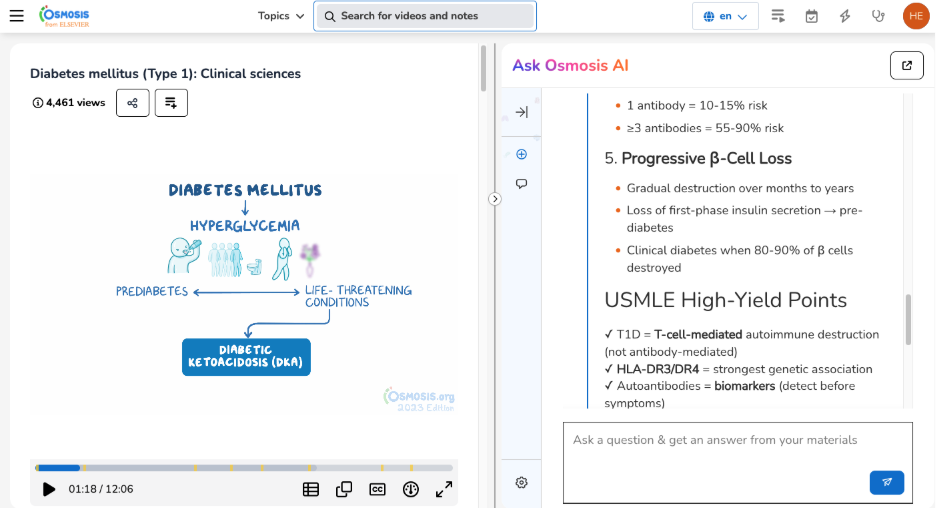
Have a question while watching an Osmosis video or reviewing a note or decision‑making tree? Osmosis AI stays with you in context as you study. Instead of treating AI as a separate destination, a persistent chat panel remains visible alongside videos and learning content, so you can ask questions the moment confusion arises without leaving the page. This reduces friction between getting stuck and getting clarity, keeps you focused, and allows understanding to build across a study session. By keeping AI available but unobtrusive, Osmosis AI acts as a continuous study companion rather than something bolted on.
Why aren’t general‑purpose AI tools enough for board exam preparation?
General‑purpose AI tools can provide correct answers, but board exam preparation requires consistent exam‑relevant framing, clinical context, and learning‑focused structure.
General‑purpose AI tools are increasingly capable and can be configured to cite sources or focus on specific domains. However, studying for health professions exams requires more than correctness alone. Learners need explanations that are consistently exam‑relevant, clinically focused, and structured in ways that support retention and application.
Because general‑purpose AI is designed to answer many kinds of questions across many use cases, its output may vary in depth, framing, or emphasis depending on how a question is asked. Osmosis AI is purpose‑built for health care education and board preparation. It operates within a controlled Elsevier content environment and grounds responses in trusted Osmosis and Elsevier sources, helping ensure explanations are consistent, traceable, and aligned with how topics are taught, tested, and applied in practice.
What happens when AI doesn’t cite sources?
When AI responses aren’t clearly grounded in sources, learners lose the ability to verify what they’re learning.
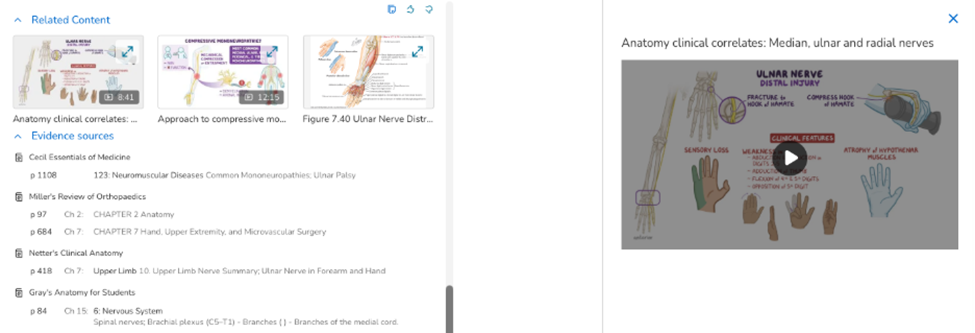
That can slow studying, introduce uncertainty, or lead to gaps in understanding, especially early in training. Osmosis AI provides citations where available so learners can trace explanations back to trusted Elsevier sources, verify details, and explore further when needed.
Why is Osmosis AI built for learning and retention rather than “everything”?
Osmosis AI is built for learning and retention because supporting health professions education requires focus and consistency, not maximum versatility.
Rather than trying to serve every possible use case, Osmosis AI is intentionally designed around how health care students actually learn and prepare for exams. It prioritizes structured explanations, visual learning, active recall, exam readiness, and clinical application.
The goal of Osmosis AI isn’t to replace effective study practices, but to reinforce them. By encouraging follow‑up questions, flashcards, assessment items, and clinical cases, Osmosis AI emphasizes active learning that promotes critical thinking. This focus also supports safer use of AI in health professions education by strengthening clinical reasoning rather than encouraging passive dependence.
Is Osmosis AI an LLM, and does that matter?
Osmosis AI is not a standalone, general‑purpose LLM; it is a purpose‑built educational AI experience designed specifically for health professional education.
Osmosis AI leverages a combination of frontier large language model technology and retrieval of Elsevier content as part of its underlying system. Osmosis AI is embedded within the Osmosis learning platform and operates within a controlled Elsevier content environment. Responses are shaped to support understanding, retention, and clinical application rather than broad or unrestricted use.
This design focus helps ensure consistency, reliability, and alignment with how healthcare professional students are taught and assessed.
How does Osmosis AI follow responsible AI principles?
Osmosis AI is developed in alignment with Elsevier’s Responsible AI Principles.
These principles emphasize five core areas: real‑world impact, unfair bias prevention, explainability and transparency, human oversight, and privacy and data governance. Osmosis AI is designed as an educational support tool embedded inside Osmosis, not for clinical decision‑making. Responses are evaluated through expert review, structured quality assessments, user feedback, and ongoing monitoring.
Because Osmosis AI is a learning aid, learners should continue to verify important information against cited sources, course materials, and primary references.
How should learners use Osmosis AI while still developing their clinical reasoning skills?
AI can speed up learning, but how learners use Osmosis AI matters if they want to build, not replace, clinical reasoning skills.
Unstructured AI use can lead to skill erosion, including de-skilling (losing skills by offloading thinking), mis-skilling (learning errors or flawed reasoning), and never-skilling (failing to build core competencies in the first place). Automation bias, or trusting confident outputs too quickly, can make these risks worse.
The difference comes down to where AI appears in the learning sequence. Educational research often describes two models: the Cyborg model and the Centaur model. In the Cyborg model, AI is tightly integrated into the workflow and helps generate reasoning in real time. While this can mirror how AI is used in clinical practice, it is risky for early learners who are still developing independent competence.
In the Centaur model, which is recommended for early health professions learners or before baseline competence is established, you remain the primary decision‑maker. A safe Centaur workflow looks like this:
- Reason on your own (commit to your best answer or differential)
- Consult Osmosis AI to clarify understanding, organize information, or check your thinking
- Evaluate the output by deciding what you accept, reject, or modify based on your own judgment
- End with active learning, such as questions, flashcards, or clinical cases
Used this way, Osmosis AI helps you move faster without putting your reasoning on autopilot. The Centaur model protects against skill erosion and keeps AI where it belongs—as a coach that supports learning, not a crutch that replaces it.
What does “clarity in seconds” unlock for learners?
Going from question to clarity in seconds unlocks confidence, efficiency, and better study habits.
By keeping explanations trustworthy, structured, and connected to active learning, Osmosis AI helps healthcare learners prepare for classes, board exams, and clinical practice more efficiently. That means fewer wasted hours, stronger understanding, and safer AI use that preserves the clinical reasoning skills essential for patient care.
Ready to experience it for yourself? Try Osmosis AI today in your study workflow and see how quickly you can go from question to clarity.
References
- Abdulnour, R.-E. E., Gin, B. C., & Boscardin, C. K. (2025). Educational strategies for clinical supervision of artificial intelligence use. The New England Journal of Medicine, 393(8), 786–797. https://doi.org/10.1056/NEJMra2503232
- Berzin, T. M., & Topol, E. J. (2025). Preserving clinical skills in the age of AI assistance. The Lancet, 406(10513), 1719–1721.https://doi.org/10.1016/S0140-6736(25)02075-6
- Cabitza, F., Natali, C., Marconi, L., & Dias Duran, L. D. (2025). AI induced deskilling in medicine: A mixed method review and research agenda for healthcare and beyond. Artificial Intelligence Review, 58, Article 356.https://doi.org/10.1007/s10462-025-11352-1
- El Tarhouny, S. E. S., & Farghaly, A. A. (2026). Deskilling dilemma: Brain over automation. Frontiers in Medicine, 13, 1765692. https://doi.org/10.3389/fmed.2026.1765692
- Hosseini, S. M. (2025). AI misuse and passiveness of students in medical education. Advances in Physiology Education, 49(4), 721–725. https://doi.org/10.1152/advan.00164.2025
- Izquierdo Condoy, J. S., AriasIntriago, M., Tello DelaTorre, A., Busch, F., & Ortiz Prado, E. (2025). Generative artificial intelligence in medical education: Enhancing critical thinking or undermining cognitive autonomy? Journal of Medical Internet Research, 27, e76340. https://doi.org/10.2196/76340
- Janumpally, R. R., Nanua, S. S., Ngo, A., & Youens, K. (2025). Generative artificial intelligence in graduate medical education. Frontiers in Medicine, 11, 1525604. https://doi.org/10.3389/fmed.2024.1525604
- Kirpalani, A., Grimmer, J., & Wang, P. Z. T. (2025). Exploring medical student trust in generative artificial intelligence (ChatGPT) versus peers in team-based learning. Medical Science Educator, 35, 671–674. https://doi.org/10.1007/s40670-025-02289-9
- Monteith, S., Glenn, T., Geddes, J. R., Whybrow, P. C., Achtyes, E. D., Bauer, R., & Bauer, M. (2026). Artificial intelligence and deskilling in medicine. The British Journal of Psychiatry, 1–3. https://doi.org/10.1192/bjp.2025.10496
- Park, G. L., Beck Dallaghan, G. L., Bradley, J., Sikander, Q., Jung, H., Zhang, K., Polites, G., & Jokela, J. (2026). Generative artificial intelligence in medical training: Utilization patterns across knowledge, patient care, systems reasoning, and innovation. Medical Science Educator.
https://doi.org/10.1007/s40670-025-02623-1 - Schubert, T., Oosterlinck, T., Stevens, R. D., Maxwell, P. H., & van der Schaar, M. (2025). AI education for clinicians. eClinicalMedicine, 79, 102968. https://doi.org/10.1016/j.eclinm.2024.102968
- Turner, L., Knopp, M. I., Mendonca, E. A., & Desai, S. (2025). Bridging artificial intelligence and medical education: Navigating the alignment paradox. ATS Scholar. https://doi.org/10.34197/ats-scholar.2024-0086PS

Try Osmosis today! Access your free trial and find out why millions of current & future clinicians & caregivers love learning with us.
Leave a Reply