
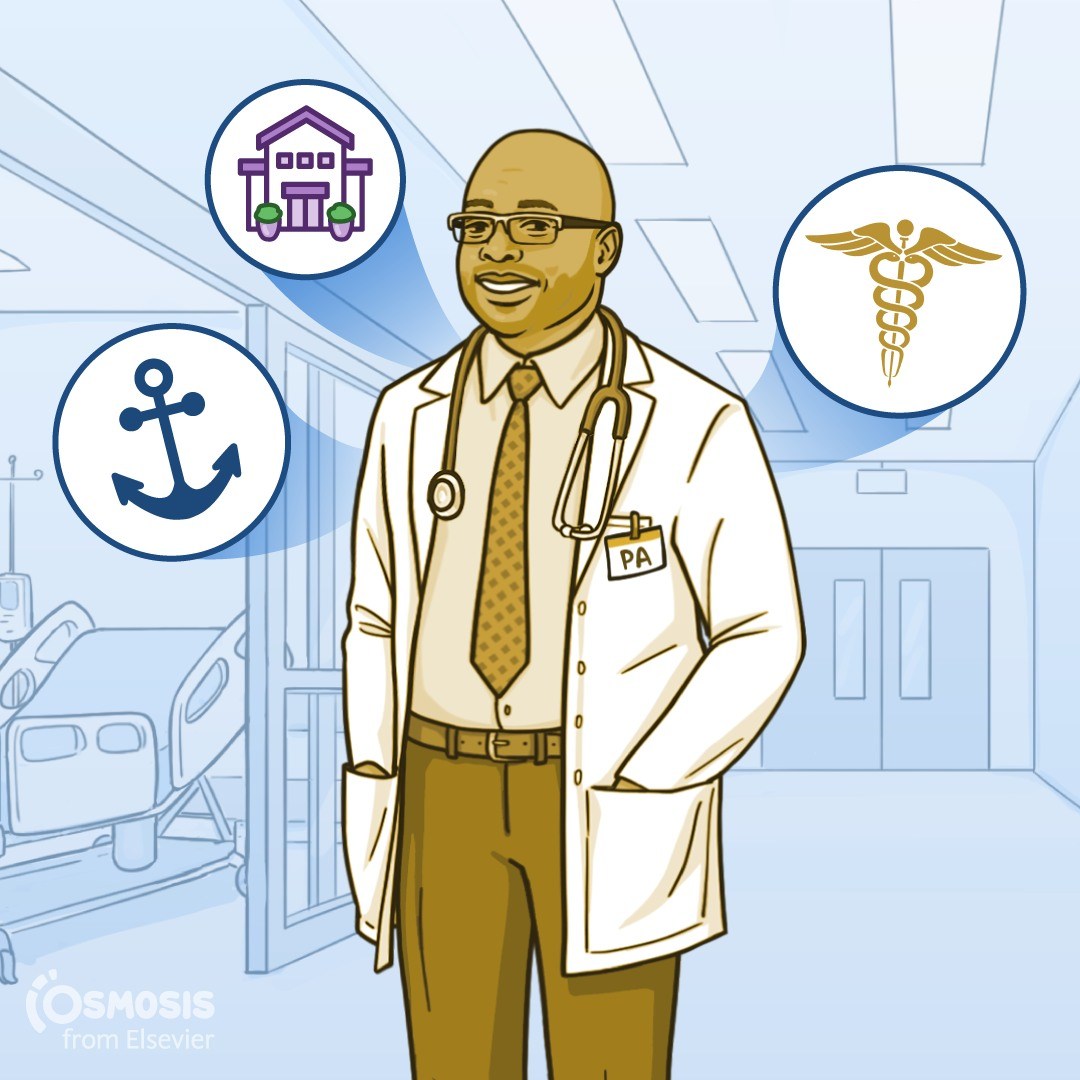
When National PA Week rolls around every October, it’s easy to treat it as a week of thank-yous and break-room cake. But the date itself, October 6, marks something specific: the anniversary of the very first PA class graduating from Duke University in 1967. That first class was made up of four former Navy Hospital Corpsmen, chosen by Dr. Eugene Stead because their military medical training had already given them more clinical experience than most incoming students could dream of.
Nearly sixty years later, Willie Dodson is walking almost exactly that same path, corpsman to PA, just on his own timeline. He spent 20 years as a Navy Hospital Corpsman, built a second career in real estate, and then went back to school in his late fifties to become a Physician Associate. We sat down with him to talk about why he changed careers, what it was actually like, and what he’d say to anyone who thinks taking a new career path later in life is “too late.”
“A No-Brainer”
For Willie, the pull toward medicine started decades before he ever set foot in a classroom. He first crossed paths with a PA in 1984: a Warrant Officer who treated him for a strained muscle aboard the USS Kitty Hawk. He wasn’t especially impressed by the man, but he couldn’t stop thinking about the role itself: how was someone who wasn’t a doctor treating patients?
The real spark came later, when he met a family friend in PA school who was clearly thriving. “He seemed to be excited about school and what he was studying,” Willie recalls. Watching that friend build a life around medicine — buying a house, teaching at the university he’d graduated from — planted something in my mind that never fully went away.
By his late 30s, still on active duty, Willie considered pursuing PA school. But becoming a commissioned officer at that stage felt like starting over at the bottom of a new ladder. So he shifted toward healthcare leadership instead, working as a Hospital Administrator after retiring from the Navy. When that path left him frustrated, he moved into real estate, first as a broker, later as a franchise sales director, where he thrived.
Through it all, the pull toward medicine never left. His wife, Gina, finally named what he hadn’t: “She knew that I was not happy with what I was doing, although I did it well,” he says. “Gina observed that I hadn’t been really excited about a job unless I was talking about, or treating patients.” So she encouraged him by helping Willie research PA programs. They toured schools together, and he applied to eight. He got into two.
Looking back at the throughline — Hospital Administrator, real estate, and finally PA — Willie describes the decision: “My skills and experience as a Hospital Corpsman in the Navy was very beneficial. A no-brainer!”

Walking Back Into a Classroom
Going back to school decades after his last classroom experience came with its own learning curve, literally. “It was difficult, as I had not been a student for many years and learning in college had changed drastically since I was a student last,” he says.
There was also the matter of standing out. On the first day of class, most of his classmates assumed he was one of the professors. Age gaps made it harder to build close friendships with fellow students, but it opened different kinds of relationships elsewhere: preceptors and professors gravitated toward him during rotations, drawn to the depth of real-world experience he brought into the room. “One preceptor even deems me to this day her favorite student,” he says.
His program, he’s quick to note, never treated his age as a liability. If anything, his corpsman background became a teaching tool for the classroom, with professors using his real-world experience to ground abstract discussions in what patient care actually looks like.
Stepping back into clinical settings surfaced a strange, layered feeling. “I felt beautifully ignorant, yet somewhat informed and educated, all at the same time,” he says. “Kind of confident yet apprehensive.” Much of his corpsman training came back to him quickly; some of it had simply been renamed. As he puts it, with a laugh: “Names had been changed to protect the innocent!”
The True Cost of the Career Change
The hardest part of going back to school wasn’t academic; it was structural. After years of being the one in charge, adjusting to living on a student’s income and the lack of authority took real recalibration. “Adjusting to not walking in as a leader. Not having control over the amount of money I could make,” he says. He and his wife were managing a mortgage and a lifestyle that didn’t match a student budget. “It taught me incredible budgeting skills,” he adds, and, in his words, “by the Grace of God we managed to get to this point.”
Coming Full Circle
Ask Willie whether he knew, going in, that he was retracing the exact origin story of the PA profession, and the answer is a firm yes, and it clearly matters to him. “It is incredibly meaningful,” he says. “I can truly see how being a Hospital Corpsman, especially my experiences, fit perfectly into the role of a PA.” That fit shows up in how he practices today at Christ Community Health Services in Memphis, Tennessee: “Now that I am practicing, I see I have a confidence that most mid-level practitioners take years to build.”
Day to day, the job has matched, and in some ways exceeded, what he expected from his busiest student rotations, minus one thing he wasn’t fully prepared for: the business side of medicine. “There is a lot of pressure on the ‘business side’ of being a practitioner that one really can’t see until you’re in the midst of it,” he says. He’s also become philosophical about the limits of modern medicine’s “silver bullet” mentality: the assumption that there’s a pill or fix for everything. “We don’t truly know all there is to know about [the body],” he says. “Every human being is different.”
What Three Careers Taught Him
Asked what his three very different careers — corpsman, real estate, PA — have in common, Willie doesn’t hesitate: leadership, management, productivity, and, ultimately, service to people. But each one shaped him differently. The Navy taught him camaraderie. Real estate taught him drive and how to understand what people really want before they can articulate it themselves. Medicine, he says, taught him to see the whole person, “mentally, physically, or spiritually,” and to appreciate both the resilience and the limits of the human body. “This body has an expiration date, the same as most everything on this planet,” he says. “And we have got to ‘keep it movin’’ until that expiration date. Healthy is possible, but it’s a whole lotta work!”
Advice for Anyone Who Thinks It’s Too Late
For anyone sitting on the fence about a major career change later in life, Willie’s advice is direct: “Go for it! However, seriously consider your arena. If youth is what is typical, there are skills and opportunities that someone with ‘skills’ can bring. Know your audience.”
It’s fitting advice from someone whose own path proves the point. Sixty years after four Navy corpsmen became the first physician assistants in the country, Willie is a living reminder that the profession’s roots, service, hands-on experience, and a willingness to start over are still exactly what it’s built on.
Key Takeaways
- National PA Week begins October 6, connecting the celebration to the early history of the PA profession.
- Willie’s transition from Navy Hospital Corpsman to Physician Associate echoes the military medical background associated with the profession’s earliest practitioners.
- Decades of military, leadership, and professional experience gave Willie transferable skills he could bring into PA education and patient care.
- Returning to school later in life required adjusting to a different academic environment as well as major financial and lifestyle changes.
- Willie’s experience demonstrates how a nontraditional career path can bring valuable perspective, experience, and patient-centered skills into the PA profession.

Happy PA Week to you all!
Leave a Reply