
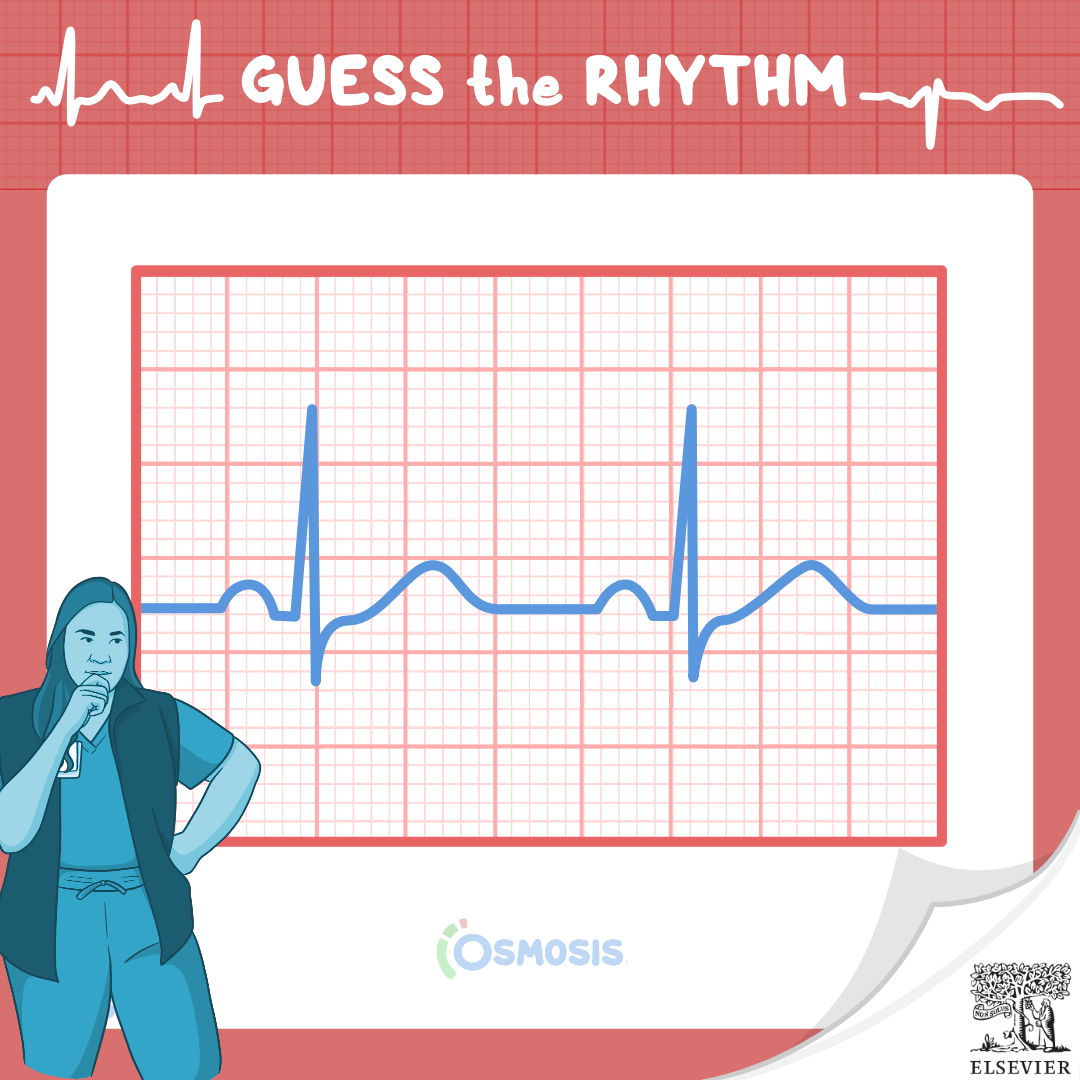
The findings of the above ECG indicate a normal sinus rhythm and normal cardiac electrical activity. Remember, the ECG paper has large squares with thick lines, and inside each are 25 smaller squares with thinner lines. Horizontally, each small square represents 0.04 seconds.
There are eight main things to look for on an ECG to ensure everything is normal.
First, the heart rate can be calculated by counting the number of QRS complexes in six seconds and multiplying that number by 10.
Second, the heart rhythm regularity can be assessed by checking the distance between the peaks of two consecutive P waves and two consecutive R waves. If the ratio of the P-P and R-R intervals is 1, then the heart rhythm is regular.
Third, the P wave should be checked to ensure it is present, regular in timing and shape, and that there is one for each QRS complex.
Fourth, the PR interval is checked to make sure it’s consistently between 0.12 to 0.20 seconds, which is three to five little boxes.
Fifth, the QRS duration should be consistently less than 0.1 seconds, which is two and a half little boxes.
Sixth, the ST segment should not be elevated or depressed more than 1 small box.
Seventh, the T wave shape should be asymmetric and height should be less than 5 millimeters in precordial leads and less than 10 millimeters in limb leads.
And last, but not least, the QT interval should be less than or equal to half of a cardiac cycle, which can be calculated by measuring the distance between two successive R waves.
Learn more about this and other types of cardiac rhythms in Osmosis: Electrocardiogram (ECG) – Normal sinus rhythm (NSR): Nursing
Key Takeaways
- Calculate heart rate by counting QRS complexes in 6 seconds times 10.
- Assess rhythm regularity using P-P and R-R interval comparisons.
- Check P wave presence, timing, and one per QRS complex.
- Ensure PR interval is between 0.12 and 0.20 seconds consistently.
- Verify QRS duration is less than 0.1 seconds and ST segment is normal.

Want more practice questions? Try Osmosis by Elsevier today! Access your free trial and discover why millions of current and future clinicians and caregivers love learning with us.
Leave a Reply