
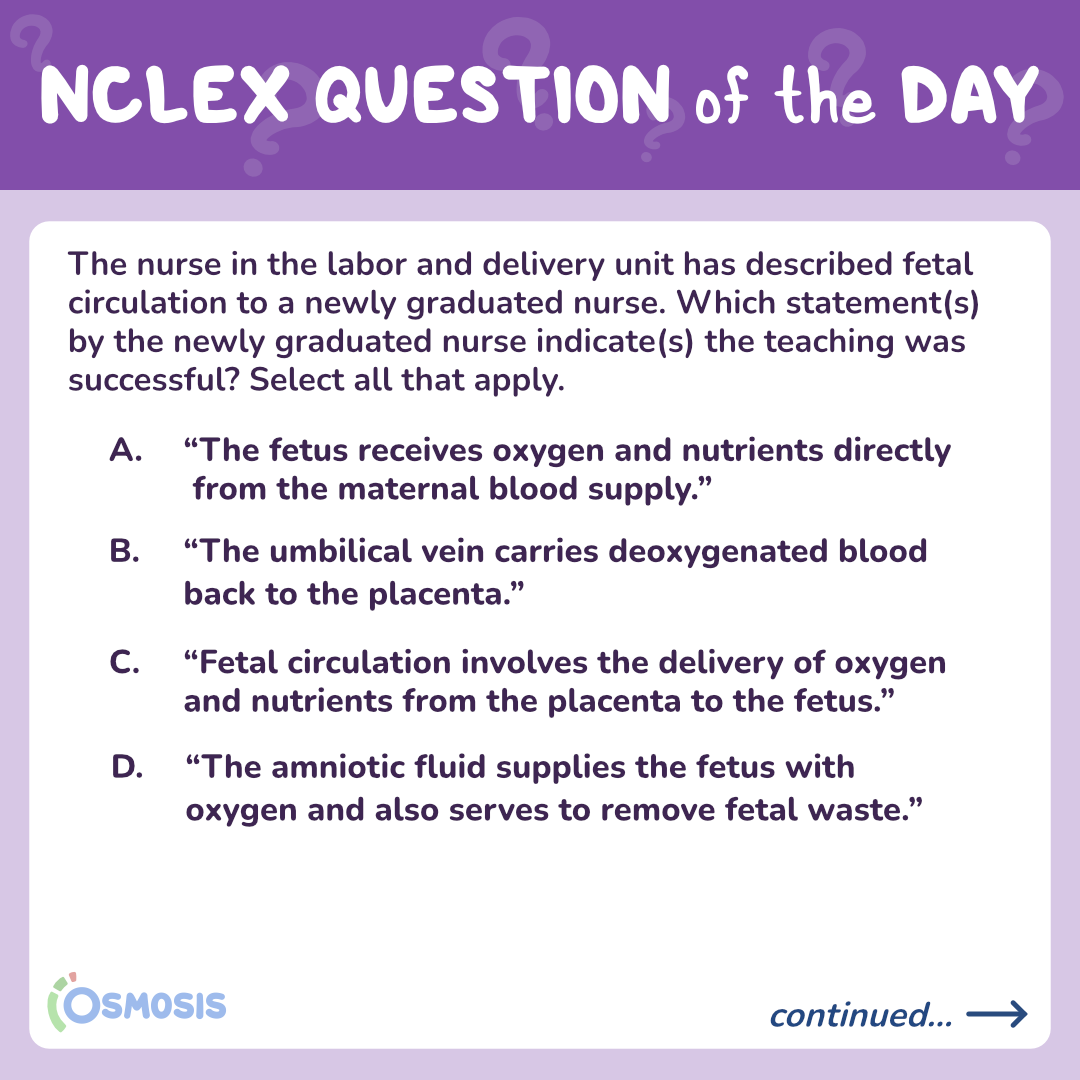
Today’s NCLEX-RN® question of the day focuses on fetal circulation. Do you know the answer? Let’s find out!
The nurse in the labor and delivery unit has described fetal circulation to a newly graduated nurse.
Which statement(s) by the newly graduated nurse indicate(s) the teaching was successful? Select all that apply.
A. “The fetus receives oxygen and nutrients directly from the maternal blood supply.”
B. “The umbilical vein carries deoxygenated blood back to the placenta.”
C. “Fetal circulation involves the delivery of oxygen and nutrients from the placenta to the fetus.”
D. “The amniotic fluid supplies the fetus with oxygen and also serves to remove fetal waste.”
E. “Oxygenated blood first flows to the fetal liver and divides at the ductus venosus.”
F. “In the fetal heart, the pressure on the left side is higher than the right side.”
G: “The foramen ovale is an opening between the right and left atria.”
H. “In the fetus, the lungs are not involved in gas exchange.”
Scroll down for the correct answer!
Check out our NCLEX-RN Study Plan Guide!
The correct answer to today’s NCLEX-RN® Question are…
C. “Fetal circulation involves the delivery of oxygen and nutrients from the placenta to the fetus.”
Rationale: This statement indicates teaching was successful. Fetal circulation involves the delivery of oxygen and nutrients from the placenta to the fetus.
E. “Oxygenated blood first flows to the fetal liver and divides at the ductus venosus.”
Rationale: This statement indicates teaching was successful. Oxygenated blood first flows through the umbilical vein and to the fetal liver, and there, the circulation divides as it meets the first fetal shunt called the ductus venosus.
G: “The foramen ovale is an opening between the right and left atria.”
Rationale: This statement indicates teaching was successful. The foramen ovale is an opening between the right and left atria. This shunt allows most of the blood to bypass the lungs and flow directly into the left atrium.
H. “In the fetus, the lungs are not involved in gas exchange.”
Rationale: This statement indicates teaching was successful. The fetal lungs are not involved in gas exchange; instead, there are three fetal shunts that redirect the blood to ensure the highest oxygenated blood reaches the heart and brain while redirecting blood away from the nonfunctional fetal lungs.
Main Takeaway

Fetal circulation involves delivering oxygen and nutrients from the placenta to the fetus and transporting waste products from the fetus to the placenta so that they are eventually eliminated by the mother’s body. Fetal circulation has unique features because the fetal lungs are not involved in gas exchange. There are three fetal shunts, which redirect the blood to ensure blood with the highest concentration of oxygen reaches the heart and brain while redirecting blood away from the nonfunctional fetal lungs. First, the umbilical cord connects the fetus to the placenta, which takes on the role of exchanging oxygen, carbon dioxide, nutrients, and wastes. Oxygenated blood first flows through the umbilical vein and to the fetal liver, and there, the circulation divides as it meets the first fetal shunt called the ductus venosus.
At this point, most of the blood passes through the ductus venosus and flows directly into the inferior vena cava. Meanwhile, the remaining blood perfuses the liver and then meets up with the rest of the blood in the inferior vena cava. Together, this blood flows into the right atrium of the fetal heart. In the fetal heart, the pressure on the right side is higher than on the left side of the heart. This is because the fetal lungs are filled with fluid, and the arteries are tightly constricted, so the pressure in the fetal lungs is high, leading to increased pressure on the right side of the heart. This pressure difference allows most of the oxygenated blood in the right atrium to pass through the second shunt, called the foramen ovale, an opening between the two atria. This shunt allows most of the blood to bypass the lungs and flow directly into the left atrium. The blood then flows into the left ventricle, which pumps it through the aorta to supply oxygenated blood to perfuse the brain, the heart, and the rest of the fetus.
At the same time, the right ventricle pumps blood into the pulmonary trunk. Since the lungs are collapsed, only a small portion of oxygenated blood enters the lungs. The remaining blood flows through the third shunt, called the ductus arteriosus, into the descending aorta and eventually to the umbilical arteries that lead to the placenta. After birth, when the baby takes its first breath, the lungs expand, and pulmonary blood flow increases. This makes pulmonary vessels expand and decreases pulmonary pressure, resulting in decreased pressure on the right side of the heart. The change in pressures causes the foramen ovale to close.
As the baby continues to breathe, arterial oxygen levels increase, causing the ductus arteriosus to constrict. When the umbilical cord is cut, the placental circulation is separated from the fetal circulation, causing the ductus venosus to constrict. The closing of the three shunts is gradual and may take up to 48 hours to fully close.
Incorrect Answer Explanations
A. “The fetus receives oxygen and nutrients directly from the maternal blood supply.”
Rationale: This statement indicates additional teaching is needed. The fetus does not receive oxygen and nutrients directly from the maternal blood because maternal and fetal blood do not mix.
B. “The umbilical vein carries deoxygenated blood back to the placenta.”
Rationale: This statement indicates additional teaching is needed. The umbilical artery, rather than the umbilical vein, carries deoxygenated blood back to the placenta.
D. “The amniotic fluid supplies the fetus with oxygen and also serves to remove fetal waste.”
Rationale: This statement indicates additional teaching is needed. The amniotic fluid provides cushioning for the fetus; it does not supply oxygen or remove fetal waste. Instead, the umbilical cord, which connects the fetus to the placenta, takes on the role of eliminating waste.
F. “In the fetal heart, the pressure on the left side is higher than the right side.”
Rationale: This statement indicates additional teaching is needed. In the fetal heart, the pressure on the right side is higher than on the left side of the heart. This is because the fetal lungs are filled with fluid, and the arteries are tightly constricted, so the pressure in the fetal lungs is high, leading to increased pressure in the right side of the heart.
Want to learn more about this topic?
Watch the Osmosis video: Fetal circulation: Nursing

Get your free trial now to find out why millions of current and future clinicians and caregivers love learning by Osmosis.
Leave a Reply