
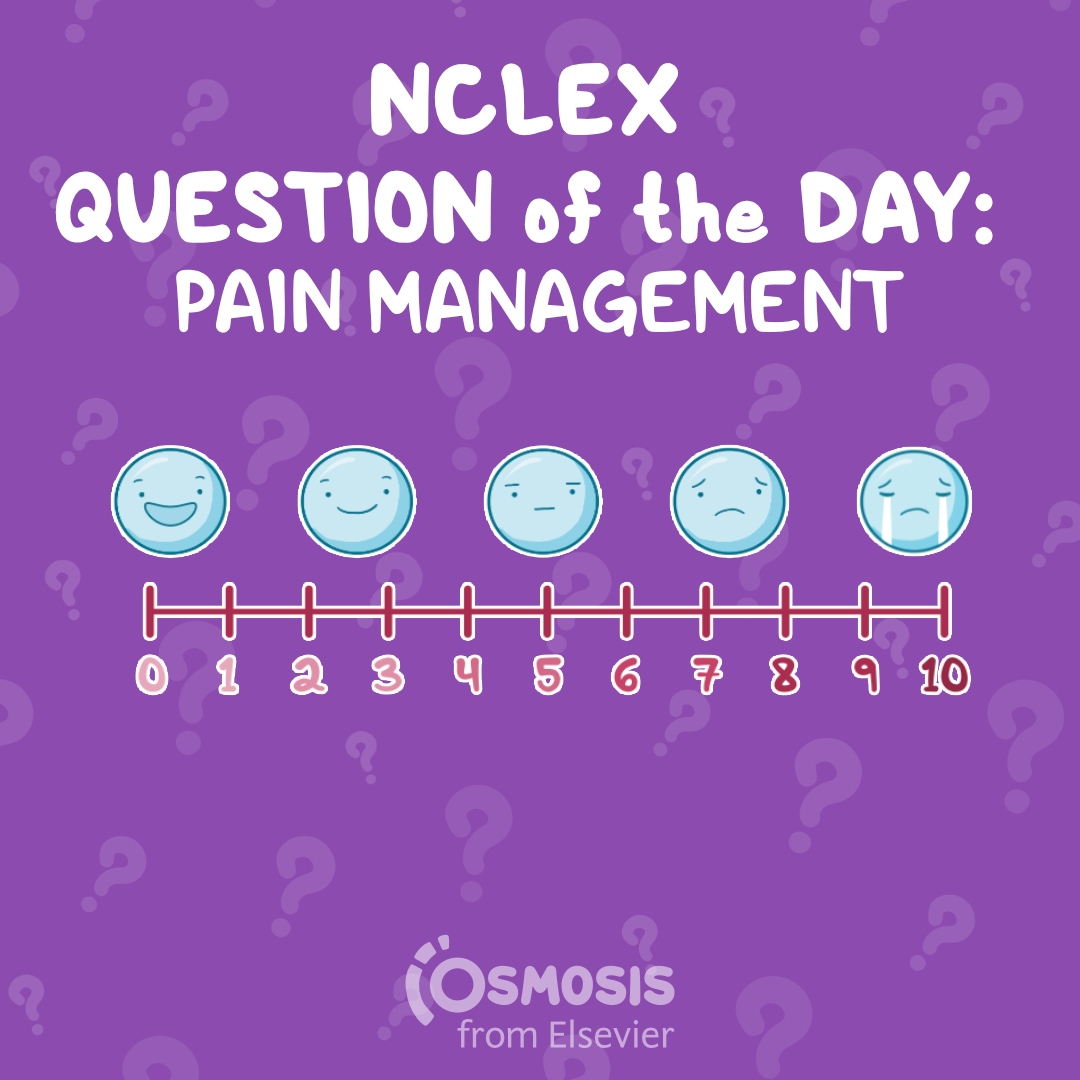
Today’s NCLEX-RN® question of the day focuses on evaluating pain management. Do you know the answer? Let’s find out!
The nurse is caring for an adult hospitalized patient receiving morphine for pain following chest tube insertion. An hour prior, the patient stated their pain was an 8/10 on the pain scale, and received 2 mg of morphine intravenously.
Which nursing intervention is most appropriate to evaluate the medication’s effectiveness?
A. Obtain a set of vital signs
B. Calculate their pain using the FLACC scale
C. Ask the patient to rate their pain on a scale from 0 to 10
D. Score the patient on the Clinical Opiate Withdrawal Scale (COWS)
Scroll down for the correct answer!
The correct answer to today’s NCLEX® Question is…
C. Ask the patient to rate their pain on a scale from 0 to 10
Rationale: Prior to administration of the morphine, the patient rated their pain on the numeric pain scale (0 to 10). The most appropriate way to reevaluate their pain is to reassess pain using the same scale.
Main Takeaway
Pain can be evaluated both objectively and subjectively. Certain pain scales utilize objective findings, such as FLACC, while others ask the patient to rate their pain using subjective metrics like numbers or images. Since the nurse used the numeric pain scale to assess pain prior to administering the morphine, asking the patient to rate their pain on the numeric scale again will be the most reliable way of evaluating the effectiveness of the intervention. Vital signs are also valuable in providing objective data about pain and response to medication; however, must be correlated with other pain indicators. The Face, Legs, Activity, Cry, Consolability (FLACC) scale is a measurement used to assess pain for pediatric patients between 2 months and 7 years of age or individuals that are unable to communicate their pain rather than adult patients who can communicate. The Clinical Opiate Withdrawal Scale (COWS) score is not used to assess pain, rather, it is used to assess withdrawal symptoms in patients with substance use disorder.
Incorrect Answer Explanations
A. Obtain a set of vital signs
Rationale: Vital signs can provide objective information about the pain. For example, when patients are in pain, their heart rate and blood pressure can be elevated. However, an isolated set of vital signs is not the most appropriate evaluation measure to determine whether the medication was effective.
B. Calculate their pain using the FLACC scale
Rationale: The Face, Legs, Activity, Cry, Consolability, or FLACC, scale is an objective measurement used to assess pain for pediatric patients between 2 months and 7 years of age or individuals that are unable to communicate their pain. This scale is not the most appropriate way to evaluate pain for this adult patient who can verbalize their pain.
D. Score the patient on the Clinical Opiate Withdrawal Scale (COWS)
Rationale: The COWS score is not used to assess pain. Rather, it is used to assess withdrawal symptoms in patients with substance use disorder.
Want to learn more about this topic?
Watch the Osmosis video: Pain Assessment and Management

Try Osmosis from Elsevier today! Access your free trial and find out why millions of current and future clinicians and caregivers love learning by Osmosis.
Leave a Reply