
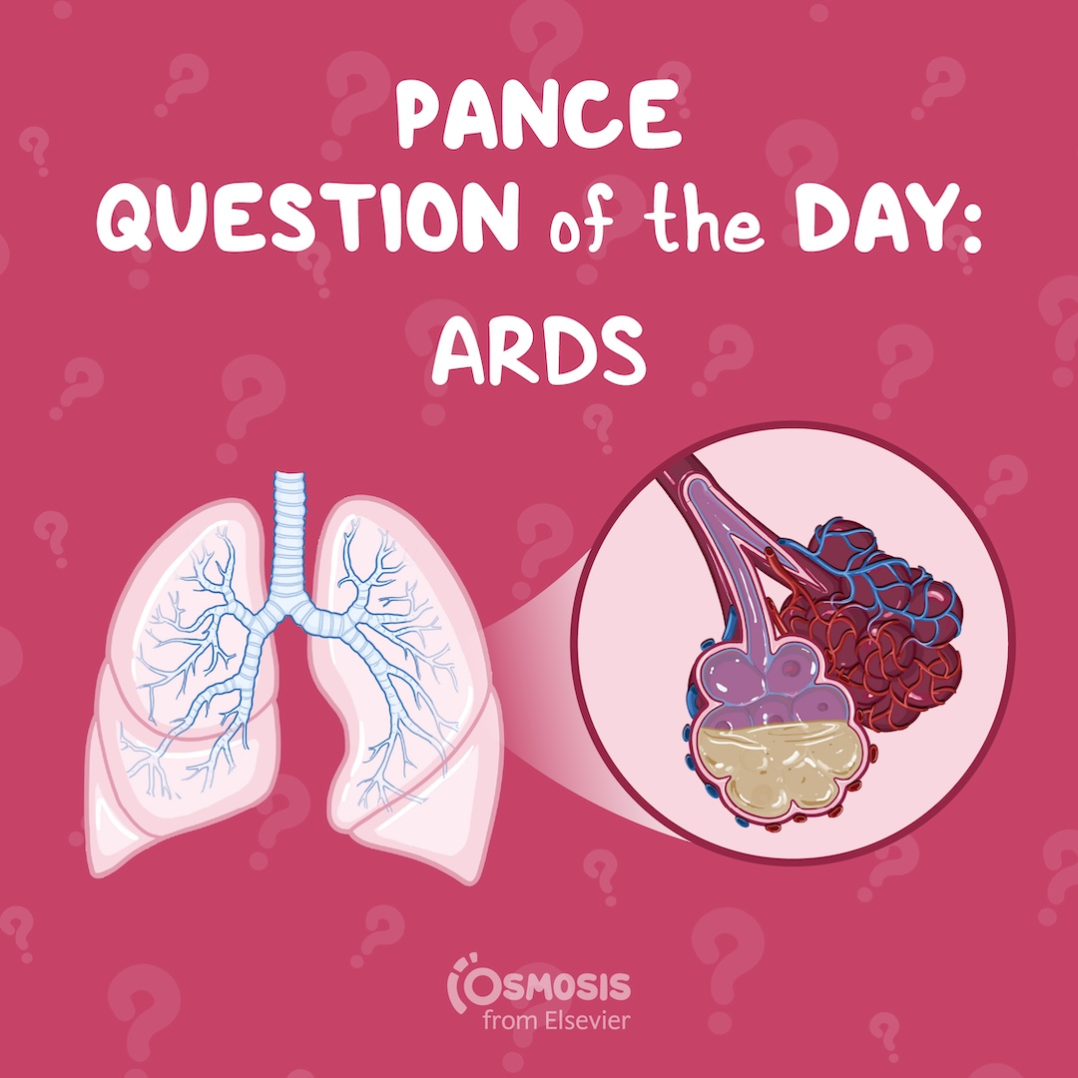
Prepare for the PANCE® with this challenging clinical scenario involving a 58-year-old patient with hypertension in the ICU to manage pneumonia and ARDS. Examine the clinical details to make an informed decision about their care.
A 58-year-old man with a history of hypertension is admitted to the intensive care unit for management of pneumonia and subsequent acute respiratory distress syndrome (ARDS). He was intubated and mechanically ventilated due to worsening hypoxemia. His initial ventilator settings were set to a tidal volume of 6 mL/kg of predicted body weight, with a positive end-expiratory pressure (PEEP) of 5 cm H2O. Temperature is 38.3°C (100.9°F), heart rate is 102/min, respiratory rate is set at 12 breaths/min on the ventilator, blood pressure is 135/85 mmHg, and oxygen saturation is 88% on FiO2 of 50%. The patient is put in a prone position. Lung auscultation reveals bilateral crackles. Arterial blood gas (ABG) analysis shows pH 7.3, PaCO2 40 mm Hg, PaO2 55 mm Hg, and HCO3– 24 mEq/L. PaO2/FiO2 ratio=110.
Which of the following is the best next step in management?
A. Increase positive end-expiratory pressure (PEEP) to 8 cm H2O
B. Increase FiO2 to 80%
C. Increase tidal volume to 8 mL/kg
D. Increase respiratory rate to 16 breaths/min
E. Switch the patient to a supine position
Scroll down to find the answer!
The correct answer to today’s PANCE® Question is…
A. Increase positive end-expiratory pressure (PEEP) to 8 cm H2O
Correct: See Main Explanation.
Incorrect Answer Explanations
B. Increase FiO2 to 80%
Incorrect: Escalating FiO2 to 80% is not the first-line approach for moderate hypoxemia in ARDS. High FiO2 levels can increase the risk of oxygen toxicity. The primary strategy should be to optimize PEEP to improve oxygenation while minimizing potential oxygen-related lung injury.
C. Increase tidal volume to 8 mL/kg
Incorrect: Increasing tidal volume to 8 mL/kg is generally avoided in ARDS due to the risk of volutrauma and should only be considered as a last resort for severe refractory hypercapnia, which this patient does not currently exhibit.
D. Increase respiratory rate to 16 breaths/min
Incorrect: Adjusting the respiratory rate is not the first step in addressing hypoxemia in patients with moderate ARDS. It is considered when addressing ventilation issues, particularly hypercapnia. In this patient with ARDS and acceptable PaCO2 levels, the priority is to optimize oxygenation through PEEP adjustments rather than altering respiratory rate.
E. Switch the patient to a supine position
Incorrect: Prone positioning is recommended in moderate ARDS to improve oxygenation as it decreases the amount of weight and compression on the lungs, allowing more air to get to the alveoli, which has already been implemented for this patient. Reverting to supine positioning is contrary to the recommended practice for severe hypoxemia in ARDS and could potentially worsen V/Q mismatch and oxygenation.
Main Explanation
This patient presents with clinical findings suggestive of acute respiratory distress syndrome (ARDS) secondary to pneumonia. Based on PaO2/FiO2 ratio=110 he can be diagnosed with moderate disease. The best step to improve oxygenation in this patient is to increase the positive end-expiratory pressure (PEEP) to 8 cm H2O. The patient’s current oxygen saturation (88%) and PaO2 (55 mm Hg) indicate inadequate oxygenation, necessitating adjustments in ventilator settings.
Increasing PEEP is a key strategy to improve oxygenation in ARDS. It helps to recruit collapsed alveoli, improve functional residual capacity, and reduce intrapulmonary shunting, thereby enhancing oxygenation. A careful increase in PEEP can improve gas exchange without significantly raising the risk of barotrauma.
For hypoxemia (PaO2 < 60 mm Hg), increasing PEEP is recommended to improve oxygenation before escalating FiO2, due to the risks associated with oxygen toxicity. Hyperoxia (PaO2 > 90 mm Hg) warrants decreasing FiO2 to avoid similar toxicities. On the ventilation side, if the patient is acidotic (PaCO2 high and pH < 7.25), increasing the respiratory rate (RR) is advised, and as a last resort, increasing tidal volume (Vt) may be considered. Conversely, if PaCO2 is low and pH > 7.45, reducing Vt or RR is recommended, and sedation may be deepened to decrease metabolic demand and respiratory drive. Throughout the management, ensuring lung-protective ventilation to prevent alveolar overdistension is critical. This is assessed by measuring plateau pressure (Pplat) with an inspiratory hold, aiming for a goal Pplat ≤ 30 cm H2O.
For patients with moderate severity, ARDS-prone positioning and increased levels of PEEP may be used. In addition to ventilator management, all patients with ARDS should receive supportive care, potentially medications like diuretics, and severity should be assessed regularly to determine the need for other measures like neuromuscular agents to induce paralysis and ECMO for severe disease.
Major Takeaway
In ARDS management, optimizing PEEP is a key initial step for improving oxygenation in patients with moderate disease, with careful monitoring to balance oxygen needs against the risk of ventilator-induced lung injury. Lung-protective ventilation strategies, including low tidal volumes and optimal PEEP, are central to managing ARDS effectively.
Want to learn more about this topic?
Watch this Osmosis video: Acute respiratory distress syndrome

Get your free trial now to discover why millions of current and future clinicians and caregivers love learning with us.
Leave a Reply