
Today’s USMLE® Step 2 CK question of the day features a 38 -year-old woman coming in for a follow up appointment due to an elevated alkaline phosphatase level. What’s underlying condition is she experiencing and what are the next, best next steps? Let’s find out!
A 38-year-old woman comes to the clinic for a follow up. At her initial visit a week ago, routine labs were ordered which revealed an elevated alkaline phosphatase level, which was then confirmed with repeat testing. Review of systems is significant for mild pruritus. She has no family history of liver disease. Past medical history is noncontributory. Vitals are within normal limits. Physical examination is unremarkable. Laboratory findings are shown below. Right upper quadrant ultrasound shows a normal appearing gallbladder and biliary tract.
| Laboratory value | Result |
| Complete Blood Count | |
| Hemoglobin | 13.5 g/dL |
| Leukocyte count | 5500/mm3 |
| Platelet Count | 200,000/mm3 |
| Serum Chemistry | |
| Sodium | 142 mEq/L |
| Potassium | 4.2 mEq/L |
| Chloride | 95 mEq/L |
| Creatinine | 1.2 mg/dL |
| Alanine aminotransferase | 20 U/L |
| Aspartate aminotransferase | 21 U/L |
| Serum albumin | 4 g/dL |
| Serum total bilirubin | 0.8 mg/dL |
| Total protein | 6 g/dL |
| Alkaline phosphatase level | 220 U/L |
| Antimitochondrial antibodies (AMA) | positive |
A. Fatigue
B. Cold intolerance
C. Edema
D. Epigastric pain radiating to the back
E. Exertional chest pain
Scroll down for the correct answer!
The correct answer to today’s USMLE® Step 2 CK Question is…
A. Fatigue
Correct: See Main Explanation.
Incorrect Answer Explanations
B. Cold intolerance
Incorrect: Cold intolerance is typically associated with hypothyroidism. While liver diseases can affect overall metabolism, cold intolerance is not a symptom of PBC.
C. Edema
Incorrect: Edema may be a sign of late-stage liver disease and cirrhosis in PBC; however, this patient has only mild symptoms and lab work shows no evidence of significant liver damage, therefore she most likely has early-stage disease.
D. Epigastric pain radiating to the back
Incorrect: This type of pain is more indicative of gastrointestinal conditions like pancreatitis or peptic ulcer disease. PBC primarily affects the liver and does not typically cause this specific pattern of abdominal pain, although some patients may experience intermittent right upper quadrant abdominal pain.
E. Exertional chest pain
Incorrect: Exertional chest pain is commonly associated with cardiac conditions, such as angina pectoris, resulting from reduced blood flow to the myocardium. It is not a symptom typically associated with PBC, which primarily involves the liver and biliary tract.
Main Explanation
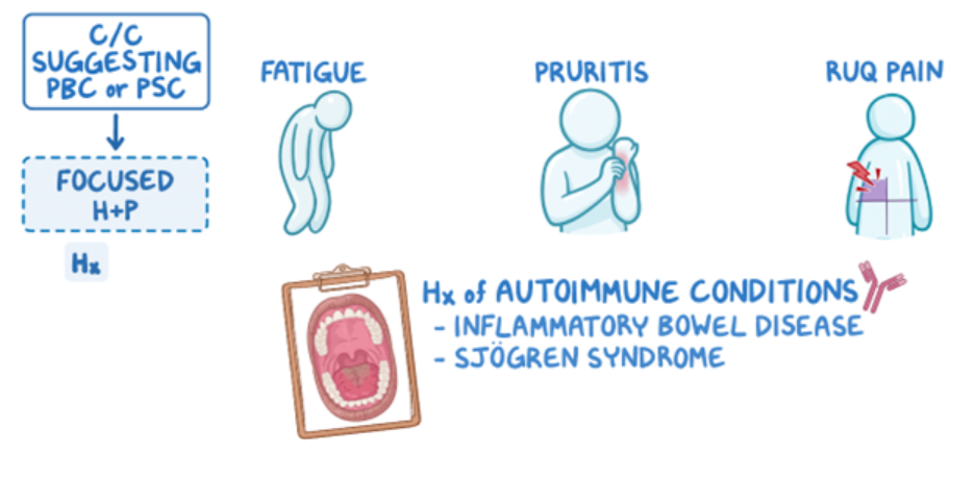
This patient who presents with an elevated alkaline phosphatase level and mild pruritus likely has cholestasis. Given normal ultrasound, the biliary obstruction is likely to be intrahepatic, making primary biliary cholangitis (PBC) likely. Patients with PBC can be asymptomatic, or they may present with fatigue, pruritus, and right upper quadrant pain.
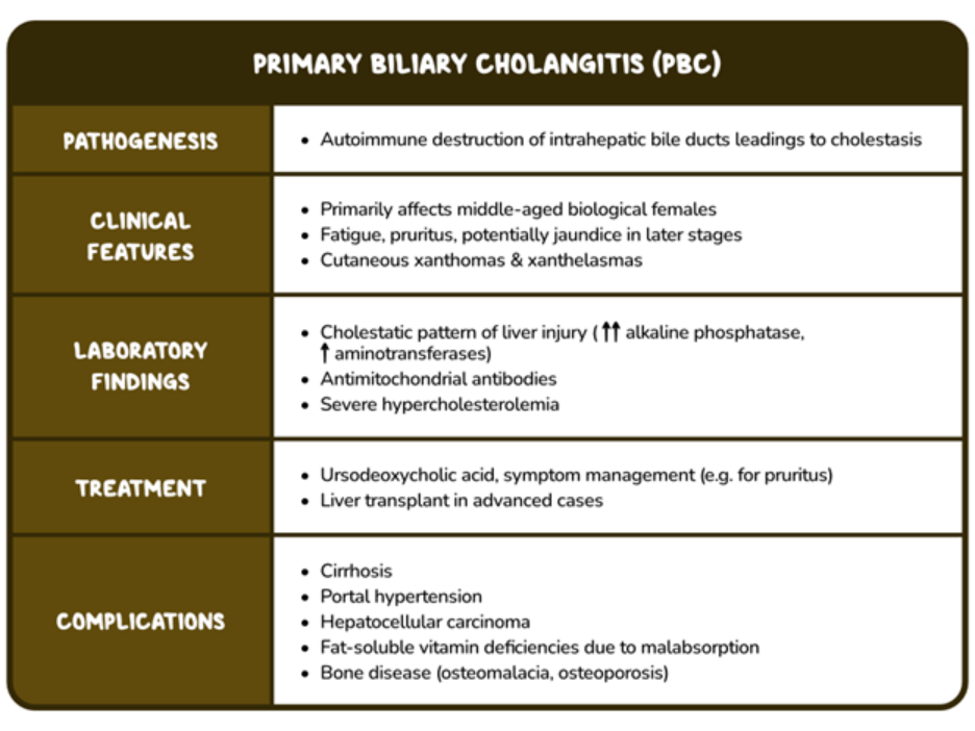
PBC is an autoimmune disorder that affects the small and medium intrahepatic bile ducts. Autoimmune destruction of intrahepatic bile ducts leads to cholestasis. PBC is more prevalent in women, with a female-to-male ratio of 9:1. While it is often asymptomatic, patients can present with fatigue and pruritus. Fatigue is one of the most common early symptoms of the disease. As the disease progresses, patients may experience pruritus, which is due to the accumulation of bile salts in the skin. Studies have recently shown that the fatigue seems to stem from muscle mitochondrial dysfunction, due to the autoimmune destruction of mitochondria that characterizes the condition.
Physical examination findings in the early stages of PBC may be unremarkable, but as the disease progresses, signs of chronic liver disease, such as jaundice (yellowing of the skin and eyes) and hepatomegaly may be seen. In later stages, patients can have signs of liver cirrhosis like ascites and spider angiomata (small, spider-like blood vessels on the skin).
Typically, alkaline phosphatase levels are elevated in PBC. If they exceed 1.5 times the upper limit of normal, a positive antimitochondrial antibody (AMA) test result can establish the diagnosis without the need for a liver biopsy. The primary treatment for PBC is ursodeoxycholic acid, which is associated with histologic improvement, increased survival rates, and reduced reliance on liver transplantation.
Major Takeaway
Patients with primary biliary cholangitis (PBC) are often asymptomatic in early disease, or they may present with pruritus and fatigue. In later stages, they may present with jaundice and hepatomegaly and eventually with signs and symptoms of cirrhosis.
Want to learn more about this topic?
Watch the Osmosis video: Primary biliary cholangitis and primary sclerosing cholangitis: Clinical sciences
References
- Lleo, A., Wang, G. Q., Gershwin, M. E., & Hirschfield, G. M. (2020). Primary biliary cholangitis. The Lancet, 396(10266), 1915-1926.

Get your free trial of Osmosis from Elsevier today to discover why millions of clinicians and caregivers love learning by Osmosis.
Leave a Reply