
Today, we’re examining a clinical case of a 53-year-old man seeing his PCP for his annual visit. Based on his history, which vaccinations would you recommend?
A 53-year-old man presents to his primary care physician for his annual visit. Since his last visit one year ago, he has had no new concerns. He reports adequate sleep, nutrition, and exercise. He drinks alcohol socially but does not smoke or use other recreational substances. His last Tdap booster was six years ago. Past medical history is significant for hypertension for which he takes amlodipine. Vital signs are within normal limits. The patient is well-appearing and in no acute distress. Cardiopulmonary, abdominal, and musculoskeletal examinations are within normal limits.
Which of the following vaccinations is indicated now?
A. Recombinant (Zoster) vaccine (RZV)
B. Tdap booster
C. RSV vaccine
D. HPV vaccine
E. Hepatitis A vaccine
Scroll down for the correct answer!
The correct answer to today’s USMLE® Step 2 Question is…
A. Recombinant (Zoster) vaccine (RZV)
Correct: See Main Explanation.
Incorrect Answer Explanations
B. Tdap booster
Incorrect: This patient has received a Tdap booster within the last ten years. It is unnecessary to have another vaccination for 4 more years unless he sustains a severe wound that is at high-risk for infection.
C. RSV vaccine
Incorrect: There is no specific recommendation regarding immunization against RSV infection for patients aged 50-60. For patients older than 60 years, immunization is recommended for immunocompromised patients and those with certain chronic diseases.
D. HPV vaccine
Incorrect: The HPV vaccine is not recommended for adults greater than age 45.
E. Hepatitis A vaccine
Incorrect: The hepatitis A vaccine is not routinely indicated for patients 50 years and older unless they are unvaccinated and at increased risk for infection or at increased risk for severe disease from infection.
Main Explanation
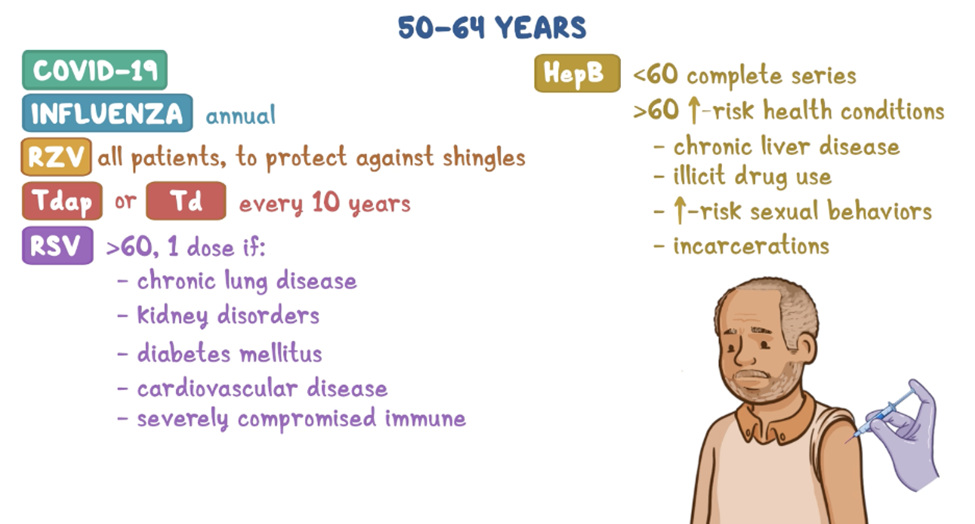
This patient, who is 53 years old with a past medical history significant for hypertension and without health concerns or other chronic conditions, presents for routine evaluation with his primary care physician. A core component of annual primary care evaluation is ensuring that patients are up-to-date on vaccinations. Based on this patients age, he is a candidate for the recombinant zoster vaccine (RZV) which is administered to help prevent shingles. Two doses of recombinant zoster vaccine (RZV) to prevent shingles and related complications is recommended for adults aged ≥50 years.
Immunizations, also known as vaccines, stimulate the immune system to produce antibodies against specific microorganisms. These antibodies disable pathogens and remain in the body to provide long-term immunity, decrease the likelihood of infection, and decrease its severity. The vaccination schedule for adults is determined by age and underlying immune status and can be divided into recommendations for four diverse groups based on age, 19-26yo, 27-49yo, 50-64yo, and patients aged 65 and older. Administration of vaccines should occur based on the recommendations for each age group and the compounding risk factors such as pregnancy or immunosuppression.
Major Takeaway
Routine adult vaccination is based on age and associated risk factors. The recombinant zoster vaccine (RZV) is recommended for adults aged ≥50 years.
Want to learn more about this topic?
Watch the Osmosis video: Herpes zoster infection (shingles): Clinical sciences
References
- (2024). Recommended adult immunization schedule. ACIP.
https://www.cdc.gov/vaccines/schedules/downloads/adult/adult-combined-schedule.pdf - (2022). Adult Immunizations. AAFP.
Centers for Disease Control and Prevention. Adult Immunization Schedule by Age. CDC. Published November 16, 2023. https://www.cdc.gov/vaccines/schedules/hcp/imz/adult.html - Centers for Disease Control and Prevention. Adult Immunization Schedule by Medical Condition and Other Indication. CDC. Published November 16, 2023. https://www.cdc.gov/vaccines/schedules/hcp/imz/adult-conditions.html.
- Center for Disease Control and Prevention. Vaccine-Preventable Adult Diseases. CDC. Reviewed March 30, 2022. https://www.cdc.gov/vaccines/adults/vpd.html.

Get your free trial and discover why millions of current and future clinicians and caregivers love learning with us.
Leave a Reply