
Today’s NCLEX® LPN question of the day focuses on the nature of atelectasis. Do you know the answer? Let’s find out!
The nursing student is assigned a patient diagnosed with atelectasis and asks the nurse, “What is atelectasis?” Which information should the nurse include in their response?
A. Atelectasis is when the alveoli in a lung subsegment or the entire lung collapses.
B. Atelectasis is a condition in which a collection of blood builds within the pleural space.
C. Atelectasis is a condition in which air leaks into the space between the pleural space and the chest wall.
D. Atelectasis is a condition in which air becomes trapped in the pleural space causing a mediastinal shift.
Scroll down for the correct answer!
The correct answer to today’s NCLEX-PN® Question is…
A. Atelectasis is when the alveoli in a lung subsegment or the entire lung collapses.
Rationale: Atelectasis is when the alveoli within part of a lung, or less commonly, an entire lung collapses, impairing gas exchange.
Main Takeaway
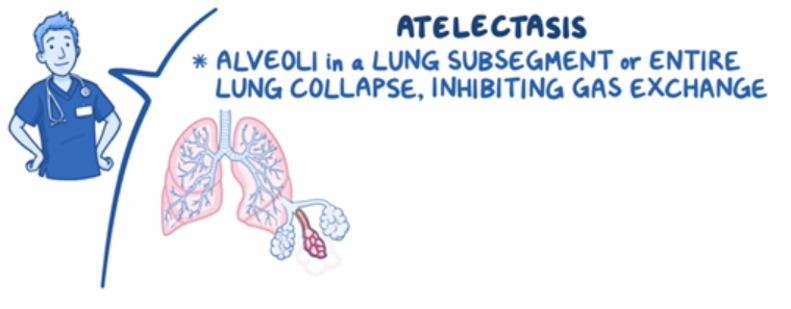
Atelectasis is a condition where the alveoli in a lung subsegment or the entire lung collapse, inhibiting gas exchange.
Incorrect Answer Explanations
B. Atelectasis is a condition in which a collection of blood builds within the pleural space.
Rationale: This does not describe atelectasis. A hemothorax is the accumulation of blood within the pleural space, between the visceral and parietal pleura.
C. Atelectasis is a condition in which air leaks into the space between the pleural space and the chest wall.
Rationale: This does not describe atelectasis. A pneumothorax is the accumulation of air within the pleural space, between the visceral and parietal pleura.
D. Atelectasis is a condition in which air becomes trapped in the pleural space causing a mediastinal shift.
Rationale: This does not describe atelectasis. A tension pneumothorax occurs when air becomes trapped within the pleural space, causing increased intrathoracic pressure and a mediastinal shift.
Want to learn more about this topic?
Watch this Osmosis video: Atelectasis: Nursing

Get your free trial to find out why millions of current and future clinicians and caregivers love learning with us.
Leave a Reply