
A 26-year-old man is brought to the trauma bay after a high-speed car accident. Do you know the best, next step in managing his care? Let’s find out!
A 26-year-old man is brought to the trauma bay following a high-speed motor vehicle collision at 55 mph. Emergency medical services (EMS) report that the airbags deployed. There was no prolonged extrication. The patient appears confused, but it is unclear if he struck his head. A cervical collar was placed in the field. Upon arrival at the hospital, the patient is confused but can speak a few words. Temperature is 36 °C (98.6 °F), heart rate is 124/min, blood pressure is 88/50 mmHg, respiratory rate is 24/min, and oxygen saturation is 85% on nasal cannula. The primary survey demonstrates tracheal deviation to the right, absent breath sounds over the left chest, and ecchymoses overlying the left anterior chest wall without signs of a flail chest.
Which of the following is the most appropriate next step in management?
A. Calculate Glasgow Coma Scale (GCS)
B. Perform a FAST exam
C. Left-sided needle thoracostomy
D. Expose the patient fully
E. Draw blood work and order a chest x-ray
Scroll down for the correct answer!
The correct answer to today’s USMLE® Step 2 CK Question is…
C. Left-sided needle thoracostomy
Correct: See Main Explanation.
Incorrect Answer Explanations
A. Calculate Glasgow Coma Scale (GCS)
Incorrect: Calculating a GCS is part of the “Disability” component of the primary survey. This patient is unstable with a likely tension pneumothorax; therefore, the team should address the life-threatening abnormality identified during “Breathing” immediately before continuing the assessment.
B. Perform a FAST exam
Incorrect: A focused assessment with sonography for trauma (FAST) examines for free fluid in the pericardial and intra-abdominal spaces, including the pelvis. A FAST examination may be performed as an adjunctive test during trauma evaluation. However, this unstable patient has clinical findings of a tension pneumothorax and requires immediate intervention during the “Breathing” step of the primary survey before additional diagnostic testing.
D. Expose the patient fully
Incorrect: “Exposure” is the final step of the primary survey. It is crucial to fully expose the patient when evaluating for additional blunt or penetrating trauma, as well as burns. However, this patient’s life-threatening tension pneumothorax should be addressed during “Breathing” before proceeding to the next steps of the primary survey.
E. Draw blood work and order a chest x-ray
Incorrect: Blood work and chest x-ray are important adjunctive studies in the evaluation of patients who have sustained high-energy blunt trauma. However, this patient has clinical findings of a tension pneumothorax and requires immediate intervention before proceeding with diagnostic studies.
Main Explanation
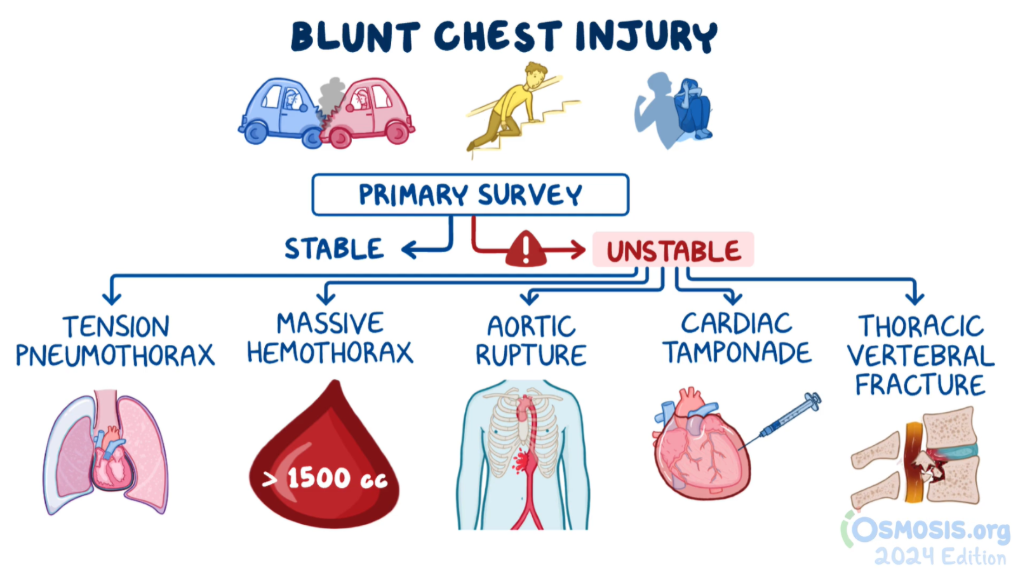
This patient presents to the emergency department following a motor vehicle collision with signs of left chest wall trauma. He is unstable with hypoxia and hypotension, as well as ecchymoses overlying the left chest wall, tracheal deviation to the right, and absent breath sounds on the left side. These findings are consistent with a left tension pneumothorax causing obstructive shock. Tension pneumothorax requires immediate decompression and should not be delayed for diagnostic imaging. Therefore, the next step is left-sided needle thoracostomy, followed by chest tube placement.
The first step in any trauma evaluation is to perform a primary survey using an ABCDE assessment. First, assess the Airway while stabilizing the cervical spine. If a patient can speak, the airway is currently patent. Once airway patency has been assessed, ensure adequate Breathing or ventilation by assessing oxygenation, ventilation, and chest wall injuries and by providing supplemental oxygen or other necessary measures. Next, assess Circulation and obtain 2 large-bore IVs or IO access while continuously monitoring vital signs, such as heart rate and blood pressure. Then, assess Disability and neurologic status by calculating the Glasgow Coma Scale (GCS) and examining the pupils and motor and sensory function. Spinal precautions should be maintained until spinal injury has been ruled out. Finally, Expose the patient by removing clothing to assess for associated injuries.
During the primary survey, patients who cannot protect or maintain their airway may require endotracheal intubation. However, life-threatening breathing abnormalities identified during the primary survey should be treated immediately. For example, if this patient with a tension pneumothorax requires intubation, the pneumothorax should be decompressed first because positive-pressure ventilation can worsen the tension pneumothorax and hemodynamic instability.
Major Takeaway
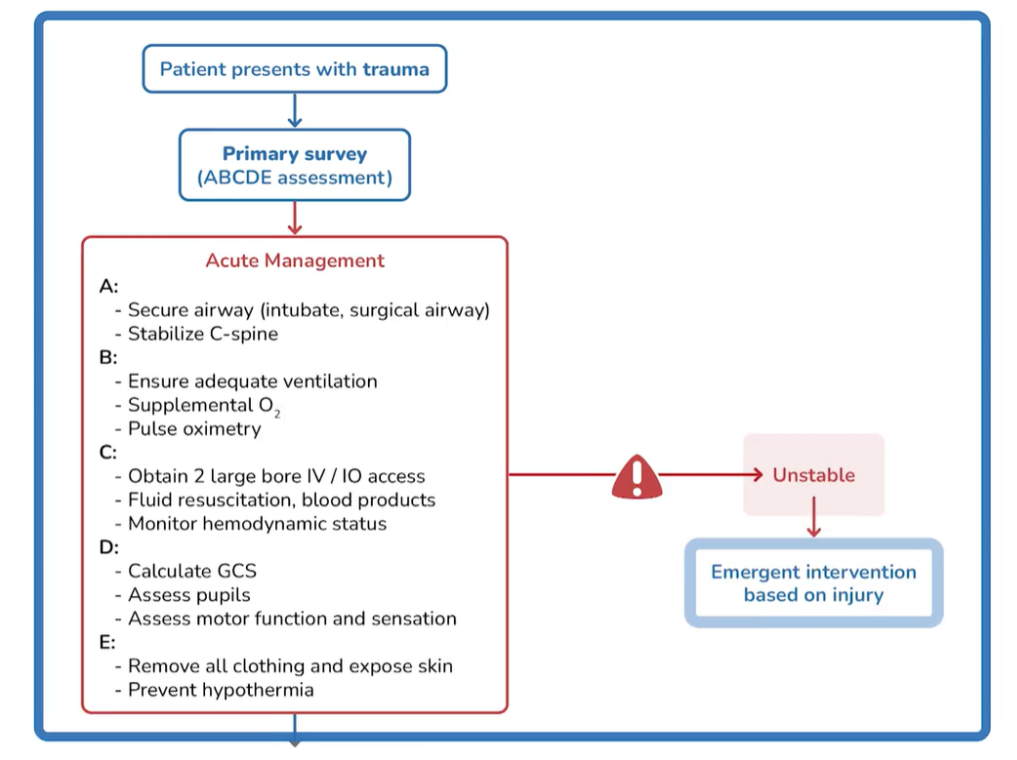
The first step in evaluating a patient with blunt chest trauma is to perform a primary survey using the ABCDE approach: Airway, Breathing, Circulation, Disability, and Exposure. Although these steps are generally performed sequentially, any life-threatening injury identified during the primary survey should be treated immediately.
Want to learn more about this topic?
Watch the Osmosis video: Approach to blunt chest injury: Clinical sciences
References
- American College of Surgeons. Advanced Trauma Life Support (ATLS): Student Course Manual. 10th ed. American College of Surgeons; 2018:63-79.

Get your Osmosis from Elsevier free trial now to discover why millions of clinicians and caregivers love learning by Osmosis!
Leave a Reply