
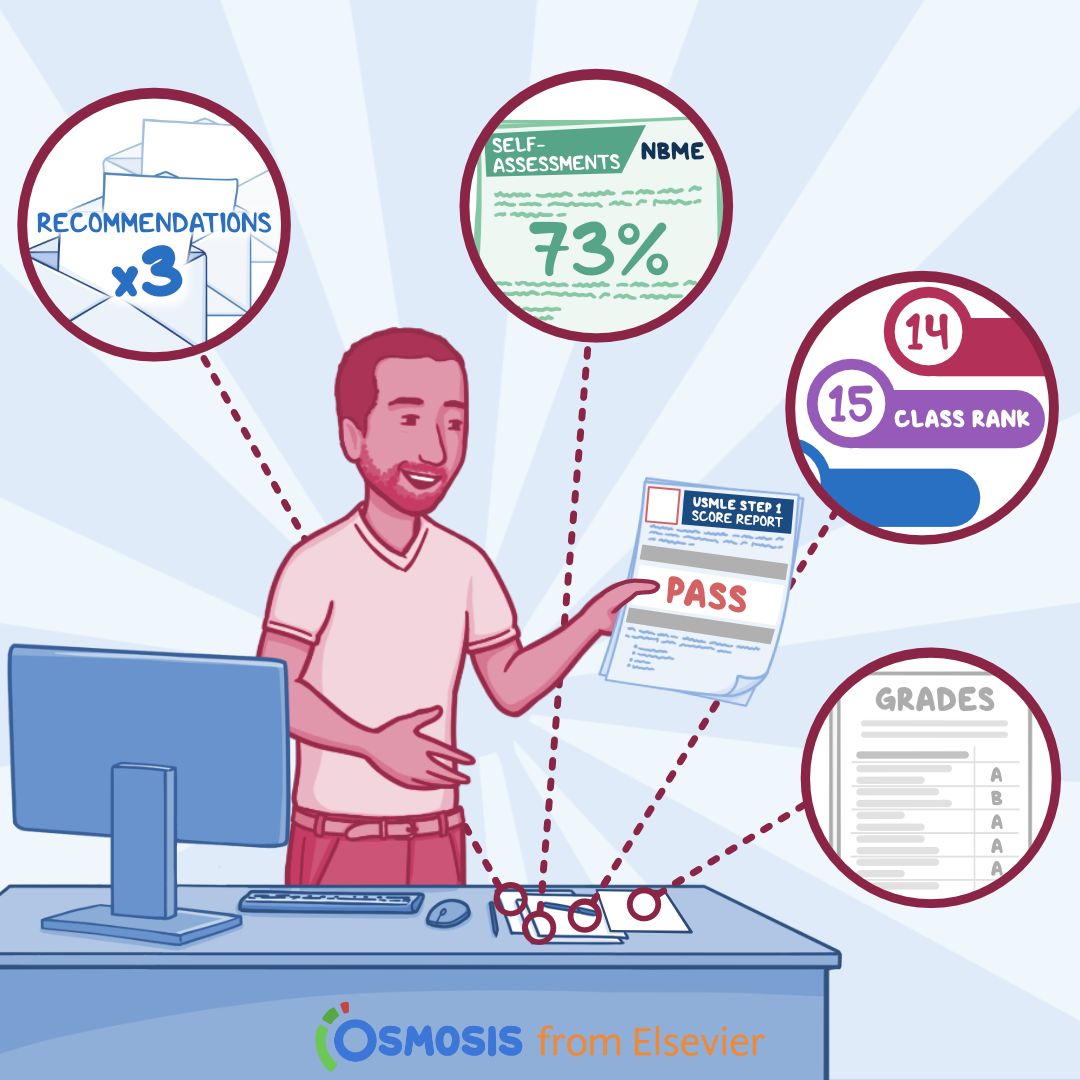
For decades, the USMLE Step 1 exam loomed large in every medical student’s life. Scored numerically, it was often the single most important factor that residency programs used to compare applicants. But since January 2022, Step 1 has shifted to pass/fail reporting. This change has left students wondering: if it’s pass/fail now, what counts as a “good” Step 1 score?
Let’s break it down!
Why Step 1 Went Pass/Fail
The USMLE shifted Step 1 to pass/fail to help reduce stress, improve student wellness, and encourage more holistic residency selection.
Instead of judging applicants by one number, residency committees assess them on a broader set of qualities, including clinical performance, research, leadership, and communication skills.
Still, passing Step 1 remains essential. You can’t move on to clerkships or sit for Step 2 CK without it.
The Ultimate Guide to USMLE Step 1 (Osmosis) ->
What Does a “Good” Step 1 Score Mean Now?
Since no three-digit number will appear on your transcript, a “good” Step 1 score in the pass/fail era is one that achieves two things:
1. A Confident Pass:
- Not just scraping by at the passing threshold but demonstrating clear mastery of the content.
- Practically, this means consistently scoring well above the ~60–65% “safe zone” on NBME practice exams.
2. A Strong Foundation for What Comes Next:
- Step 1 is still the bedrock for clerkships and Step 2 CK.
Students who master Step 1 material tend to perform better on the wards and on Step 2 CK, which is now the differentiating exam for residency.
In short, performing well on Step 1 means you successfully pass the exam and show confidence that you’ve prepared for clinical training and Step 2 CK.
A Breakdown of USMLE Step 1 ->
How to Tell If Your Step 1 Performance Is “Good”
Even without a reported number, there are reliable ways to judge whether your preparation is paying off:
- NBME Self-Assessments: These give predictive percent-correct scores and show how far above (or near) the passing cut-off you are.
- UWorld Performance: Consistently hitting 70%+ correct in practice blocks is a strong sign of mastery.
- School Benchmarks (e.g., CBSE): Many schools require this pre-Step 1 exam, which closely mirrors real test readiness.
If you’re comfortably above passing on these measures, your Step 1 result is likely “good”, not just because you’ll pass, but because you’re ready for clerkships and Step 2 CK success.
USMLE Step 1 Pass/Fail Transition (USMLE.org) ->
How Osmosis Can Help You Assess
Osmosis offers structured ways to make sure your “pass” is more than a bare minimum:
1. Quiz Builder & Question Bank
- Target weak areas with custom quizzes by subject or system.
- Track percent-correct improvement over time to see if you’re trending into the safe zone.
2. High-Yield Video Lessons
- Concise, visual explanations that help you master challenging concepts.
- It is especially useful when practice questions reveal recurring knowledge gaps.
3. Personalized Study Schedules
- Osmosis helps organize your study days so you steadily reinforce knowledge instead of cramming.
4. Progress Tracking Dashboards
- Visualize how many topics you’ve covered and mastered — an improved quiz performance = a strong predictor of a solid Step 1 pass.
How to Use Osmosis Quizzes to Study for Step 1 ->
Why “Good” Step 1 Performance Still Matters
Even if programs don’t see your Step 1 score, your preparation still has ripple effects:
- Step 2 CK Readiness: Step 2 CK is now the primary exam that residency programs use to compare applicants. Strong Step 1 prep makes Step 2 CK less daunting.
- Clerkship Success: Knowing your basic sciences means you’ll shine during patient care — something residency directors notice in evaluations.
- Confidence & Efficiency: Passing with a good margin reduces stress, letting you focus on clinical skills, research, and other parts of your residency application.
Today, there’s no such thing as a “250” or “260” being a “good” Step 1 score. Instead, a good Step 1 result means:
- You pass with confidence, showing you didn’t just squeak by.
- You build a solid scientific foundation that fuels strong clerkship performance and a competitive Step 2 CK score.
In other words, a good Step 1 score not only allows you to move forward, but to excel in the rest of medical school and beyond.
USMLE Examination Results and Scoring ->
Key Takeaways
- Step 1 is now pass/fail to reduce stress and encourage holistic residency review.
- A good Step 1 means confidently passing, not just barely meeting the threshold.
- Strong Step 1 prep builds a foundation for clinical rotations and Step 2 CK success.
- Use NBME self-assessments and practice question banks to track readiness.
- Osmosis tools help learners target their weak areas and organize efficient study schedules.
Additional Reading
- All Your USMLE Step 1 Questions Answered: The Osmosis Ultimate Guide
- How to Use Osmosis Quizzes to Prep for USMLE® Step 1
- How to Use Osmosis Quizzes to Prep for USMLE® Step 2
- How to Use Osmosis to Help You Thrive During Clinical Rotations
- How the Switch to Pass/Fail is Going (AMA)

Access your free trial to find out why millions of current and future clinicians and caregivers love learning with us.
Leave a Reply