
Prepare for the PANCE® with this challenging clinical scenario involving a 45-year-old man with productive cough and hemoptysis, along with night sweats, fatigue, and weight loss. What’s the most likely diagnosis?
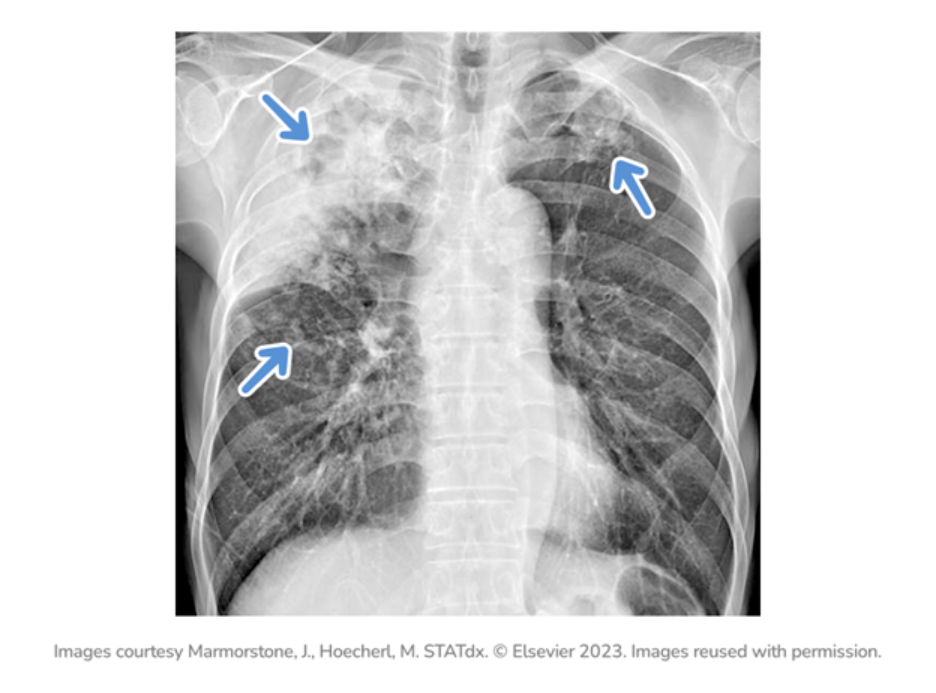
A 45-year-old man presents to the emergency department with a 4-week history of a productive cough and hemoptysis. The patient also reports night sweats, fatigue, and unintentional weight loss of 4.5 kg (10 lbs). The patient reports that his wife who was in India last year taking care of her elderly parents, has been experiencing similar symptoms. Past medical history is significant for hypertension and a 20-pack-year smoking history. Temperature is 38.1°C (100.6°F), pulse is 85/min, blood pressure is 134/82 mmHg, respiratory rate is 20/min, and oxygen saturation is 94% on room air. Chest auscultation reveals rhonchi in the right upper lung field. Chest radiography (below) shows cavitary apical lung lesion with surrounding infiltrates.
Which of the following is the most likely underlying cause of this patient’s presentation?
A. Lung abscess
B. Community-acquired pneumonia
C. Pulmonary tuberculosis
D. Squamous cell carcinoma of the lung
E. Hodgkin lymphoma
Scroll down to find the answer!
The correct answer to today’s PANCE® Question is…
C. Pulmonary tuberculosis
Correct: See Main Explanation.
Incorrect Answer Explanations
A. Lung abscess
Incorrect: Lung abscesses present in individuals with a history of alcohol abuse or aspiration risk. Symptoms often include productive cough, fever, and weight loss. Abscesses present as cavitary lesions with air-fluid levels which are not seen in this patient’s chest radiograph.
B. Community-acquired pneumonia
Incorrect: Community-acquired pneumonia presents acutely with high fever, productive cough, and purulent sputum. In this patient, the insidious onset symptoms, presence of similar symptoms in a household member with a history of travel to India, and the chest x-ray findings are more consistent with the diagnosis of pulmonary tuberculosis.
D. Squamous cell carcinoma of the lung
Incorrect: Squamous cell carcinoma of the lung can present with hemoptysis, cough, and weight loss in a patient with a history of smoking and often presents as a solitary lung nodule or mass, not as a cavitary apical lesion with surrounding infiltrates.
E. Hodgkin lymphoma
Incorrect: Hodgkin lymphoma can cause systemic symptoms like fatigue, night sweats, and weight loss. The pulmonary findings seen in this patient are more typical of TB because household contact has similar symptoms.
Main Explanation
The patient presents with a productive cough, hemoptysis, systemic symptoms, and radiographic findings of a cavitary apical lung lesion with surrounding infiltrate. These findings are suggestive of pulmonary tuberculosis.
Tuberculosis is caused by Mycobacterium tuberculosis, a slow-growing aerobic bacterium that primarily affects the lungs, but can also impact other parts of the body. Risk factors include living in environments such as nursing homes, homeless shelters, or correctional facilities, having a family member or close contact with tuberculosis, or spending time in a country with a high prevalence of TB. Risk factors for developing active tuberculosis include immunocompromised states, malignancy, or immunosuppressive therapy.
Patients typically present with respiratory symptoms such as chronic cough and hemoptysis, as well as systemic symptoms including unintentional weight loss, anorexia, fever, and night sweats. Physical examination may reveal pulmonary findings such as dullness to percussion, low-pitched, hollow breath sounds, rales, and rhonchi consistent with consolidations. Chest imaging may show a solitary cavitary lesion known as a Ghon focus, which is a classic sign of pulmonary tuberculosis and often involves the upper lobe due to the higher oxygen tension in these areas. Other findings include patchy consolidation, nodularity, and ipsilateral lymphadenopathy.
Major Takeaway
The classic presentation of pulmonary tuberculosis includes a chronic cough, and systemic symptoms (e.g. fatigue, night sweats, unintentional weight loss), which may be accompanied by hemoptysis. Close contact with individuals infected with tuberculosis is a key risk factor.
Want to learn more about this topic?
Watch this Osmosis video: Tuberculosis: Pathology review
References
- Lewinsohn DM, Leonard MK, LoBue PA, et al. Official American Thoracic Society/Infectious Diseases Society of America/Centers for Disease Control and Prevention Clinical Practice Guidelines: Diagnosis of Tuberculosis in Adults and Children. Clin Infect Dis. 2017;64(2):111-115. doi:10.1093/cid/ciw778

Want more PANCE®-style practice questions? Try Osmosis by Elsevier today! Access your free trial and discover why millions of current and future clinicians and caregivers love learning by Osmosis.
Leave a Reply