Amyotrophic lateral sclerosis (ALS): Nursing
Introduction0:00–0:21
Amyotrophic lateral sclerosis or ALS, also called Lou Gehrig’s disease, is a progressive neuromuscular disease characterized by damage and degeneration of the upper motor neurons in the brain, as well as the lower motor neurons in the spinal cord.Now, let’s quickly go over the physiology of the neuromuscular system, which includes muscles and the motor neurons serving them to ultimately trigger voluntary muscle contraction.
Physiology0:21–1:05
When we want to perform a movement, the motor cortex of the brain sends electrical impulses through an upper motor neuron.
In turn, this neuron travels down the lateral corticospinal tract cord, until it reaches a second neuron, called the lower motor neuron, which relays the electrical impulses.
Then, the lower motor neurons give rise to the peripheral nerves that carry the electrical impulses directly to the desired muscle fibers, which ultimately contract.Now, the exact cause of ALS is unknown, with some evidence suggesting the cause to be excessive levels of the neurotransmitter glutamate, which can cause neurons to become overexcited, leading to damage and even death.
Causes & risk factors1:05–2:05
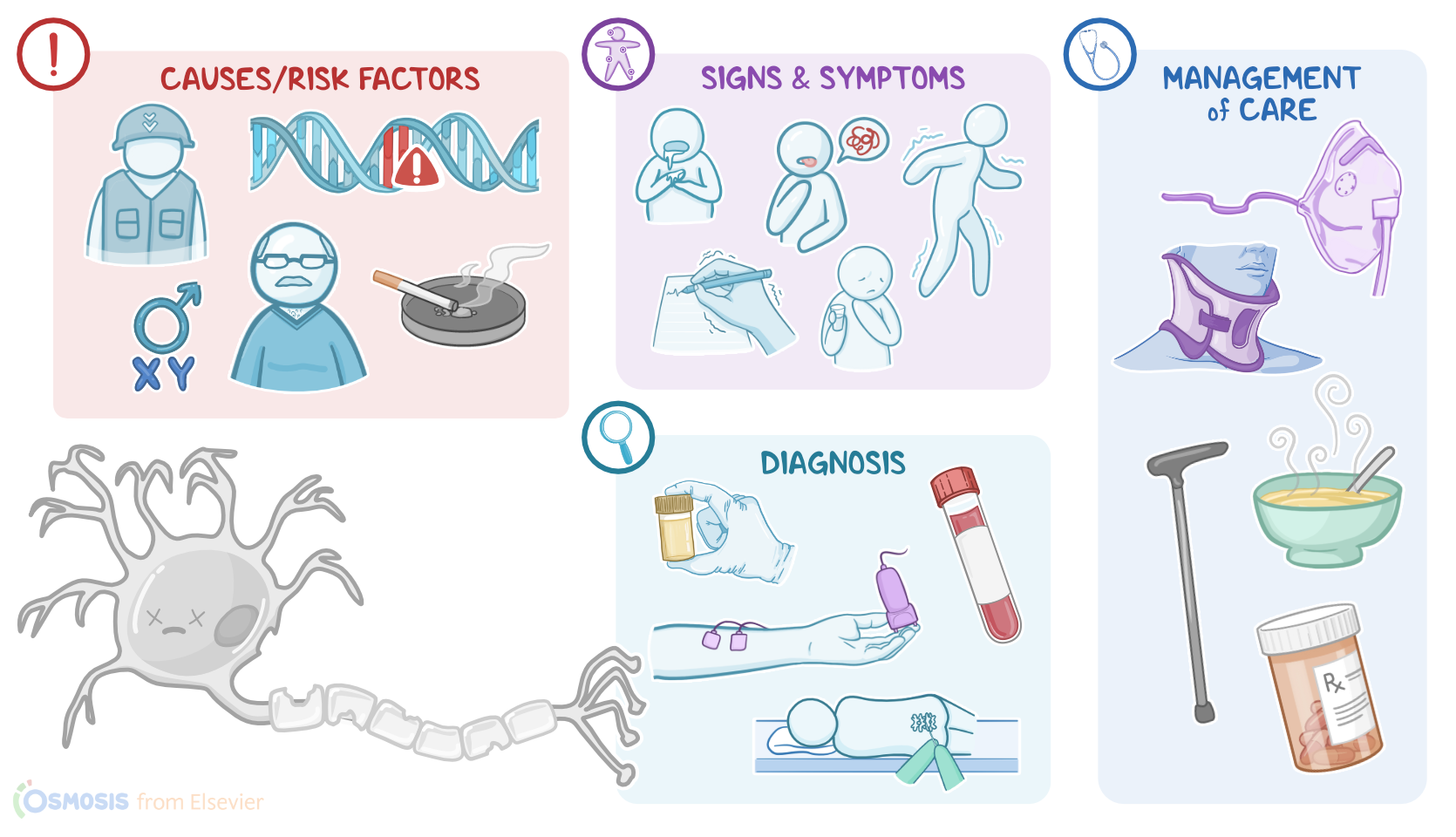
In addition, between five to ten percent of ALS cases have a mutation in the C9ORF72 gene, suggesting that the disease can be inherited.Risk factors of ALS can be grouped into modifiable and nonmodifiable risk factors.
Modifiable risk factors include smoking and participating in military wars, especially in Gulf wars, where individuals are often exposed to traumatic injuries and the inhalation of chemicals and metals.On the other hand, non-modifiable risk factors include white race, being assigned male at birth, in addition to age between 40 and 60 years, and family history.The pathology of ALS starts with the degeneration of upper and lower motor neurons in the brain and the spinal cord respectively.
Pathology2:05–2:50
This weakens the ability of neurons to transmit electrical impulses, and leads to progressive degeneration of muscles, a process called amyotrophy.
As a result, the messages that originate from the motor cortex of the brain won’t reach the muscles to trigger voluntary contraction.
As the motor neurons die, sclerosis occurs at the lateral columns of the spinal cord, causing them to become hardened. Now, due to its progressive nature, ALS tends to worsen overtime, until eventually reaching total muscle paralysis.The clinical manifestations of ALS start in the limbs, and typically include progressive muscle weakness and atrophy, in addition to difficulties with fine motor movements and being easily fatigued.Clients with ALS can also present with other motor manifestations, such as involuntary contractions, as well as spasticity or increased muscle tone and stiffness, and hyperreflexia or overactive reflexes.
Clinical manifestations2:50–4:09
As the disease progresses, additional manifestations include slurred speech, difficulty swallowing, and drooling, as well as gastroesophageal reflux.Late stages of the disease can even involve respiratory muscles, including rib cage muscles and the diaphragm.
As a result, clients can develop complications like pneumonia and respiratory failure.Additionally, due to the debilitating nature of the disease, clients can often experience emotional lability, depression, and sleep disorders.
Bowel and bladder function is not typically affected by ALS. Mental capacity often remains intact, as well, though frontotemporal dementia can be present.
Unfortunately, most cases of ALS lead to death within two to five years from the diagnosis.The diagnosis of ALS starts with the client's history and physical assessment, followed by tests to rule out other causes.
These tests include blood and urine tests, in addition to spinal tap to rule out inflammatory nerve conditions; as well as imaging like MRI to rule out conditions like brain tumors or multiple sclerosis.Additional diagnostic tests include nerve conduction studies or NCS, which helps detect how well the nerves can transmit impulses to the muscles; as well as electromyography or EMG, which helps detect the abnormal electrical activity of the muscles.
Diagnosis4:09–4:54
Lastly, diagnosis of ALS can be confirmed with a muscle biopsy that shows denervation and atrophy.Unfortunately, there’s no cure for ALS, so treatment is typically geared at relieving symptoms, psychological support, and delaying the progression of the disease.
This can be achieved by administering certain medications, such as riluzole, which reduces damage to motor neurons by decreasing glutamate levels in the brain; as well as edaravone, which is an antioxidant that destroys free radicals that may cause damage to the neurons.Alright, now let’s take a look at the nursing care you’ll provide to your client with ALS.
Treatment4:54–7:51
Your priority nursing goals are to provide supportive care and emotional support.Begin by instituting fall precautions and assessing your client’s ability to perform their activities of daily living, or ADLs for short.Then, collaborate with the physical and occupational therapist to implement range of motion and strengthening exercises, as well as make recommendations on the use of assistive devices such as foot drop splints to support ambulation, finger splints to increase gripping ability, and a cervical collar to support their head and neck.Next, assess their respiratory status including their breathing patterns and breath sounds.
Elevate the head of the bed and use a suction aspirator to assist with secretion management.. Keep in mind that as the ALS progresses, you may need to provide positive-pressure ventilation.Then, assess your client’s pain level, including the presence of muscle spasms.
Assist them into a comfortable position, provide comfort measures, and administer prescribed baclofen and diazepam to help with any discomfort.Also, perform a nutritional assessment, noting their current weight, swallowing pattern, as well as their gag and cough reflexes.
Ensure a referral to a speech pathologist and a registered dietician have been placed, and provide the prescribed oral nutrition, such as thickened foods and liquids to facilitate swallowing.Finally, remember to address your client’s psychosocial needs.
Keep in mind that ALS can change your client’s self-perception, resulting in anxiety and depression. Develop a communication plan that will allow your client to continue to express their thoughts and feelings, and facilitate communication with devices like an erasable whiteboard, picture board, tablets, or other electronic devices, as well as a pen and paper.
Support them in making decisions about which treatments they want to support nutrition and breathing. Additionally, collaborate with the case manager to coordinate counseling, ongoing care, and services, as well as resources like support groups and information about palliative and hospice care, as needed.Alright, let’s move on to client and family teaching.
Begin by explaining that ALS causes a gradual wasting away of nerve cells that help them move their muscles, making it difficult for them to walk, talk, swallow, and breathe.
Review the plan of care, and allow plenty of time for them to ask questions.Teach them about their prescribed medications, and instruct them to take them exactly as directed.
Also stress the importance of keeping regular follow-up appointments with their healthcare providers for continued monitoring and care.Next, talk to them about lifestyle modifications they can incorporate into their daily routine.
Encourage them to continue to work with their physical and occupational therapists, and advise them to use mobility aids and other adaptive equipment, as needed, to help them to remain as independent as possible.
General client & family teaching7:51–9:39
Also advise them to pace themselves when doing their ADLs, and to take rest breaks as needed to decrease fatigue.To help prevent falls, encourage your client to promote safety in the home, by keeping walkways unobstructed, avoiding using throw rugs, and maintaining adequate lighting.
Also recommend safety measures in the bathroom like installing handrails, using a shower seat, and using a higher toilet seat.Also emphasize the importance of staying well-hydrated and eating a balanced diet.
Encourage smaller, more frequent meals, to sit up while eating, and to eat slowly. Also provide them with a list of nutritious “easy-to-eat” foods that are easy to swallow.Finally, advise them to contact their healthcare provider if their symptoms seem to be progressing; and to seek emergency medical care if they have problems swallowing or breathing.Alright, as a quick recap….
Amyotrophic lateral sclerosis or ALS, also called Lou Gehrig’s disease, is a progressive neuromuscular disease characterized by degeneration of the upper motor neurons in the brain and the lower motor neurons in the spinal cord.The exact cause of ALS is unknown, but it could be related to excess levels of the neurotransmitter glutamate.
Risk factors include a family history of ALS, smoking, participating in military wars, white race, being assigned male at birth, and 40 to 60 years of age.
The pathology of ALS involves degeneration of upper and lower motor neurons which impairs the ability of the electrical impulses to reach the muscles, preventing contraction and eventually leading to muscle degeneration.
ALS is progressive, and tends to worsen over time, until eventually it causes total muscle paralysis, and eventually death.Diagnosis starts with the client's history and physical assessment, followed by tests to rule out other causes.
Review9:39–11:08
ALS can be confirmed with a muscle biopsy that shows denervation and atrophy. Since there’s no cure for ALS, treatment is typically geared at relieving symptoms, providing psychological support, and delaying the progression of the disease.
Priority goals of nursing care include providing supportive care and emotional support. Client and family education includes self-care at home and when to seek medical attention.
the neuro transmitter glutamate Risk factors include a family history of A L S smoking participating in military wars White race being assigned male at birth and 40 to 60 years of age The pathology of A L S involves a generation of upper and lower motor neurons which impairs the ability of the electrical impulses to reach the muscles preventing contraction and eventually leading to muscle degeneration A L S is progressive and tends to worsen over time until eventually it causes total muscle paralysis and eventually death diagnosis starts with the clients history and physical assessment followed by tests to rule out other causes A L S can be confirmed with a muscle biopsy that shows Denna vacation and atrophy since there's no cure for A L S treatment is typically geared at relieving symptoms providing psychological support and delaying the progression of the disease Priority goals of nursing care include providing supportive care and emotional support Client and family education includes self care at home
| AMYOTROPHIC LATERAL SCLEROSIS (ALS) | ||
| KEY POINTS | NOTES | |
| DEFINITION |
| |
| PHYSIOLOGY |
| |
| CAUSES AND RISK FACTORS |
| |
| PATHOPHYSIOLOGY |
| |
| SIGNS AND SYMPTOMS |
| |
| DIAGNOSIS |
| |
| TREATMENT |
| |
| MANAGEMENT OF CARE |
| |
| PATIENT AND FAMILY TEACHING |
| |
- "Medical-surgical nursing: Concepts for interprofessional collaborative care" Elsevier (2021)
- "Lewis’s medical-surgical nursing: Assessment and management of clinical problems" Elsevier (2020)
- "Saunders comprehensive review for the NCLEX-RN examination" Elsevier (2018)
- "Disease-modifying therapies in amyotrophic lateral sclerosis" Neuropharmacology (2020)
- "¿Por qué degeneran las motoneuronas? Actualización en la patogenia de la esclerosis lateral amiotrófica" Neurología (2019)
- "The role of mitochondria in amyotrophic lateral sclerosis" Neuroscience Letters (2019)
No notes for this video yet
Try adding a note below