Anxiety disorders: Nursing process (ADPIE)
Client Report0:00–0:33
Georgia Ryan is a 22-year-old female client who presents to her college campus clinic with a report of an inability to sleep and difficulty concentrating for the past 9 months.
Georgia says that lately she's been self-isolating from fellow students and that she has stopped attending her classes the past few days.
After a review of Georgia's medical history and current symptoms, the Advanced Practice registered nurse, or APRN diagnoses Georgia with generalized anxiety disorder.
Pathology0:33–5:49
Anxiety is the anticipation of a future threat or stressful situation with an uncertain outcome and is often associated with feelings of fear, worry, and nervousness, which causes avoidant behaviors.
Anxiety disorders are a group of disorders in which these feelings are disproportionate to the stressful situation and can be accompanied by physical and psychological symptoms that are so severe as to interfere with day to day activities.
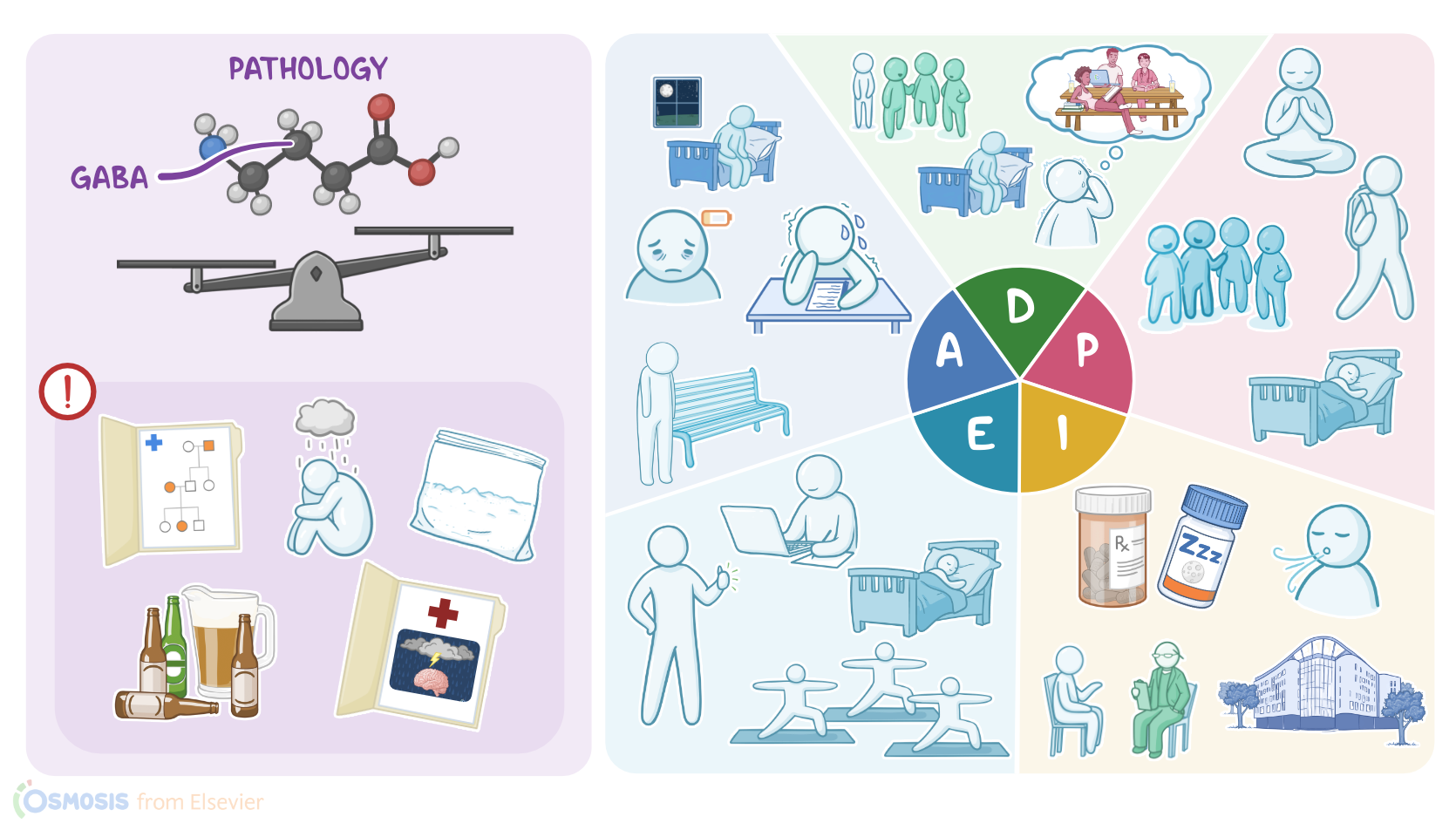
The most common anxiety disorders include generalized anxiety disorder, panic disorder, and phobia-related disorders. Now the underlying cause of anxiety disorders is poorly understood, but it seems to be related to an imbalance of the neurotransmitter GABA.
The main risk factors for anxiety disorders include having a family history of an anxiety disorder or experiencing a personal trauma.
Other risk factors include having other mental health disorders, having medical conditions like hyperthyroidism or pheochromocytoma, and using or experiencing withdrawal of substances like alcohol or cocaine.
Anxiety disorders typically present with symptoms like excessive fear, worry, and nervousness that interfere with day to day activities, but there are slight variations between the different anxiety disorders.
Clients with generalized anxiety disorder may experience restlessness, fatigue, difficulty concentrating, irritability, muscle tension, and trouble sleeping.
These symptoms persist for at least 6 months. On the other hand, panic disorder is characterized by recurrent episodes of sudden panic attacks with uncontrollable fear, which may cause symptoms like palpitations, chest or abdominal pain, sweating, trembling, shortness of breath, dizziness, chills or hot flashes, paresthesia or a pins and needles sensation, as well as derealization or feelings of unreality, depersonalization or detachment from self, and a feeling of impending doom.
With phobia-related disorders, there's an excessive fear or anxiety about a specific object or situation, like certain animals, insects or objects, as well as certain situations, environments, or enclosed places.
There's also social anxiety disorder, previously called social phobia, in which clients experience fear and anxiety caused by social situations where they feel judged or under scrutiny, such as meeting groups of new people or going on job interviews.
Social anxiety disorder can be accompanied by selective mutism, which is when they fail to speak at specific social situations, such as at school or in public, and is usually more common in children under the age of 5.
Finally, clients may experience agoraphobia, meaning that they have an intense fear of public spaces, and they often fear they may not be able to leave or escape a situation if they have a panic attack.
Over time, anxiety disorders can lead to a number of complications, which include social isolation, academic or professional impairment, and an overall poor quality of life.
In addition, clients may have difficulty sleeping, which can lead to fatigue. Finally, clients with anxiety disorders often develop other mental health disorders like depression, substance misuse, personality disorders, and even suicidal ideation.
Diagnosis of anxiety disorders relies on history and clinical presentation, as well as diagnostic tools like the mental status examination or MSE and the Diagnostic and Statistical Manual of Mental Disorders, the 5th edition, or DSM 5.
To confirm the diagnosis, other causes must be ruled out first, which means that symptoms can't be better explained by other psychiatric or medical conditions.
Treatment of an anxiety disorder typically involves psychotherapy, including cognitive behavioral therapy or CBT for short, which focuses on teaching the client strategies to better cope with stress and social pressures and to identify anxious patterns of thinking.
In addition, lifestyle changes like having a regular sleep schedule and a healthy diet, as well as meditation, deep breathing exercises, physical activity, and yoga have also shown benefits.
Some clients may also be treated with medications such as selective serotonin reuptake inhibitors or SSRIs like fluoxetine, sertraline, citalopram, escitalopram, and fluvoxamine, as well as selective norepinephrine reuptake inhibitors or SNRIs like venlafaxine, duloxetine, and desvenlafaxine.
The second blind choice is tricyclic antidepressants or TCAs for short, such as doxepin and amitriptyline. Medications are more effective when used along with CBT.
In an acute setting, such as during a panic attack, beta blockers can be used to lower the heart rate and BP. Benzodiazepines can also be used as a last resort in an acute setting, since they act very rapidly, but they have a high potential for dependence and abuse.
Assessment5:49–7:12
All right, let's begin George's assessment. As you enter the room, you observe that Georgia appears exhausted and restless.
When you ask her what brought her to the clinic today, she tells you that she has been unable to sleep ever since she started her college classes 9 months ago and is currently averaging 3 to 4 hours of sleep per night.
She also shares that she has been having difficulty concentrating in class and on homework and is worried because this has caused her grades to drop.
She adds that it's difficult for her to de-stress even on the weekends or holiday breaks. When you ask her how this has impacted her relationships with others, Georgia tells you that she has struggled to fit in with her other classmates and has been increasingly isolating herself throughout the semester.
Georgia begins crying as she expresses self-doubt regarding her ability to be successful in college. You validate George's feelings through therapeutic communication and assure her that the healthcare team will assist her.
George's vital signs are temporal temperature 98.6 °F or 37 °C, heart rate 94 BPM, respiration rate 18 breaths per minute, and BP 110/63 millimeters of mercury.
You document your findings and let her know the APRN will be in to see her shortly. All right.
Diagnosis7:12–7:32
After collaborating with the APRN and Georgia, you create the following plan of care to address her symptoms. In 6 weeks, Georgia will demonstrate the use of relaxation techniques to reduce her own anxiety.
Planning7:32–7:58
She will experience improved quality and quantity of sleep. She will discuss feelings that accompany impaired social interactions, and she will begin regularly attending her classes and start interacting with others.
OK, you now begin implementing Georgia's plan of care. The APRN has prescribed the SSRI fluoxetine to help treat her anxiety.
Implementation7:58–9:37
You teach Georgia the importance of taking the prescribed dose every morning and stress that it may take up to 4 weeks before she experiences the full effect of the medication.
You explain that melatonin is an over the counter supplement that helps regulate the timing of the body's internal circadian rhythms, and you recommend that she take it one hour before bedtime.
Next, you let Georgia know that the APRN has set up appointments for CBT where she will develop skills for stress management.
Then you review some relaxation exercises Georgia could easily do to promote a more relaxed state of mind, such as deep breathing, progressive muscle relaxation, and visualization techniques.
You strongly encourage her to join in-person campus initiatives that are dedicated to student mental wellness. To address her academic difficulties, you encourage Georgia to reach out to her professors about opportunities for additional classroom support and assist her in connecting with the campus tutoring center.
And finally, you make an appointment for her to return to the campus clinic in 6 weeks to check on her progress. It's been 6 weeks since Georgia was diagnosed with generalized anxiety disorder, so let's check back in with her to evaluate how she's doing so far.
Evaluation9:37–10:40
You observe that Georgia appears calm and well rested. She tells you that she has been consistently taking the fluoxetine and melatonin as prescribed, and that lately she's been able to sleep 6 to 7 hours per night.
She reports that the additional sleep has made it easier for her to concentrate in class. She says that when she starts feeling anxious, progressive muscle relaxation and thinking about sitting by a lake near her childhood home is often helpful.
When you ask Georgia about her current socialization patterns, she happily tells you that she has joined a yoga and meditation group, which has helped her feel more connected to campus life and her fellow students.
She goes on to share that the CBT is going well and that she's receiving the academic support she needs from her professors and the tutoring center.
You are happy to see that Georgia is meeting the goals of her plan of care and is experiencing improved mental wellness.
Georgia Ryan presented to the campus clinic with signs and symptoms of generalized anxiety disorder. Your assessment revealed stress, difficulty concentrating, and social isolation.
Summary10:40–11:17
Your priority nursing diagnoses were anxiety, insomnia, and impaired social interaction. Careful planning allowed you to create goals that focused on alleviating Georgia's symptoms, and implementation of the plan of care involved providing emotional support and mental health resources.
Finally, you evaluated that Georgia's plan of care was effective in promoting Georgia's well-being.
| ANXIETY DISORDERS | ||
| KEY POINTS | NOTES | |
| PATIENT REPORT |
| |
| PATHOPHYSIOLOGY |
| |
| DIAGNOSIS AND TREATMENT |
| |
| ASSESSMENT |
| |
| NURSING DIAGNOSES |
| |
| PLANNING |
| |
| IMPLEMENTATION |
| |
| EVALUATION |
| |
- "Ackley and Ladwig’s Nursing Diagnosis Handbook: An Evidence-Based Guide to Planning Care, 13th edition" Mosby (2022)
- "Aortic Coarctation: Basic Imaging Findings and Management" Journal of Radiology Nursing (2020)
- "Psychedelics: Alternative and Potential Therapeutic Options for Treating Mood and Anxiety Disorders" Molecules (2022)
- "Davis Advantage for Townsend’s Essentials of Psychiatric Mental-Health Nursing Concepts of Care in Evidence-Based Practice, Ninth edition" F.A. Davis Company (2022)
- "Anxiety disorders" Lancet (2021)
- "Anxiety Disorders in Older Patients" Prim Care Companion CNS Disord (2019)
No notes for this video yet
Try adding a note below