Arterial blood gas (ABG) - Overview: Nursing
Introduction0:00–0:14
Arterial blood gas, or ABG for short, is a test used to measure the acid-base components and pressure of gasses in the arterial blood.
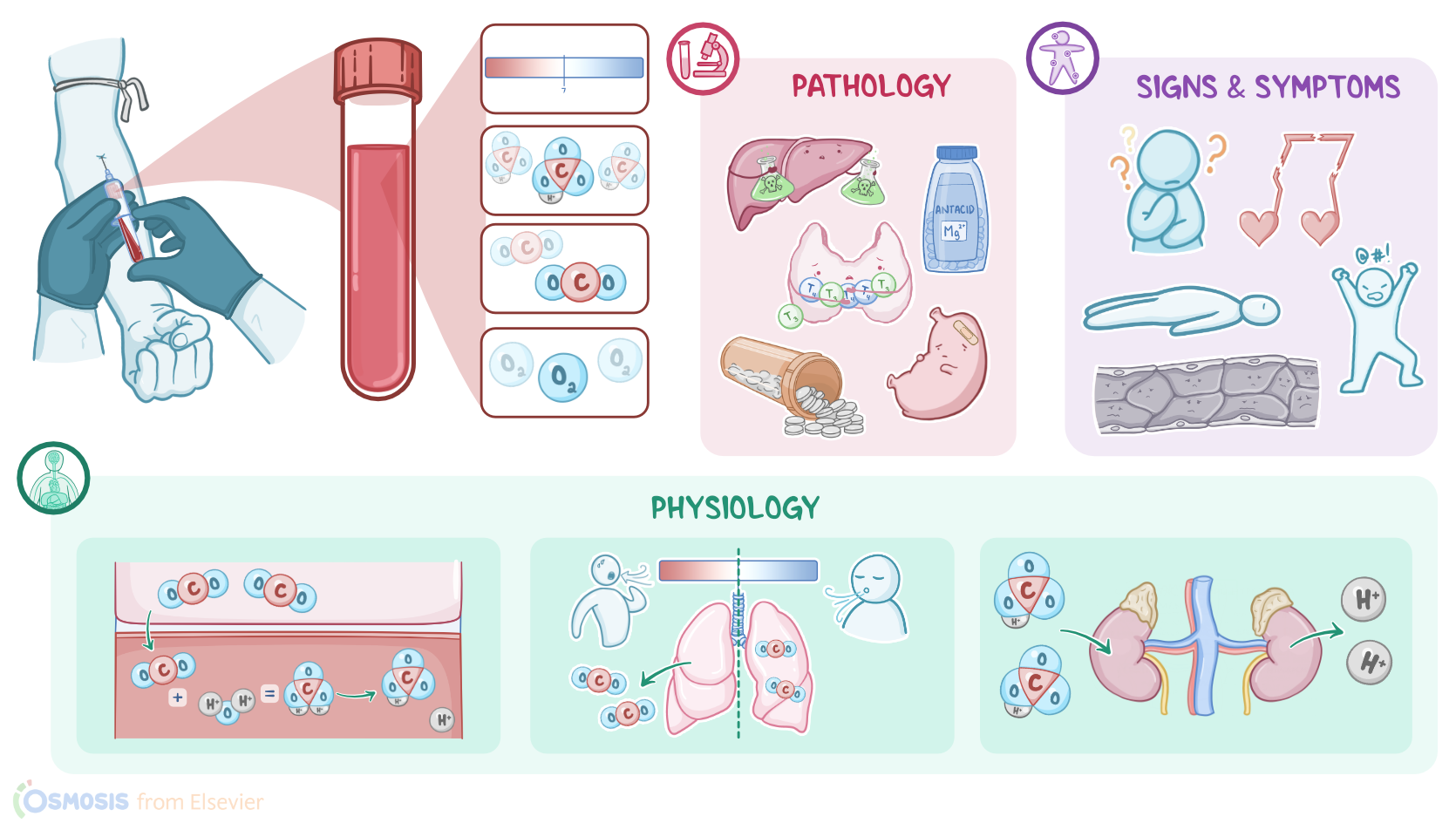
Now, the components of an ABG are pH, bicarbonate, carbon dioxide, and oxygen. First, there’s pH, which means ”potential of hydrogen,” so it reflects the concentration of hydrogen ions, or H+, in the blood.
Physiology0:14–5:06
There’s an inverse relationship between pH and H+, meaning that when there’s more H+, the pH decreases and becomes more acidic, and, when there’s less H+, the pH increases, and becomes less acidic.
The normal pH ranges from 7.35 to 7.45. If the pH is less than 7.35, it's considered acidosis; while a pH greater than 7.45 is alkalosis.Then, there’s bicarbonate, HCO3-, which is a base: a substance that can combine with H+ and remove it from solution.
When there’s more HCO3-, the pH increases and becomes more basic, and, when there’s less HCO3-, the pH decreases, and becomes more acidic.
Normally, HCO3- ranges from 21 to 28 mEq/L.Up next is the partial pressure of carbon dioxide, or PaCO2, which measures the amount of carbon dioxide dissolved in the arterial blood; and partial pressure of oxygen, or PaO2, which measures the amount of oxygen in the arterial blood.
For these gasses, “P” stands for partial pressure and “a'' stands for arterial. The normal PaCO2 should range from 35 to 45mm Hg, and PaO2 should range from 80 to 100mmHg.Finally, there’s oxygen saturation or SaO2, which refers to the percentage of hemoglobin molecules in the blood that have oxygen attached to them.
SaO2 should be 95% or more.Now, when you think about it, acids are continually being produced by normal metabolic processes like cellular oxidation and the breakdown of nutrients, so the body needs a way to handle all these hydrogen ions to prevent major shifts in the overall pH.
The first line of defense is the cellular buffering system. Now, in everyday language a buffer is something that acts like a protective cushion, and the same is true of physiologic buffers; they protect the pH balance by keeping it from rising or falling too quickly.
This system is always present and responds within seconds when there’s a disturbance in the pH. The most common buffer in the body is the bicarbonate-carbonic acid system.
It all starts with a by-product of cell metabolism called carbon dioxide or CO2, which is released by the cells into the blood.
In the blood, CO2 mixes with water, or H2O, to form carbonic acid, or H2CO3. Now, carbonic acid easily dissociates into bicarbonate, and hydrogen ions.
This reaction can go in both directions, which is actually how the buffering system works. Now, if the pH is increased, which means that there is less H+, we call that alkalosis.
To oppose alkalosis, this reaction is amplified and we get more bicarbonate and hydrogen ions. In contrast, decreased pH, which means there is more H+, is called acidosis.
To oppose acidosis, the reaction is reversed. So, excess H+ are used by bicarbonate to generate more carbonic acid, which gives us more carbon dioxide that can be eliminated by the lungs.So, the lungs are the second line of defense, which respond to shifts in pH by changing the respiration rate.
With acidosis, chemoreceptors in the brain sense a high concentration of hydrogen ions, and stimulates an increase in respirations so more CO2 is eliminated from the body.
Alternatively with alkalosis, chemoreceptors sense a low concentration of hydrogen ions, and stimulate a decrease in the respiratory rate so more CO2 is retained.
This is a quick response, occurring within minutes of acid-base alterations.For the last line of defense, we have the kidneys, which help maintain pH by eliminating excess H+ and reabsorbing more bicarbonate.
This is a slow response, which can take hours to days.Okay, sometimes the defenses that keep the body’s pH in check can become overwhelmed, resulting in either acidosis or alkalosis.
Metabolic causes of acidosis can be the result of increased acid production, like with lactic acidosis, which is caused by decreased tissue perfusion and anaerobic metabolism; diabetic ketoacidosis, which involves extreme hyperglycemia and an excessive breakdown of fatty acids in people with diabetes or increased ingestion of acids, like methanol, salicylates, or ethylene glycol.
Pathology5:06–7:12
It can also be caused by decreased elimination of acids, which can happen with renal failure; or by increased elimination of base, like with excessive diarrhea, which eliminates too much HCO3- from the intestines.On the other hand, respiratory causes of acidosis can be any condition that impairs ventilation and gas exchange, because these impairments cause retention of CO2.
So, causes can include respiratory depression, like with central nervous system depression from opioids or sedatives; respiratory muscle impairment, like with a spinal cord or chest wall injury; or conditions that impair diffusion across the alveolar-capillary membrane, like pneumonia or pulmonary edema.
Now, metabolic causes of alkalosis primarily occur from removal of too much acid from the body. This can be from excessive vomiting or prolonged gastric suctioning.
Other causes include the ingestion of too many antacids or parenteral administration of too much sodium bicarbonate.On the flipside, respiratory causes of alkalosis can be any condition that causes hyperventilation, since this can result in a loss of too much CO2.
So, this can include conditions that increase metabolic demands, like fever or thyrotoxicosis; or psychogenic responses to anxiety, fear, or pain.Now, small changes in pH can have significant effects on cellular function.
First, acidosis has a depressive effect on the central nervous system, or CNS. So, clients who are acidotic often become disoriented and even comatose.
In contrast, alkalosis can cause over-excitability of the CNS, which can manifest as irritability, muscle spasms, or seizures.
The pH level can also affect the concentration of the potassium level in the body. In acidosis, renal excretion of H+ increases, which causes retention of potassium, thereby increasing the serum potassium level.
Clinical manifestations7:12–8:35
Moreover, potassium tends to move out of cells in exchange for H+, which moves into the cells, further increasing the potassium level.
In an alkalotic state, the opposite occurs. The serum potassium decreases due to renal retention of H+ and excretion of potassium; as well as movement of potassium into cells in exchange for H+.
Both acidosis and alkalosis increase the risk of cardiac arrhythmias due to altered serum potassium. Other clinical manifestations of acidosis include hyperventilation, in an attempt to remove more CO2 from the body; while in alkalosis, respirations will be depressed, leading to hypercapnia and hypoxia.Alright, as a quick recap….
An ABG measures the acid-base components and pressures of gasses in arterial blood, including pH, HCO3-, PaCO2, PaO2, and SaO2.
When these defenses become overwhelmed, acidosis or alkalosis can result. Clinical manifestations of acidosis include CNS depression, hyperkalemia, and hyperventilation; while alkalosis can manifest as CNS excitability, hypokalemia, and hypoventilation.
Both acidosis and alkalosis increase the risk of cardiac arrhythmias due to altered serum potassium. all right It's a quick recap and A B G measures The acid based components and pressures of gas is an arterial blood including potential of hydrogen bicarbonate partial pressure of carbon dioxide partial pressure of oxygen and saturation of oxygen The pH reflects the hydrogen concentration in the blood which has an inverse relationship with the pH level There are three lines of defence to keep the pH and balance the buffering system the lungs and the kidneys When these defenses become overwhelmed acidosis or alkalosis can result Clinical manifestations of acidosis include CNS depression hypokalemia and hyperventilation while alkalosis can manifest as CNS excitability hypokalemia and hyperventilation Both acidosis and alkalosis increase the risk
Review8:35–9:24
| ARTERIAL BLOOD GAS (ABG) - OVERVIEW | ||
| KEY POINTS | NOTES | |
| DEFINITION |
| |
| PHYSIOLOGY |
| |
| PATHOLOGY |
| |
| CLINICAL MANIFESTATIONS |
| |
No notes for this video yet
Try adding a note below