Arterial blood gas (ABG) - Respiratory acidosis: Nursing
A 75-year-old male client with a history of end-stage chronic obstructive pulmonary disease, or COPD, is brought to the emergency department with shortness of breath and disorientation.
On assessment, he is tachypneic; cyanotic around his lips and earlobes; and respirations are rapid and shallow. The health care provider suspects respiratory acidosis secondary to end-stage COPD exacerbation, so an arterial blood gas is ordered to assess for changes in acid-base balance.Alright, arterial blood gas, or ABG for short, is a test used to measure the acid-base components and pressure of gasses in the arterial blood.
Normal ABG values for healthy adults are a pH ranging from 7.35 to 7.45, bicarbonate, or HCO3- ranging from 21 to 28 mEq/L; carbon dioxide or PaCO2 ranging from 35 to 45 mm Hg; PaO2 ranging from 80 to 100 mm Hg, and SaO2 should be more than 95%.Now, respiratory acidosis is a condition in which the normal mechanism of ventilation is disturbed, resulting in hypoventilation.
During hypoventilation, the respiratory rate and depth both decrease, the minute ventilation, which is the volume of air that moves in and out of the lungs in a minute, decreases, and the amount of CO2 eliminated from the body decreases.
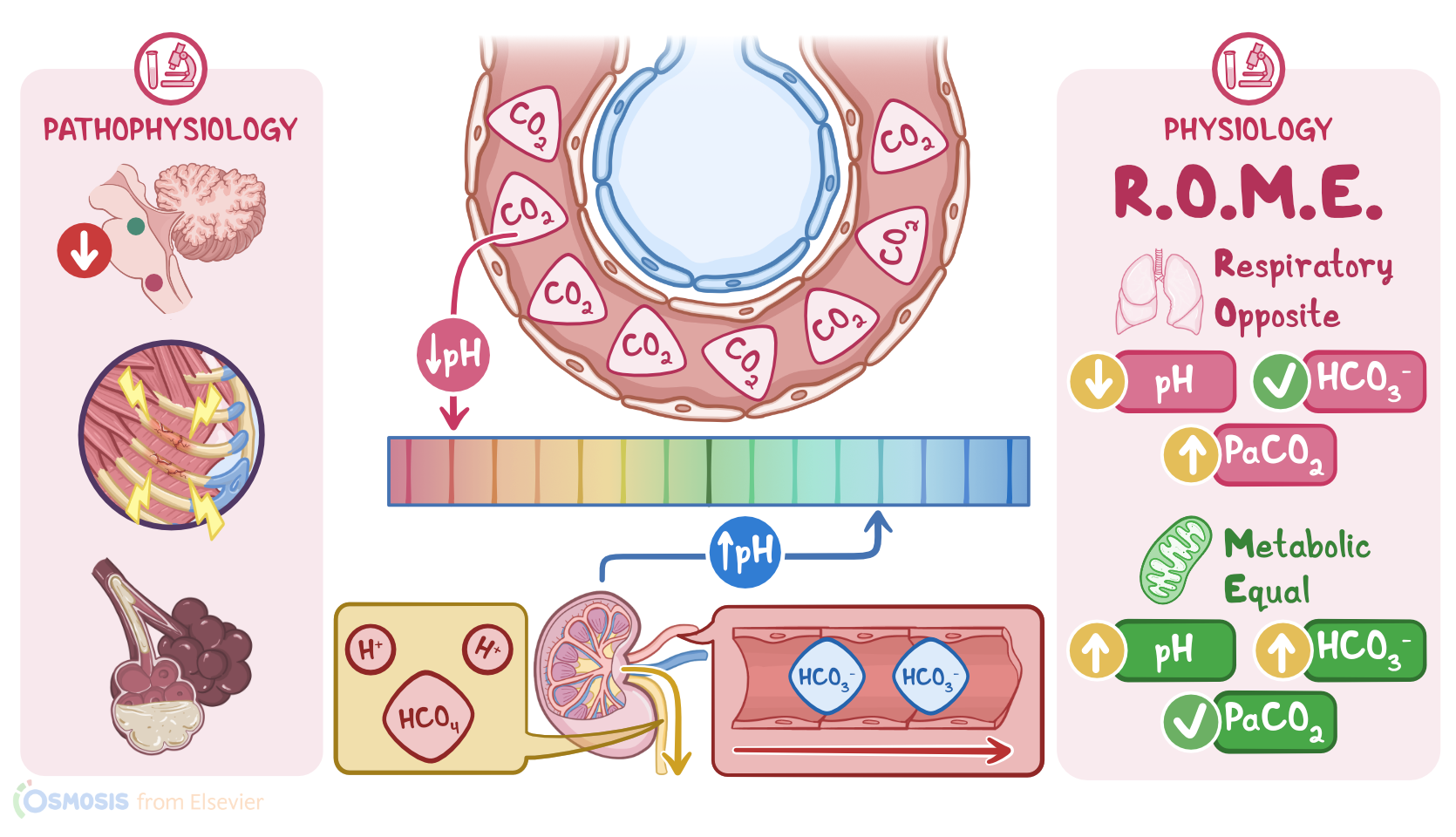
So, more CO2 is retained because there's more CO2 produced by the body than can be eliminated. In the blood, increased CO2 binds to water, and forms carbonic acid, which then dissociates into hydrogen ions, and bicarbonate.
Initially, the increase in bicarbonate helps buffer the hydrogen ions, slowing the drop in pH. Over time, the increased amount of hydrogen will eventually result in acidosis.Now, there are some conditions that can alter ventilation, including those that can affect the respiratory center in the brain, as well as the lungs, the respiratory muscles, or gas exchange itself.
For example, a stroke and medications like opiates and barbiturates depress the respiratory center in the brain, slowing respirations and increasing the risk of hypoventilation.Sometimes, the lungs can’t ventilate properly, like when there is an airway obstruction that prevents air from entering or exiting the lungs.
Then, with chest trauma, ventilation can be decreased due to pain. Finally, in other conditions, like COPD and pulmonary edema, the lungs and muscles work properly, but the gas exchange is reduced.
Now, as the pH continues to decrease and move out of the normal range, the body will attempt to correct the imbalance, a process called compensation.
With respiratory acidosis, the renal system is the main mode of compensation. The process begins when the kidneys start to excrete the excess acid, while also reabsorbing bicarbonate.
Compensation can't completely correct the pH imbalance, and it won’t fix the underlying cause of the pH imbalance.Clinical manifestations of respiratory acidocis can initially include headache and restlessness, followed by lethargy, myocardial depression, and hypotension.
Skin and mucous membranes can remain pink from CO2-related vasodilation, or cyanotic if hypoxemia is present. To interpret an ABG, the first thing you’ll do is to look at the pH.
If it’s less than 7.35 your client is acidotic; and if it’s greater than 7.45 your client is alkalotic. Once you know whether your client is acidotic or alkalotic, then you’ll look at the PaCO2 and HCO3- and compare it to the pH to determine if the acid-base imbalance is caused by a metabolic or a respiratory issue.
When an acid-base imbalance is primarily caused by a respiratory issue, the pH and PaCO2 will move in the opposite direction; so, as the pH increases, the PaCO2 decreases, and vice versa.
On the other hand, when an acid-base imbalance is primarily caused by a metabolic issue, the pH and HCO3- will move in the same direction.
So, as the pH increases, the HCO3- also increases, and vice versa. You can use the ROME acronym to help remember these relationships, where RO stands for Respiratory and Opposite for the relationship of pH and PaCO2, and ME stands for Metabolic and Equal for the pH and HCO3- relationship.Okay, let’s go back to your client who came to the emergency room.
The ABG results are pH 7.27; PaCO2 50 mmHg; and HCO3- 27 mEq/L. So, looking at the pH of 7.27, you note it is less than 7.35, so your client is acidotic.
Next, you compare the pH to the PaCO2 and HCO3-. The PaCO2 of 50 mmHg is increased and the HCO3- is normal at 27 mEq/L.
So, since the pH and the PaCO2 are moving in opposite directions, you can conclude your client is experiencing respiratory acidosis.
This is consistent with the client’s history of COPD and the probable diagnosis of an acute exacerbation. Now, we can also say that this client’s respiratory acidosis is uncompensated, meaning that although the kidneys are attempting to compensate for the acid-base imbalance, the pH has not returned to normal.
In cases where compensation has started to kick in, you can look for evidence of partial compensation by analyzing the PaCO2 and HCO3- for levels inconsistent with the pH.
So let’s say your client’s ABG results are pH 7.30; PaCO2 50 mmHg; and HCO3- 30 mEq/L. In this case, the pH is low, but the PaCO2 and HCO3- are increased and moving in the same direction, which tells us that the kidneys are attempting to correct by retaining HCO3-, but have not been successful in normalizing the pH.
Now if this client has fully compensated for respiratory acidosis, their ABG results may look something like this: pH 7.35, which is the lower end of normal, PaCO2 48 mmHg and HCO3- 30 mEq/L.
The PaCO2 and HCO3- are still both increased but the pH has normalized.Okay, let’s look at the nursing care you’ll provide for a client with respiratory acidosis.
Your priority goal is to assist with identifying and addressing the underlying cause of the acid-base imbalance. For example, in the case of an acute COPD exacerbation, you may administer bronchodilators and corticosteroids while providing ventilatory support like oxygen therapy.
If the problem is an overdose of opiates, reversal using naloxone can often restore adequate respirations. Alright, as a quick recap… Respiratory acidosis is a condition in which the pH is low and PaCO2 is increased as seen when analyzing an ABG.
Respiratory acidosis can be caused by any condition that prevents the lungs from removing carbon dioxide produced by the body, like those that depress the respiratory center in the brain, hypoventilation, or reduced gas exchange.
The body can compensate for respiratory acidosis through the cellular buffering system and more importantly the renal system, which increases excretion of carbonic acid and increases reabsorption of bicarbonate in an attempt to normalize pH.
Nursing management is to assist with identifying and addressing the underlying cause. carbon dioxide produced by the body Like those that depress the respiratory center in the brain hypoventilation or reduced gas exchange The body can compensate for respiratory acidosis through the cellular buffering system And more importantly the renal system which increases excretion of carbonic acid and increases reabsorption of bicarbonate In an attempt to normalize ph nursing management is
| ARTERIAL BLOOD GAS (ABG) - RESPIRATORY ACIDOSIS | ||
| KEY POINTS | NOTES | |
| PHYSIOLOGY |
| |
| PATHOLOGY |
| |
| INTERPRETATION |
| |
| NURSING IMPLICATIONS |
| |
- "Saunders Nursing Guide to Diagnostic and Laboratory Tests - E-Book" Elsevier Health Sciences (2011)
- "Laboratory Tests and Diagnostic Procedures with Nursing Diagnoses" Pearson (2018)
- "Respiratory Acidosis" StatPearls (2022)
- "Saunders comprehensive review for the NCLEX-RN® examination" Elsevier (2020)
- "Mosby’s Diagnostic and Laboratory Test Reference" Elsevier (2021)
No notes for this video yet
Try adding a note below