Attention-deficit hyperactivity disorder (ADHD): Nursing process (ADPIE)
Client Report0:00–0:35
Paul Truslow is an 11 year old boy who was brought to the pediatrician by his mother, Miss Truslow. Miss Truslow is concerned because Paul hasn't been performing well in school, stating that he doesn't always turn in his homework assignments, and when he does, the assignments are often incomplete.
At home, Miss Truslow says that Paul forgets to do his daily tasks like brush his teeth, make his bed, and take out the garbage.
Miss Truslow and his teachers are concerned about Paul, and are worried about his grades. The pediatrician is evaluating Paul for ADHD.
Pathophysiology0:35–3:44
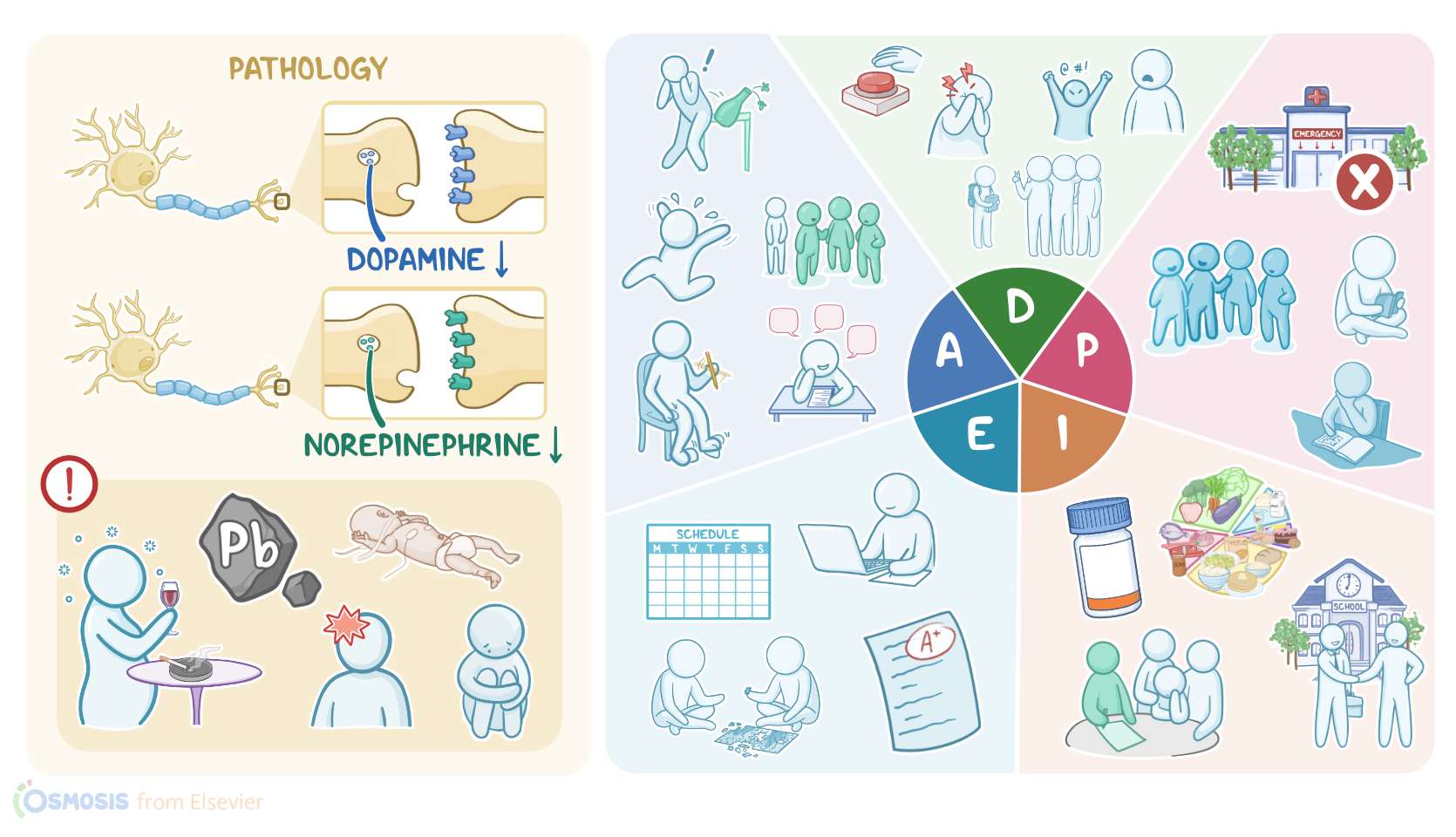
Attention deficit hyperactivity disorder, or ADHD for short, refers to a range of behaviors characterized by inattention, as well as hyperactivity and impulsivity, and is the most common mental health disorder affecting pediatric clients in the US with males being affected more frequently than females.
However, this may be due to bias in referral or diagnosis. The exact cause of ADHD is still not well understood, but it seems to be associated with the activity of dopaminergic and noradrenergic neurons within the brain.
These neurons produce and store in small vesicles, the neurotransmitters dopamine and norepinephrine, respectively. Dopamine binds to dopamine receptors and stimulates cognitive functions, motivations, and awakeness.
On the other hand, norepinephrine binds to norepinephrine receptors, subsequently boosting alertness and focus. Now, in clients with ADHD it's thought that there are lower amounts of these two neurotransmitters in the brain, although the reason why is still unknown.
Some risk factors may reach back to a child's development as a fetus during pregnancy, and they include exposure to alcohol, tobacco, and cocaine, as well as premature birth, and a birth weight lower than 1500 g.
On the other hand, early childhood risk factors include exposure to lead, iron deficiency, head trauma, obstructive sleep apnea, and certain infectious diseases such as chickenpox and measles.
Finally, psychosocial risk factors include domestic violence, conflicts, neglect, and emotional abuse. Now, symptoms of ADHD typically appear prior to the age of 12 years, are out of proportion for the client's developmental level, last for at least 6 months, and can persist till adulthood.
The most characteristic symptoms of ADHD are inattention, as well as hyperactivity and impulsivity. Inattention tends to show when children are involved in tasks that require focus and sustained mental effort.
These children struggle to sustain attention, follow instructions, and are easily distracted by extraneous stimuli like music.
As a result, they often make careless mistakes or fail to finish tasks such as chores and homework. On the other hand, clients with hyperactivity and impulsivity often struggle to sit still and may fidget, tap their feet or hands, or squirm in their seats.
In addition, they often spontaneously get up or run around in circumstances where remaining seated is expected. For example, in a classroom.
Finally, they tend to talk excessively and interrupt others, and have difficulty waiting their turn. Over time, ADHD can have some long-term consequences, such as impaired school performance and falling behind in their academic work.
Ultimately, this can lead to a decreased level of education and the development of mental health conditions like anxiety, depression, or sleep disorders.
In addition, ADHD can affect relationships with their parents, siblings, teachers, and peers. Treatment of ADHD is often challenging, and mainly involves behavioral therapy, which focuses on teaching the child better time management and organizational skills, as well as how to better cope with stress and anxiety.
Treatment3:44–4:31
In addition, parent-child behavioral therapy can help improve parent-child relationships through enhanced parenting techniques, and social skills training can help tackle deficits in social skills with peers.
Other things that can improve the child's quality of life, including maintaining a daily schedule, keeping distractions to a minimum, and setting small and reachable tasks.
Additionally, any co-existing mental health conditions should be addressed accordingly. Finally, some children may benefit from stimulant medications like methylphenidate and dextroamphetamine.
OK, let's go back and assess Paul. You ask Paul how he likes school, and he states that he actually likes school, especially physical education class.
Assessment4:31–6:00
When asked if he likes doing homework, he smiles and says he would rather be outside playing basketball. Miss Truslow provides you with a list of observations by his teachers, which includes symptoms such as difficulty following the rules and waiting his turn during games, jumping out of his seat during class, tapping his pencil on his desk, and blurting out answers to questions instead of raising his hand.
His teachers have also shared that Paul tends to prefer running instead of walking, and he tends to run into objects, or even his classmates.
His teachers have also noticed that Paul's behaviors tend to keep other children from wanting to interact with him. As you talk with Miss Truslow, you notice Paul looking away and fidgeting in his chair.
Paul's vital signs are tympanic temperature, 98.2 °F or 36.7 °C, heart rate, 98 BPM, respiratory rate, 18 breaths per minute, BP, 110/75 millimeters of mercury, SPO2, 98% on room air, and pain, 0 out of 10.
His height is 57 inches, and his weight is 90 lbs, or 40.8 kg. As you review Paul's medical record, you note that Paul does not have any significant medical history, and that no genetic, family, or socioeconomic environmental risk factors are evident.
Nursing Diagnosis6:00–6:25
After performing your assessment, you formulate your nursing diagnoses for Paul, which include ineffective impulse control related to neurotransmitter hypofunction and altered brain function, risk for injury related to hyperactivity and impulsiveness, impaired social interactions related to social behavior incongruent with norms, and for Miss Truslow, risk for parental role conflict related to disruption of family life.
Now, it's time to start planning goals for Paul's care. Long-term goals for Paul include that he will demonstrate improved impulse control and successfully regulate his own behavior in school and at home.
Planning6:25–6:53
He will demonstrate improved social relationships with family, teachers, and classmates, and successfully participate in school academics and activities.
And he will remain free from injury. And Miss Truslow will utilize available resources to support the needs of Paul and herself.
Now, it's time to get to work implementing your plan of care for Paul and his mother. The physician has prescribed a combination of behavioral and psychological therapy, along with the stimulant methylphenidate.
Implementation6:53–7:50
You provide teaching about the drug, including that it should be taken once each day in the morning, as well as some side effects to watch for, including nausea, loose stools, and weight loss.
You explain that the drug may decrease Paul's appetite and affect his growth. So, you teach Miss Truslow to provide Paul with nutrient-dense meals and snacks.
Ms. Truslow and Paul have been referred to family therapy, as well as individual therapy so they can learn to deal with ADHD symptoms, develop daily routines, organize tasks, and build new communication skills.
You also encourage Ms Truslow to meet with Paul's teachers and involve them in the plan of care. Finally, you make weekly follow-up appointments for Paul while his medication dosage is adjusted and his progress is monitored.
Evaluation7:50–8:33
After one month of treatment, you check in with Paul and Miss Truslow to evaluate their progress. Paul is tolerating his medication well so far.
Paul tells you he feels like he's doing better in school, is enjoying learning new things, and he's started to spend time playing with friends.
Miss Truslow shares that having a familiar routine each day helps Paul accomplish tasks, and this provides him with pride and satisfaction.
She mentions that his teachers report that Paul is not as distracted in class, is not running into things and other people as much as he used to, and is completing his homework more often.
She goes on to say that the therapy she's received so far has given her the confidence she needs to support Paul in a more positive way.
Summary Review8:33–9:12
All right, it's a quick recap. Paul Truslow is an 11 year old male who was brought to the pediatrician by his mother with symptoms of ADHD.
Your assessment revealed that he had poor academic performance and difficulty following instructions at home. Your nursing diagnoses include ineffective impulse control, risk for injury, impaired social interactions, and risk for parental role conflict.
The goals you identified while planning care for Paul included impulse regulation, improved social interaction, improved academic performance, and parental support.
You implemented your plan of care and will continue to evaluate outcomes for Paul and Miss Truslow.
| ATTENTION-DEFICIT HYPERACTIVE DISORDER (ADHD) | ||
| KEY POINTS | NOTES | |
| PATIENT REPORT |
| |
| PATHOPHYSIOLOGY |
| |
| DIAGNOSIS AND TREATMENT |
| |
| ASSESSMENT |
| |
| NURSING DIAGNOSES |
| |
| PLANNING |
| |
| IMPLEMENTATION |
| |
| EVALUATION |
| |
- "Ackley and Ladwig’s Nursing Diagnosis Handbook: An Evidence-Based Guide to Planning Care. 13th edition." Mosby (2022)
- "Saunders Comprehensive Review for the NCLEX-RN. 9th edition" Saunders (2022)
- "Harrison’s Principles of Internal Medicine. 21st edition" McGraw Hill / Medical (2022)
- "Attention-deficit hyperactivity disorder" Lancet (2020)
- "Critical Care Nursing: Diagnosis and Management. 9th edition" Elsevier (2021)
- "Clinical Practice Guideline for the Diagnosis, Evaluation, and Treatment of Attention-Deficit/Hyperactivity Disorder in Children and Adolescents [published correction appears in Pediatrics. 2020 Mar;145(3):]" Pediatrics (2019)
No notes for this video yet
Try adding a note below