Case study - Delirium: Nursing

Case study - Delirium: Nursing

Watch later

Watch later

Physiology of pain: Nursing
Preoperative care: Nursing
Postoperative care: Nursing
Buerger disease: Nursing
Raynaud phenomenon: Nursing
Peripheral arterial disease (PAD): Nursing process (ADPIE)
Peripheral venous disease (PVD): Nursing process (ADPIE)
Altered level of consciousness (LOC): Nursing
Delirium: Nursing
Seizure disorder: Nursing process (ADPIE)
Antiepileptics: Nursing pharmacology
Analgesics: Nursing pharmacology
Influenza: Nursing
Tuberculosis (TB): Nursing
Asthma: Nursing process (ADPIE)
Bacterial pneumonia: Nursing process (ADPIE)
Chronic obstructive pulmonary disease (COPD): Nursing process (ADPIE)
Venous thromboembolism (VTE): Nursing process (ADPIE)
Corticosteroids - Inhaled: Nursing pharmacology
Oxygen therapy: Nursing pharmacology
Mast cell stabilizers - Inhaled: Nursing pharmacology
Bronchodilators: Nursing pharmacology
Cholecystitis: Nursing
Cholelithiasis: Nursing
Diverticular disease: Nursing
Diarrhea: Nursing
Intestinal obstruction: Nursing
Gastroesophageal reflux disease (GERD): Nursing process (ADPIE)
Peptic ulcer disease (PUD): Nursing process (ADPIE)
Hiatal hernia: Nursing process (ADPIE)
Cirrhosis: Nursing process (ADPIE)
Antacids: Nursing pharmacology
Antiemetics: Nursing pharmacology
Proton pump inhibitors (PPIs): Nursing pharmacology
Histamine H2 antagonists: Nursing pharmacology
Gallstone-dissolving agents: Nursing pharmacology
Laxatives: Nursing pharmacology
Gastric mucosal protective agents: Nursing pharmacology
Antidiarrheals: Nursing pharmacology
Benign prostatic hyperplasia (BPH): Nursing process (ADPIE)
Urinary tract infections (UTIs): Nursing process (ADPIE)
Diuretics - Thiazide, thiazide-like, loop, and potassium-sparing diuretics: Nursing pharmacology
Antihyperlipidemics - Statins: Nursing pharmacology
Immune response - Adaptive: Nursing
Autoimmunity: Nursing
Hypersensitivity reactions - Type I: Nursing
Hypersensitivity reactions - Type II: Nursing
Hypersensitivity reactions - Type IV: Nursing
Hypersensitivity reactions - Type III: Nursing
Inflammatory process: Nursing
Immune response - Innate: Nursing
Systemic lupus erythematosus (SLE): Nursing
Rheumatoid arthritis (RA): Nursing process (ADPIE)
Lyme disease: Nursing process (ADPIE)
Pressure injury: Nursing process (ADPIE)
Amputation: Nursing
Hip fractures: Nursing
Osteoarthritis: Nursing
Gout: Nursing process (ADPIE)
Fractures: Nursing process (ADPIE)
Musculoskeletal injuries: Nursing process (ADPIE)
Skeletal muscle relaxants: Nursing pharmacology
Diverticulosis and diverticulitis
Hygiene - Ostomy care: Nursing skills
Integumentary: Emptying closed drains
Escherichia coli
Clostridium difficile (Pseudomembranous colitis)
Wound healing
Acute compartment syndrome: Nursing process (ADPIE)
Bone remodeling and repair
Alzheimer disease
Seizures and epilepsy
Case study - Gastroesophageal reflux disease (GERD): Nursing
Case study - Heart failure with reduced ejection fraction (HFrEF): Nursing
Coronary artery disease (CAD) and angina pectoris: Nursing process (ADPIE)
Left-sided heart failure: Nursing process (ADPIE)
Case study - Benign prostatic hyperplasia (BPH): Nursing
Geriatric considerations - Urinary: Nursing
Urinary retention: Nursing
Urinary incontinence - Stress: Nursing process (ADPIE)
Case study - Deep vein thrombosis (DVT): Nursing
Case study - Pressure injury: Nursing
Intraoperative care: Nursing
Case study - Hip fracture: Nursing
Case study - Delirium: Nursing
Case study - Acute pain: Nursing
Case study - Dementia: Nursing
Case study - Epilepsy: Nursing
Dementia: Nursing
Case study - Chronic obstructive pulmonary disease (COPD): Nursing
Case study - Impaired gas exchange: Nursing
Case study - Pneumonia: Nursing
Geriatric considerations - Medications: Nursing
Geriatric considerations - Sensory: Nursing
Geriatric considerations - Respiratory: Nursing
Geriatric considerations - Psychosocial: Nursing
Geriatric considerations - Integumentary: Nursing
Geriatric considerations - Gastrointestinal: Nursing
Geriatric considerations - Cardiac: Nursing
Anatomy of the urinary organs of the pelvis
Renal system anatomy and physiology
Renal and urinary calculi: Nursing
Anatomy of the male reproductive organs of the pelvis

Notes

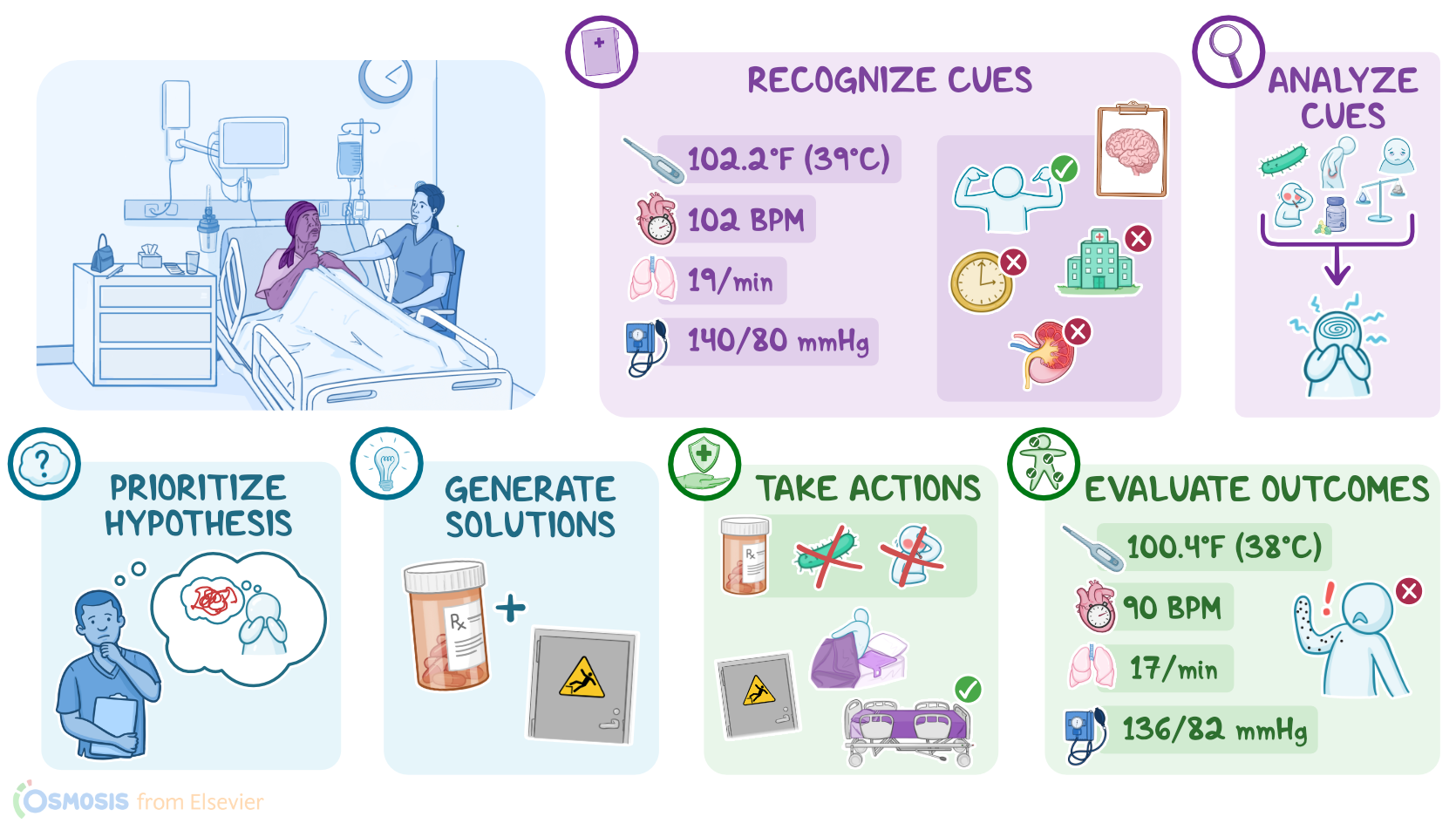
CASE STUDY - DELIRIUM

KEY POINTS
NOTES
INTRODUCTION
  • Medical-surgical unit
  • 72-year old
  • History: heart failure
  • Admitted for pyelonephritis

RECOGNIZING AND ANALYZING CUES
  • Recognize cues
    • Temperature: 102.2 F (39 C)
    • Heart rate: 102
    • Respirations: 19
    • Blood pressure: 140/80 mmHg
    • Appears anxious
    • Eyes moving across room
    • Seeing spiders
    • Disoriented to time, place, and situation
  • Analyze cues
    • No psychiatric history
    • Underlying factors can lead to delirium which can cause waxing and waning mental function, hallucinations, and delusions

PRIORITIZING HYPOTHESES, GENERATING SOLUTIONS, AND TAKING ACTIONS
  • Priority hypothesis
    • Disturbed thought processes
  • Generate solutions
    • Remain free from injury
  • Take action
    • Notify provider
    • Administer medications as prescribed
    • Encourage family to visit
    • Update date and clock to promote orientation
    • Ensure fall precautions in place

EVALUATING OUTCOMES
  • Temperature: 100.4 F (38 C)
  • Heart rate: 90
  • Respirations: 17
  • Blood pressure: 136/82 mmHg
  • Son at bedside
  • Remains disoriented but comfortable and no longer seeing spiders
  • Outcome met

Transcript

Watch video only

Nurse Melinda works on a medical surgical unit and is caring for Kadija, a 72-year-old with a history of heart failure who was admitted for pyelonephritis. After settling Kadija in her room, Nurse Melinda goes through the steps of the Clinical Judgment Measurement Model to make clinical decisions about Kadija’s care by recognizing and analyzing cues, prioritizing hypotheses, generating solutions, taking action, and evaluating outcomes

First, Nurse Melinda recognizes important cues, including Kadija’s vital signs, which are temperature of 102.2 F or 39 C, heart rate 102 beats per minute, respirations 19 breaths per minute, and blood pressure 140/80 mmHg.  

Nurse Melinda notices Kadija appears anxious, and her eyes are moving back and forth across the room. She gathers additional information from Kadija. 

Nurse Melinda: Hi Kadija, how are you feeling today? 

Kadija: Don’t you see that? There are a bunch of spiders on the wall behind you. 

Nurse Melinda turns around and notes there is nothing on the wall. 

Nurse Melinda: I don’t see any spiders, but I understand that must be very scary for you. You're safe here with me. 

Nurse Melinda conducts a brief cognitive screening and determines that Kadija is oriented to self, but not time, place, or situation.  

Next, Nurse Melinda analyzes these cues. She reviews the electronic health record, or EHR, and notes that Kadija has no history of psychiatric illness.  

Nurse Melinda recognizes that underlying factors, such as infection, fever, pain, sleep deprivation, fluid and electrolyte imbalance, as well as certain medications, can lead to alterations in a patient’s mental status, causing problems like delirium, especially in patients with advanced age and preexisting medical conditions

She also recalls that delirium can develop over several hours or days and can result in a waxing and waning of mental function, including memory, thinking, language, behavior, mood, and personality. Hallucinations and delusions also often occur.  

Nurse Melinda realizes that Kadija needs management of her altered mental status

Sources

  1. "Varcarolis’s Canadian psychiatric mental health nursing. (3rd ed.)" Elsevier (2023)
  2. "Keltner’s psychiatric nursing. (9th ed.). " Elsevier (2023)