Case study - Elder abuse and neglect: Nursing
Introduction0:00–0:36
Nurse. Kyle works in a primary care office and is caring for Judy, a 78 year old female with a history of Alzheimer's disease who was brought in for a medication refill by her son Darryl.
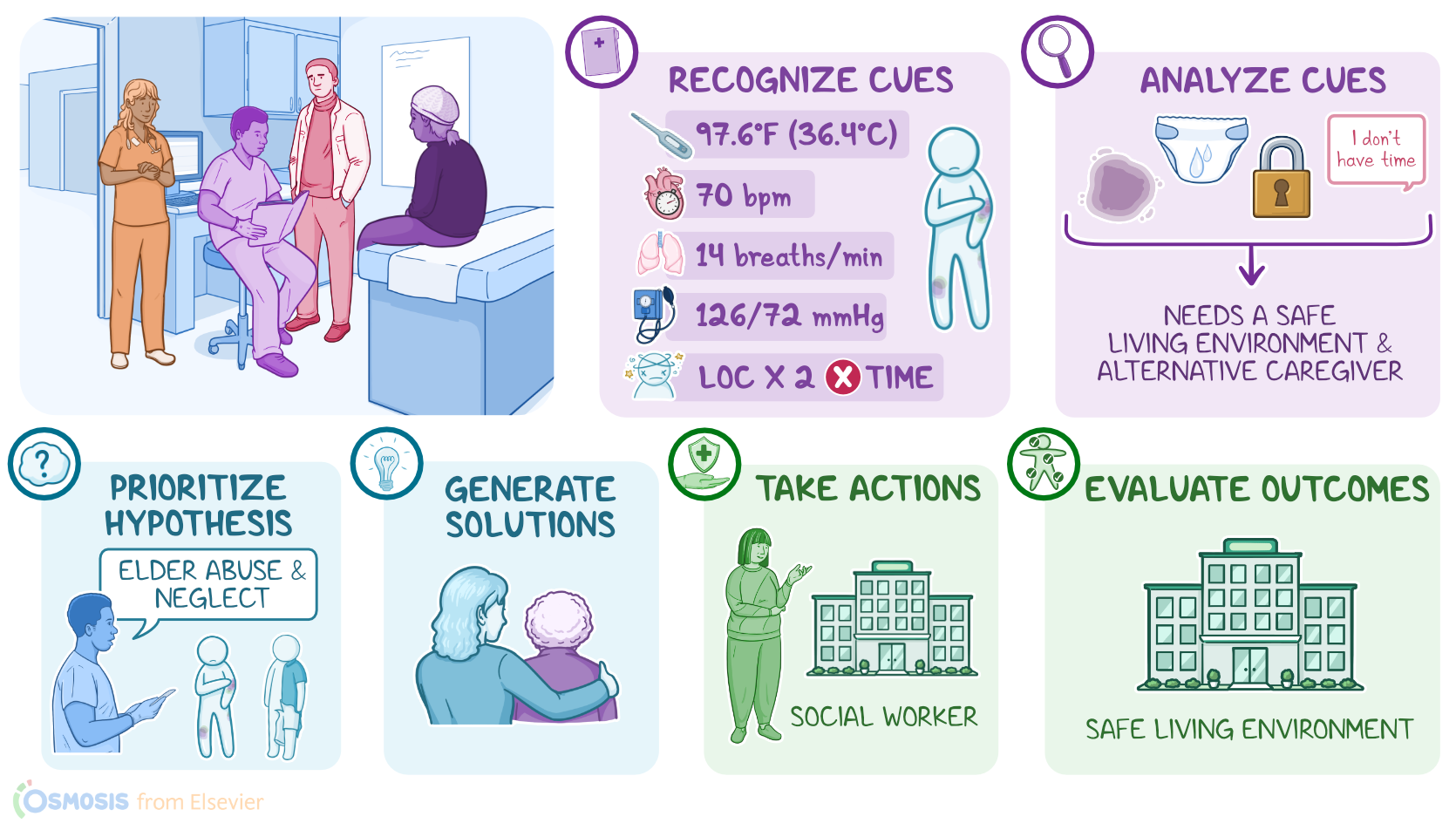
In collaboration with the registered nurse, ARN Fatima nurse, Kyle goes to the steps of the clinical judgment measurement model to make clinical decisions about Judy's care by recognizing and analyzing cues, prioritizing hypotheses, generating solutions, taking action and evaluating outcomes.
Recognizing and Analyzing Cues0:36–4:10
First, nurse Kyle recognizes important cues including Judy's vital signs which are temperature 97.6 °F or 36.4 °C. Heart rate, 70 BPM, respirations, 14 breaths per minute and BP.
1 26/72 millimeters of mercury. Judy is oriented to person and place but not time.
Nurse Kyle also notices Judy has a flat effect and avoids direct eye contact. All right, Judy, the health care provider ordered a urine sample to help monitor how your medication is working.
Can I assist you to the bathroom? Nurse, Kyle begins to assist Judy to the bathroom and notes she has a strong body odor when helping Judy remove her incontinence underwear.
He notices it's saturated with urine and her vulva is bright red with a surrounding rash. After collecting the sample.
Nurse Kyle helps Judy clean up and put on a fresh pair of underwear while Judy washes her hands. Nurse Kyle notes a circular bruise on her right arm.
Judy. I see you have a bruise on your arm.
What happened? Oh, I don't remember.
It's fine. He then helps Judy return to the exam room to wait for the health care provider.
Darryl. I noticed your mom has a bruise on her right arm.
How did she get that? Let me see it.
Oh, yeah, that looks like the spot where she always hits on the doorknob. I it's nothing.
Ok. Uh Tell me more about what you mean.
Well, since mom gets confused, she started wandering into the street a lot, I'm trying to run my business from home so I can't keep chasing after her.
So during my work hours, I keep her in the bedroom. I have a camera on to make sure she's ok.
But I've noticed she paces around and runs into things like the doorknob, which explains the mark upon further discussion.
Nurse Kyle learns Daryl helps Judy change her incontinence underwear twice per day, once when he helps her get dressed in the morning.
And then again at bedtime DL states he doesn't have time to do it more often and that Judy never specifically mentions it.
Next. Nurse Kyle analyzes these cues.
He reviews the electronic health record or E hr and notes. Judy has lost 10 lbs or 4.5 kg since her visit six months ago.
He also sees a note from the medical assistant stating that Darryl has rescheduled this appointment four times due to work conflicts or forgetfulness.
Considering these findings, Nurse Kyle suspects Judy is a victim of dependent elder abuse and neglect. Nurse Kyle knows dependent adults are unable to do their daily activities or protect their rights due to physical or mental limitations.
He also knows abuse can be intentional or unintentional and can include physical restraints like being locked in a bedroom.
And that neglect is a form of abuse that is passive occurring when caregivers are unable to meet the needs of the individual.
Like with Judy's son, Nurse Kyle recognizes that Judy needs a safe living environment and an attentive caregiver. Now using the information he's gathered along with Judy's medical history.
Prioritizing Hypotheses, Generating Solutions, and Taking Action4:10–5:24
Nurse Kyle reports his findings to RN Fontina and together they choose a priority hypothesis of elder abuse and neglect, then they generate solutions to address Judy's safety and care that will include non pharmacologic interventions and they establish the expected outcome that after intervening, Judy will have a safe living environment arranged by the end of the office visit.
Nurse Kyle then takes action to implement these solutions. First, Daryl is asked to leave the exam room so Judy can be privately evaluated by RN Fatima who conducts a head to toe assessment while nurse Kyle takes pictures of her injuries for the EHR they also arrange for an unlicensed assistive personnel or U AP to stay with Judy.
So she's not left alone with Daryl during the remainder of the visit. Meanwhile, Nurse Kyle contacts the Adult Protective Services Agency to report possible elder abuse and neglect.
While RN Fatima collaborates with the health care provider for a social work referral. At the end of the visit, nurse Kyle evaluates the outcome of his actions.
Evaluating Outcomes5:24–6:23
He speaks with the social worker who confirms there's a skilled nursing facility with an Alzheimer unit where Judy can stay while the Adult Protective Services Agency completes the investigation.
In the meantime, ARN Fatima informs Darryl that Judy will not be returning home with him. Then nurse Kyle meets with Barbara, the social worker who arrived to help Judy transition to the new living arrangement together.
They enter Judy's room to update her on the plan of care. Judy.
This is Barbara a social worker. We're concerned your son can't safely care for you.
So after this appointment, we have a new place to stay where they'll take care of you. Barbara will help you with this.
I'm sorry for what you've been through at home. We want you to be safe and happy.
Review6:23–7:00
All right. As a quick recap, nurse Kyle recognized and analyzed cues related to Judy's elder abuse and neglect and in collaboration with a fatima prioritized hypotheses and generated solutions to address this problem.
Nurse Kyle and ARN Fatima then implemented non pharmacologic measures and evaluated Judy's outcomes and compared them to the expected outcome since Judy had a safe living environment arranged by the end of the office visit, they determined the plan of care was successful.
| CASE STUDY - ELDER ABUSE AND NEGLECT | ||
| KEY POINTS | MY NOTES | |
| INTRODUCTION |
| |
| RECOGNIZING AND ANALYZING CLUES |
| |
| PRIORITIZING HYPOTHESES, GENERATING SOLUTIONS, AND TAKING ACTIONS |
| |
| EVALUATING OUTCOMES |
| |
- "Basic geriatric nursing (8th ed.)" Elsevier (2023)
No notes for this video yet
Try adding a note below