Cerebral palsy: Nursing

Last updated: March 02, 2022

Cerebral palsy: Nursing

Pediatrics

Pediatrics

Pediculosis and scabies: Nursing
Atopic dermatitis: Nursing process (ADPIE)
Childhood nutrition and obesity: Information for patients and families (The Primary School)
Childhood oral health: Information for patients and families (The Primary School)
Chickenpox (Varicella): Nursing process (ADPIE)
Appendicitis: Nursing process (ADPIE)
Fractures: Nursing process (ADPIE)
Hirschsprung disease: Nursing
Rheumatic heart disease: Nursing process (ADPIE)
Carbon monoxide poisoning: Nursing process (ADPIE)
Conjunctivitis: Nursing process (ADPIE)
Reye syndrome: Nursing process (ADPIE)
Congenital heart defects - Acyanotic: Nursing
Congenital heart defects - Cyanotic: Nursing
Kawasaki disease: Nursing
Strabismus: Nursing
Otitis media: Nursing
Eye injury: Nursing process (ADPIE)
Tonsillitis: Nursing process (ADPIE)
Cleft lip and palate: Nursing
Esophageal atresia and tracheoesophageal fistula: Nursing
Omphalocele and gastroschisis: Nursing
Poisoning: Nursing process (ADPIE)
Pyloric stenosis: Nursing process (ADPIE)
Bladder exstrophy: Nursing
Cryptorchidism: Nursing
Enuresis: Nursing
Hypospadias and epispadias: Nursing
Hemolytic uremic syndrome: Nursing
Sickle cell disease: Nursing process (ADPIE)
Erythema infectiosum (Fifth disease): Nursing
Fever: Nursing
Infectious mononucleosis: Nursing
Pertussis: Nursing
Poliomyelitis: Nursing
Rocky Mountain spotted fever (RMSF): Nursing
Rubeola (Measles): Nursing
Zika virus: Nursing
Lyme disease: Nursing process (ADPIE)
Child maltreatment: Nursing
Crisis intervention: Nursing
Therapeutic communication: Nursing
Autism spectrum disorder (ASD): Nursing
Failure to thrive (FTT): Nursing
Growth and development theories: Nursing
Growth and development - Adolescent: Nursing
Growth and development - Infant: Nursing
Growth and development - Preschool-age: Nursing
Growth and development - School-age: Nursing
Growth and development - Toddler: Nursing
Sudden infant death syndrome (SIDS): Nursing
Muscular dystrophies - Duchenne and Becker: Nursing
Clubfoot: Nursing
Scoliosis: Nursing
Developmental dysplasia of the hip: Nursing
Juvenile idiopathic arthritis: Nursing
Cerebral palsy: Nursing
Hydrocephalus: Nursing process (ADPIE)
Influenza: Nursing
Asthma: Nursing process (ADPIE)
Bronchiolitis and respiratory syncytial virus (RSV): Nursing process (ADPIE)
Epiglottitis: Nursing process (ADPIE)
Foreign body aspiration and upper airway obstruction: Nursing process (ADPIE)
Laryngotracheobronchitis (LTB) and croup: Nursing process (ADPIE)
Smoke inhalation injury: Nursing process (ADPIE)
Cystic fibrosis: Nursing
Head injury: Nursing
Pediatric psychosocial needs during illness and hospitalization: Nursing
Diarrhea: Nursing
Metabolic alkalosis
Metabolic acidosis
Shock - Hypovolemic: Nursing
Shock - Septic: Nursing
Respiratory acidosis
Acid-base map and compensatory mechanisms
Seizure disorder: Nursing process (ADPIE)
Cutaneous fungal infections: Nursing
Precocious puberty: Nursing
Tumor lysis syndrome (TLS): Nursing Process (ADPIE)
Lymphoma - Hodgkin and non-Hodgkin: Nursing
Leukemia: Nursing process (ADPIE)
Hemophilia: Nursing process (ADPIE)
Anemia - Iron-deficiency: Nursing
Biology of cancer: Nursing
Increased intracranial pressure (ICP): Nursing
Spinal cord injury (SCI): Nursing
Neurological assessment - Neonate: Nursing
Neural tube defects: Nursing
Meningitis: Nursing process (ADPIE)
Amblyopia: Nursing
Hearing impairment and otosclerosis: Nursing
Case study - Pediatric appendicitis: Nursing
Case study - Pediatric anaphylaxis: Nursing
Case study - Pediatric urinary tract infection: Nursing
Case study - Pediatric diabetes mellitus type 1: Nursing
Case study - Child maltreatment: Nursing
Case study - Autism spectrum disorder: Nursing
Case study - Sickle cell anemia: Nursing

Notes

CEREBRAL PALSY

KEY POINTS
NOTES
DEFINITION
  • Group of disorders related to movement, coordination, and posture

PHYSIOLOGY
  • Nervous system
    • Central nervous system (CNS)
    • Peripheral nervous system (PNS)
  • Muscle contraction
    • Motor cortex sends signal to upper motor neuron (UMN)
    • UMN carries information down spinal cord to lower motor neuron (LMN)
    • LMN sends signal to muscle fibers
    • Muscle contracts
  • Neuromuscular junction
    • Between UMN and LMN
    • Voltage-gated calcium channels
    • Acetylcholine

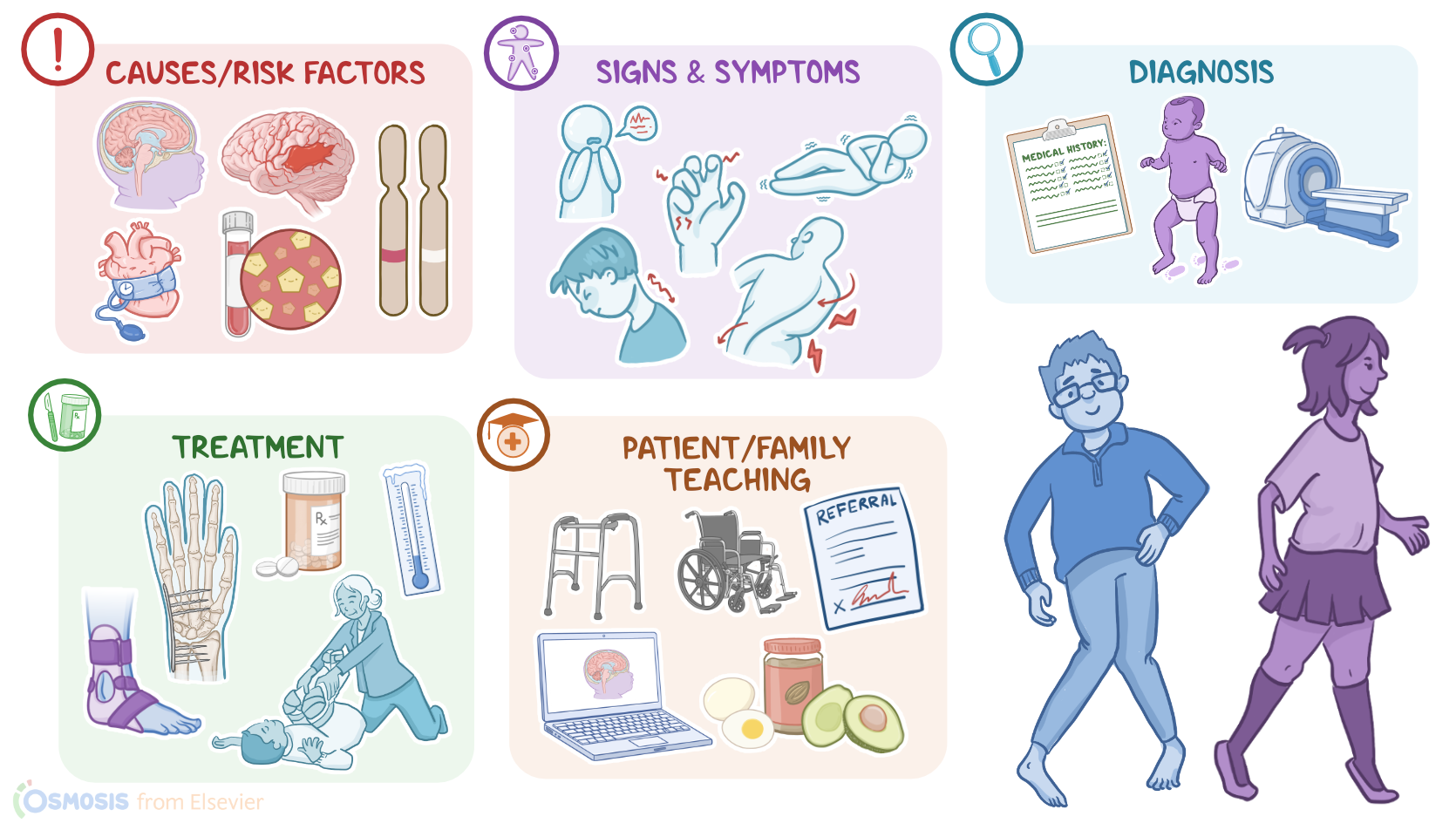
CAUSES AND RISK FACTORS
  • Causes
    • Multifactorial
  • Risk factors
    • Antenatal
      • Congenital brain malformations
      • Intrauterine infection
      • Chromosomal abnormalities
      • Intrauterine growth restriction
      • Multiple gestation
      • Preeclampsia
      • New-onset hypertension
      • Proteinuria
      • Placental abruption
      • Fetal hypoxia
    • Postnatal
      • Preterm delivery
      • Low birth weight
      • Low Apgar scores
      • Kernicterus
      • High bilirubin
      • Birth trauma
      • Cerebral hemorrhage

PATHOPHYSIOLOGY
  • Abnormal development or damage to regions of the brain that control movement
  • Motor deficits occur
    • Spastic
    • Dyskinetic
    • Ataxic
    • Mixed

SIGNS AND SYMPTOMS
  • Delayed or missed milestones
  • Scissor gait
  • Toe walk
  • Twisting, repetitive, and painful movements
  • Slow, writhing movements
  • Random, short, involuntary movements
  • Clumsy or unstable movements
  • Poor balance
  • Seizures
  • Difficulty speaking or communicating
  • Hearing or vision problems
  • Poor feeding
  • Learning disabilities

DIAGNOSIS
  • History
  • Physical assessment
  • Developmental assessments
  • MRI
  • Ultrasound

TREATMENT
  • Supportive
    • Speech, occupational, and physical therapy
    • Dieticians
    • Counselors
    • Splints or braces
    • Surgery
    • Medications
  • Neuroprotective postnatal measures

MANAGEMENT OF CARE
  • Goals of care
    • Optimize growth, motor function, and cognitive development
  • Monitor nutritional status and weight
  • Consult speech language pathologist and occupational therapist 
  • Assess posture. muscle tone, and gross and fine motor function
  • Assist with body alignment
  • Provide gentle range of motion and stretching
  • Collaborate with physical therapist 
  • Assist with adaptive equipment
  • Routinely inspect pressure points
  • Provide safe environment
  • Offer developmentally appropriate toys and activities
  • Encourage parent/caregiver involvement
  • Ensure referrals placed as needed
  • Provide outside resources

PATIENT AND FAMILY TEACHING
  • Explain condition, plan of care, and how to safely administer medications
  • How to assist with feeding and support nutrition
  • Fall prevention
  • Adaptive equipment use
  • Age-appropriate play and activities
  • Promote social interaction
  • Notify HCP
    • New symptoms
    • Require more support at home
  • Seek emergency care
    • Seizure
    • Difficulty breathing

Transcript

Watch video only

Cerebral palsy refers to a group of non-specific disorders that are typically related to movement, coordination, and posture, caused by abnormal brain development and function.

First, let’s review some anatomy and physiology of the nervous system, which is divided into the central nervous system, including the brain and spinal cord, and the peripheral nervous system, which includes all the nerves that connect the central nervous system to the muscles and organs.

So, when the brain wants a muscle to contract, like dorsiflexing the foot, the motor cortex sends a signal through the upper motor neurons which carries the information down the spinal cord and then through a lower motor neuron in the peripheral nervous system to the muscles fibers in the foot, causing it to move.

Between the lower motor neuron and the muscle fiber is a space called the neuromuscular junction. The lower motor neurons have voltage-gated calcium channels in their membranes. Whenever they receive an electrical impulse from the brain, these channels open up and let calcium inside. The increased intracellular calcium concentration triggers the release of the neurotransmitter acetylcholine into the neuromuscular junction. Acetylcholine goes from the neuron over to receptors on muscle cell membranes, causing voluntary muscle contraction.

Now, there isn’t a single cause of cerebral palsy, but rather it’s a multifactorial disease, meaning that there’s a combination of factors that can be either antenatal or postnatal, based on whether they occur before or after birth.

During these periods of early development, the brain is highly susceptible to damage. Typically, the most common factors that increase the risk of cerebral palsy during the antenatal period include congenital brain malformations; intrauterine infection; chromosomal abnormalities; intrauterine growth restriction; multiple gestation; preeclampsia, or new onset hypertension and proteinuria during pregnancy; as well as placental abruption,which is a condition where the placenta separates from the uterine wall before birth; and fetal hypoxia.

On the other hand, postnatal factors include preterm delivery; low birth weight; low Apgar scores; kernicterus, which is a very high bilirubin level that can damage the brain; birth trauma, or cerebral hemorrhage.

Now, the pathology of cerebral palsy starts with abnormal development or damage to the regions of the brain controlling movement. Since the damage occurs during development, it’s often permanent, but typically does not progress. Based on the area of the brain that’s damaged, cerebral palsy can cause different motor deficits, and that’s the way it’s classified.

There are 4 main types. Spastic cerebral palsy accounts for about 70% of cases, and this is characterized by stiff or tight muscles. Then there’s dyskinetic cerebral palsy, which is characterized by an inability to prevent involuntary muscle contractions. Third, with ataxic cerebral palsy, coordination and fine or precise movements are affected. Finally, there’s mixed cerebral palsy, where brain injury results in characteristics of more than one of the other types.

Clinical manifestations of cerebral palsy typically appear months to several years after birth. Often, the first symptoms are developmental delays and missed milestones like rolling over, sitting up without support, standing, and walking.

During this period, motor symptoms also start manifesting. Clients with spastic cerebral palsy typically present with a “scissor gait.” That’s because adductor muscles are always partly flexed, which causes the knees and thighs to constantly touch. Similarly, sometimes clients have a “toe-walk” because their calves are always flexed, which pulls the Achilles tendon up and causes someone to go up on their toes.

In contrast, clinical manifestations of dyskinetic cerebral palsy include dystonia, meaning twisting, repetitive, and often painful movements in the limbs and trunk; athetosis, which refers to slow, writhing movements; and chorea, which are random, short, involuntary movements.

Then there’s ataxic cerebral palsy, where clients often have clumsy or unstable movements and poor balance when doing things like walking or picking something up. Lastly, clients with mixed cerebral palsy will exhibit symptoms of more than one of the previous types of cerebral palsy.

Finally, apart from motor symptoms, clients with cerebral palsy can often present with seizures, difficulties with speaking and communication, hearing or vision problems, poor feeding, and learning disabilities.

Diagnosis of cerebral palsy starts with the client's history and physical assessment, followed by neurological and developmental assessments, which include General Movements Assessments and Hammersmith Infant Neuro Exam. Imaging tests, like a brain MRI or ultrasound, can also be done to look for brain lesions.

Now, the treatment of cerebral palsy differs from client to client. Generally, treatment is supportive, and aimed at managing the clinical manifestations. Clients with cerebral palsy can benefit from speech, occupational, and physical therapies, which strengthen and maintain the motor system functions. Dieticians and counselors can also help the clients overcome some of their challenges. Splints and braces can be also used to prevent or correct deformities and help clients stand or walk better.

Pharmacological options include muscle relaxants like baclofen and Botox which are used to lessen spasticity. Other medications include anticholinergics such as benztropine to reduce drooling, and anticonvulsants to prevent seizures.

In addition, surgical options, including tendon lengthening, fusion of unstable joints, or inserting a deep brain stimulator, can be done to correct deformities, or contractures.

Finally, it’s worth noting that there are preventative measures that can be taken to reduce the likelihood of cerebral palsy. These include antenatal measures, like routine prenatal care during pregnancy, as well as administering magnesium sulphate to individuals at risk of preterm birth.