Kernicterus can be caused by a variety of etiologies that increase bilirubin in the blood including insufficient bilirubin conjugation or processing (e.g., newborn jaundice), excessive bilirubin production (e.g., hemolytic disease of the newborn), and impaired bilirubin elimination (e.g., biliary atresia).
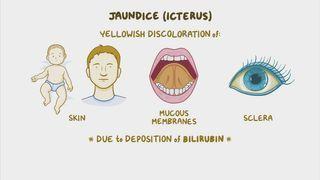
Newborn jaundice is often seen in the first days of life. It is the yellow discoloration of a newborn’s skin and eyes and is common in preterm babies with an immature liver, which is primarily responsible for bilirubin conjugation. Newborn jaundice is often self-resolving or responds well to medical therapy, therefore while it is commonly seen at birth, it rarely progresses to kernicterus.
Hemolytic disease of the newborn is a disorder that occurs when the blood types of the mother and fetus are incompatible. In these situations, the mother’s immune system produces antibodies that attack the fetus’ red blood cells, resulting in increased fetal red blood cell turnover and subsequently, abnormally high levels of bilirubin in the blood.
Biliary atresia is a rare congenital anomaly of extrahepatic duct fibrosis that leads to obstruction of bile flow, resulting in chronic inflammation and eventual obliteration of the extrahepatic biliary tree. Therefore, even though bilirubin is conjugated, it is unable to exit the liver for excretion. Biliary atresia often requires surgery to repair this structural defect. The risk of developing kernicterus increases the longer bilirubin is allowed to accumulate in the body.
Additionally, other causes that increase bilirubin in the blood include hematomas (i.e., large contained collection of blood from trauma or birth injuries), hemoglobinopathies (e.g., sickle cell disease), severe infections, and hereditary bilirubin conjugation defects (e.g., Crigler-Najjar, a genetic defect of bilirubin processing by the liver).