Cholecystitis: Nursing
Introduction0:00–0:11
Cholecystitis refers to inflammation of the gallbladder, which is a small, pear-shaped organ located beneath the liver.Now, let’s quickly review some anatomy and physiology.
Physiology0:11–1:34
The biliary tree is made of the liver, gallbladder, and bile ducts. The liver is in charge of producing bile, which is mostly made up of bile salts and acids, cholesterol, phospholipids, proteins, bilirubin and small amounts of various other compounds, like water, electrolytes, and bicarbonate.
Then, bile flows out of the liver through the hepatic ducts towards the gallbladder, where it’s stored. Now, eating fatty foods stimulates the cells in the small intestine to secrete cholecystokinin into the bloodstream.
Cholecystokinin, in turn, stimulates the gallbladder contraction, causing it to release bile through the cystic duct and then the common bile duct.Finally, the common bile duct joins the pancreatic duct, forming the ampulla of Vater, which is surrounded by the sphincter of Oddi.
This sphincter acts as a one way valve that allows bile and pancreatic juice to be drained into the duodenum, but prevents backflow from the duodenum into the pancreatic and common bile ducts.
Once in the duodenum, bile acts as a fat emulsifier, which essentially helps to digest lipids from food into small micelles, making them easier to absorb.Now, cholecystitis is caused by biliary stasis, meaning that the bile flow is impaired.
Causes & Risk factors1:34–2:44
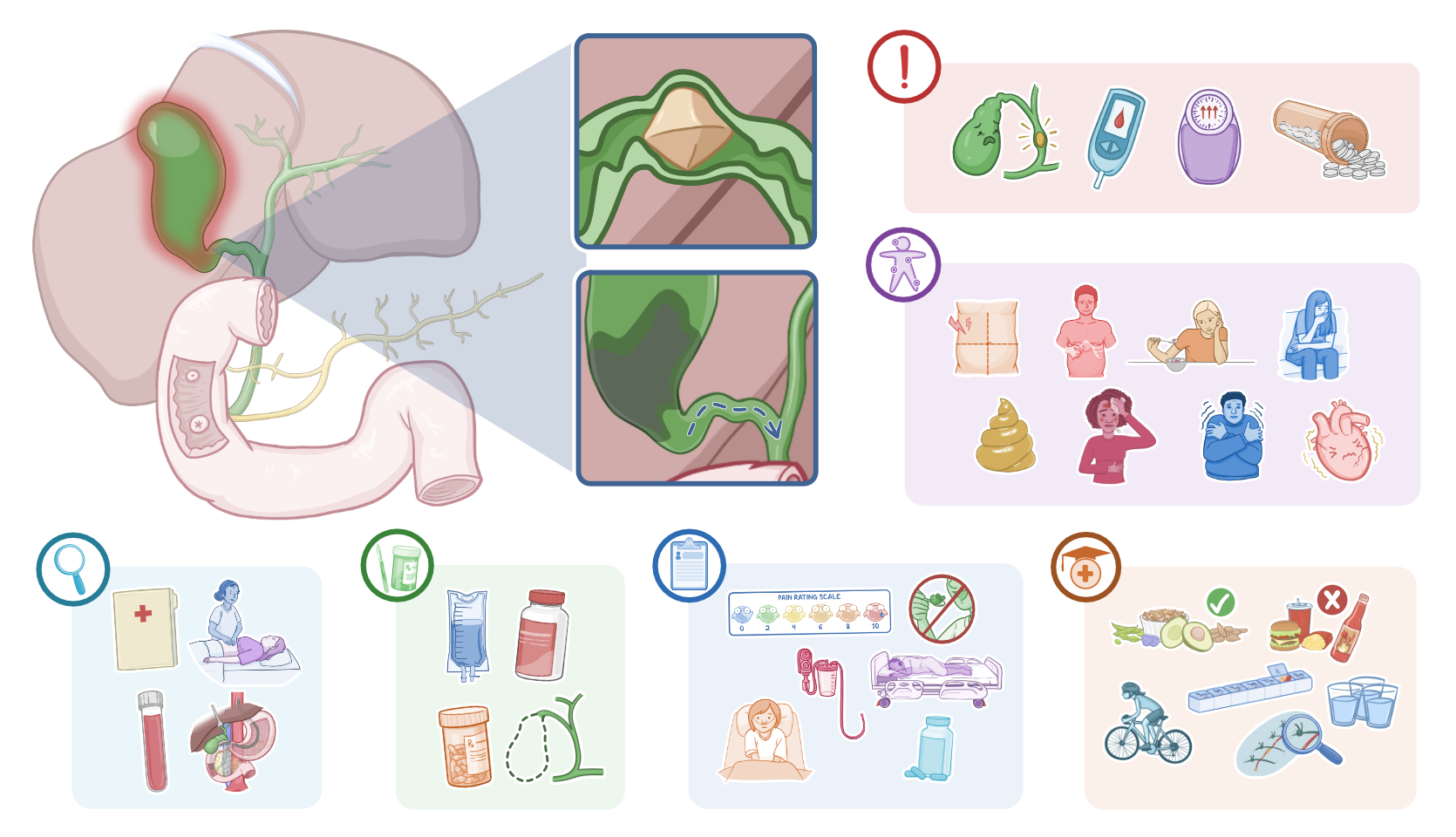
Depending on the underlying cause, cholecystitis can be classified as calculous or acalculous. The most common type is calculous cholecystitis, where biliary stasis is caused by cholelithiasis, or a gallstone, obstructing the cystic duct.
On the other hand, in acalculous cholecystitis, biliary stasis is caused by gallbladder dysfunction, leading to impaired gallbladder emptying in the absence of gallstones; most often, this occurs due to ischemia of the gallbladder, mainly in hospitalized clients who are critically ill.Risk factors for cholecystitis include cholelithiasis, diabetes, and obesity; as well as certain medications that decrease gallbladder emptying, like opioids; and conditions that lead to prolonged fasting, dehydration, or immobility, such as having cancer, sepsis, severe trauma or burns, as well as undergoing major abdominal surgery, and receiving parenteral nutrition for an extended period of time.Now, cholecystitis can be acute or chronic.
Pathology2:44–4:03
In acute cholecystitis, bile builds up inside the gallbladder, which causes irritation of the mucosa lining its walls. This also causes pressure in the gallbladder to increase, leading to wall distension and inflammation.
If this happens repeatedly, over time, clients may develop chronic cholecystitis, where the ongoing inflammation may cause the gallbladder to undergo fibrosis and calcification.
This can ultimately lead to a condition called porcelain gallbladder, in which the gallbladder becomes hard and brittle.
Now, both acute and chronic cholecystitis may lead to serious complications. For starters, once the bile flow is blocked, intestinal bacteria like Escherichia coli or Klebsiella and Enterococcus species, can slowly make their way up the biliary tract and cause infection; this is known as ascending cholangitis.
On the other hand, if the cholecystitis isn’t resolved and the pressure in the gallbladder keeps building up, it may start pushing down on the blood vessels supplying the gallbladder; as a result, the gallbladder starts to get ischemic, leading to gangrenous tissue death, so the wall might eventually perforate, ultimately leading to peritonitis and even sepsis.Now, symptoms of acute cholecystitis include acute, severe, and prolonged abdominal pain in the right upper quadrant or the epigastric region; in some cases, the pain can be referred to the right shoulder, which is known as Boas sign.
Clinical manifestations4:03–5:14
In addition, clients typically present with a positive Murphy sign; this is tested by deeply palpating the costal margin at the right upper quadrant, and then asking the client to take a deep breath; so, as the diaphragm pushes down on their inflamed gallbladder, it will cause sharp pain, forcing the client to stop breathing in further.
Other signs and symptoms include anorexia, nausea, vomiting, and intolerance for fatty foods, which may result in steatorrhea or greasy, foul-smelling stools.
Finally, some clients may develop jaundice, as well as fever, chills, and tachycardia. On the other hand, chronic cholecystitis presents with episodes of vague and steady abdominal pain, which may also be referred to the right shoulder; as well as heartburn, nausea and vomiting, intolerance for fatty foods, and some clients may develop jaundice.Diagnosis of cholecystitis starts with history and physical assessment, followed by laboratory tests showing leukocytosis and with elevated LDH, AST, ALT, and bilirubin blood levels.
Diagnosis5:14–6:04
Diagnosis can be confirmed with ultrasound, which can help detect any gallstones, as well as signs of gallbladder inflammation, such as wall thickening and pericholecystic fluid.
If the diagnosis remains unclear, the site of obstruction can be visualized with other diagnostic tests, including endoscopic retrograde cholangiopancreatography, or ERCP, which can also be used as treatment to remove the gallstone or drain the built up bile; as well as percutaneous transhepatic cholangiography, and hepatobiliary or HIDA scan.Initial treatment of cholecystitis often includes supportive measures like intravenous fluids, pain management, and antibiotics.
The definitive treatment for cholecystitis is cholecystectomy, which is surgical removal of the gallbladder. If surgery can’t be performed, an alternative treatment option is gallbladder drainage, either percutaneously or via ERCP.Okay, let’s look at the nursing care you’ll provide for a client with cholecystitis.
Treatment6:04–6:32
Your priority goals are to monitor for complications; as well as provide supportive care to relieve symptoms like fever, nausea, vomiting, and pain.Begin by asking your client about their pain, including the onset, quality, severity, location, aggravating or relieving factors, and how frequently they experience pain.
Management of care6:32–8:52
Next, assist them into a position of comfort, and administer the prescribed analgesics; in addition, if they have itching from jaundice, administer antihistamines.
For nausea and vomiting, institute NPO status, administer intravenous fluids and antiemetics, and insert a nasogastric tube for gastric decompression, as ordered.
Be sure to assist your client with mouth care after episodes of vomiting. Then, administer the prescribed antibiotics if an infection is suspected, and anticholinergics to prevent spasms and decrease gastrointestinal secretions.
Lastly, let them know what to expect during your interventions, and provide emotional support.Now, when caring for a client after a laparoscopic cholecystectomy, monitor their vital signs, as well as the incisions, and immediately report if you notice signs of bleeding or infection.
Encourage your client to cough and take deep breaths; keeping in mind that the CO2 that was used to inflate the abdomen during the procedure can sometimes linger in the abdominal cavity and irritate the phrenic nerve, making it painful for your client to breathe.
Assisting them into the Sims position can help move the CO2 away from the nerve and make deep breathing easier. Also, provide supplemental oxygen as ordered, and immediately report if your client develops tachypnea, shallow respirations, decreased SpO2, or abnormal breath sounds.
Additional interventions will include continuous monitoring of vital signs; as well as monitoring bowel sounds and bladder function; providing fluids; administering prescribed analgesics as needed; and assisting your client to change positions in bed and begin ambulating in preparation for discharge.
Okay, let’s move on to client and family teaching. Begin by explaining what the gallbladder does, and how it can be affected by their diet.
Advise your client to follow a diet with plenty of dietary fiber, fruits, and vegetables, and low in refined carbohydrates and fatty foods, which can help prevent their symptoms.
General client & family teaching8:52–11:37
Also, encourage them to engage in regular physical activity and to maintain a healthy weight. Refer them to a dietitian for an individualized diet plan if they need to lose weight.
Lastly, if your client smokes, provide information and referrals to assist with smoking cessation.Now, for clients who are being discharged after a laparoscopic cholecystectomy, instruct them on self-administration of their prescribed pain medication.
Let your client know they can resume most of their normal activities, but remind them that for the next few weeks, they should avoid strenuous activities, including sports, vigorous exercise, or heavy housework or yard work; they should also avoid lifting anything more than 10 pounds, which is approximately the weight of a gallon of milk.
Next, teach your client how to care for their incisional site. Let them know that a small amount of drainage is normal, but they should report if there’s redness, swelling, bleeding, bad-smelling drainage, or increased pain around their surgical incisions.
Remind your client to keep their incisions dry by avoiding bath tubs, hot tubs, or swimming, but let them know that they may shower and gently cleanse the area, followed by gently patting the area dry.
If sterile strips are used to cover their incision, instruct your client to keep them in place, and tell them that the strips will fall off on their own in a week or two.
If their incisions have a surgical glue on them, reassure your client that it will flake off on its own. In addition, teach your client about dietary modifications they should make while they recover.
Instruct them to drink at least 8 to 10 glasses of water daily, as well as to take the prescribed fiber supplement, and to consume foods high in fiber, including whole grains, legumes, vegetables, and fruits.
Also, remind them to avoid fatty, greasy, or spicy foods during recovery. In addition, emphasize the importance of avoiding straining with bowel movements, and prompt them to notify the healthcare provider if they don’t have a bowel movement within 2 to 3 days after they return home.
Lastly, provide your client with an appointment for their follow-up visit with their healthcare provider. All right, as a quick recap… Cholecystitis is inflammation of the gallbladder, which is a small pear-shaped organ located beneath the liver.
The liver produces bile to help digest fats, and is stored in the gallbladder and drained into the duodenum when needed.
Symptoms include abdominal pain in the right upper quadrant or the epigastric region, often referred to the right shoulder, which is known as Boas sign.
Review11:37–12:42
Other symptoms include a positive Murphy sign, fever, nausea, vomiting, intolerance for fatty foods, and jaundice. Diagnosis is based on history and physical assessment, and is confirmed with ultrasound, ERCP, percutaneous transhepatic cholangiography, or HIDA scan.
Initial treatment is focused on supportive measures with pain management and fluids, and definitive treatment is performed with a cholecystectomy.
Nursing care goals include monitoring for complications; providing supportive care to relieve symptoms like fever, nausea, vomiting, and pain, and providing education on lifestyle modifications and post-operative care.
and is confirmed with ultrasound ercp. Percutaneous transhepatic.
Cholangiography or HIDA. Scan initial treatment is focused on supportive, measures with pain management and fluids.
And definitive treatment is performed with a cholecystectomy nursing care. Goals include monitoring for complications, providing supportive care to relieve symptoms like fever, nausea, vomiting and pain and providing education on lifestyle modifications
| CHOLECYSTITIS | ||
| KEY POINTS | NOTES | |
| DEFINITION |
| |
| PHYSIOLOGY |
| |
| CAUSES AND RISK FACTORS |
| |
| PATHOPHYSIOLOGY |
| |
| SIGNS AND SYMPTOMS |
| |
| DIAGNOSIS |
| |
| TREATMENT |
| |
| MANAGEMENT OF CARE |
| |
| PATIENT AND FAMILY TEACHING |
| |
No notes for this video yet
Try adding a note below