Cholelithiasis: Nursing
Introduction0:00–0:14
Cholelithiasis refers to the presence of gallstones, or calculi, in the gallbladder as a result of precipitation of bile components, such as cholesterol and bilirubin.Now, let’s quickly review some anatomy and physiology of the hepatobiliary system, which is made of the liver, gallbladder, and bile ducts.
Physiology0:14–1:13
The liver is in charge of producing bile, which is mostly made up of bile salts and acids, cholesterol, phospholipids, proteins, bilirubin and small amounts of various other compounds, like water, electrolytes, and bicarbonate.
Then, bile flows out of the liver through the hepatic ducts towards the gallbladder, where it’s stored. Now, eating fatty foods stimulates the cells in the small intestine to secrete cholecystokinin into the bloodstream.
Cholecystokinin, in turn, stimulates the gallbladder contraction, causing it to release bile through the cystic duct, then the common bile duct, and ultimately into the duodenum.
Now, gallstone formation is caused by precipitation of bile components, such as cholesterol and bilirubin, respectively leading to the formation of cholesterol gallstones and pigment gallstones.
Causes & risk factors1:13–2:53
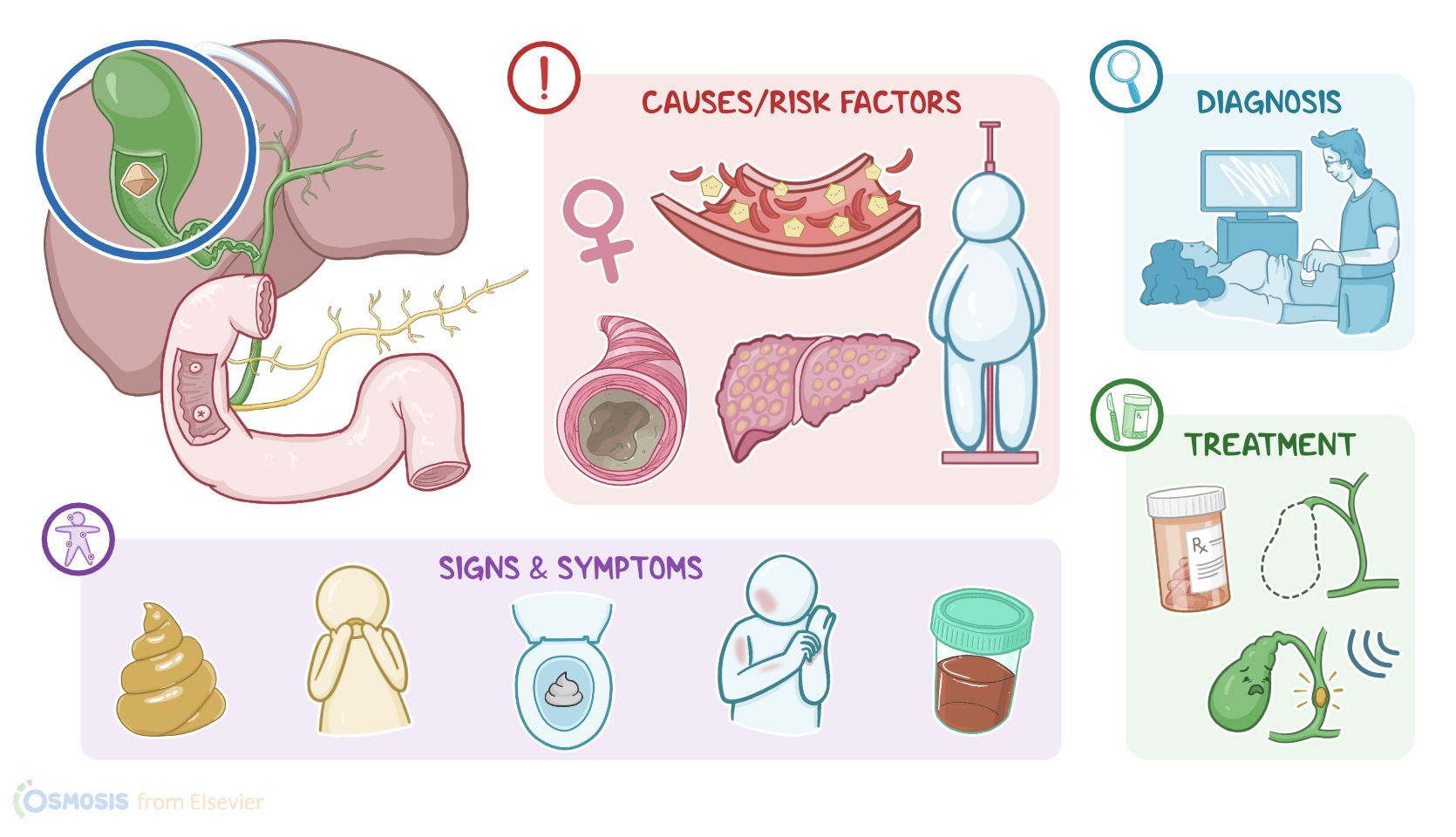
That being said, the main risk factors for cholesterol gallstones include being assigned female at birth, pregnancy, and oral contraceptive pills are associated with higher estrogen levels, which then increases cholesterol synthesis in the liver.
Other common risk factors include obesity and a high cholesterol diet; as well as increasing age, especially after 40. These can be remembered by the 3 Os for stooones, so ovulating, obesity, and older.
Next, anything affecting the terminal ileum, like Crohn’s disease, or ileal resection, can reduce the reabsorption of bile acids into the circulation and back to the liver, increasing the risk of cholelithiasis.
In addition, gallbladder stasis, or inactivity, has also been linked to gallstone formation. Risk factors for that include pregnancy and oral contraceptives, since progesterone also slows gallbladder emptying; and prolonged parenteral nutrition, which decreases cholecystokinin release and leads to biliary stasis.On the other hand, risk factors for pigment gallstones include conditions that cause extravascular hemolysis, such as sickle cell anemia.
In these situations, an increased rate of red blood cells metabolism leads to higher levels of bilirubin in the blood, which then passes on to the biliary tract.
Other risk factors include conditions like cirrhosis, and cystic fibrosis.Alright so, cholesterol gallstones are formed when the bile becomes supersaturated with cholesterol.
Pathology2:53–4:06
This means that there’s so much cholesterol that the bile salts and phospholipids can’t hold anymore in solution. As a result, cholesterol precipitates, forming solid cholesterol monohydrate crystals.
In addition to cholesterol supersaturation, there’s biliary stasis due to mucus hypomotility, and hypersecretion in the gallbladder.
In this environment, more cholesterol is added to existing crystals, leading to the formation of gallstones. On the other hand, pigment gallstones are formed when there’s a concentration of unconjugated bilirubin in the bile that is higher than normal.
These will bind to calcium ions and precipitate into calcium bilirubinate.Now, these gallstones can either remain in the gallbladder, or move out and get lodged in a duct along their way, obstructing its bile flow.
If the gallstone obstructs the cystic duct, this can lead to serious complications like acute cholecystitis, or inflammation of the gallbladder due to bile buildup.
If the gallstone gets lodged further down in the common bile duct, this also blocks the flow of bile from the liver, which is known as cholestasis.Now, the clinical manifestations of cholelithiasis depend on the gallstone’s location.
Clinical manifestations4:06–5:02
As long as the gallstones are inside the gallbladder, the client usually remains asymptomatic. However, if these gallstones move and obstruct a duct, the pressure in the gallbladder will increase as it tries to contract.
As a result, clients may experience biliary colic, which are often described as a severe, steady and dull pain in the upper right quadrant that can radiate to the right shoulder.
Biliary colic typically occurs when the gallbladder contracts a few hours after large, fatty meals, and lasts for up to an hour.
Clients may also experience nausea or vomiting. If a gallstone obstructs the flow of bile to the duodenum, the client can develop steatorrhea or greasy, foul-smelling stools; as well as clay-colored stools; dark amber urine; jaundice; and pruritus from bile salt deposits in the skin.Diagnosis of cholelithiasis involves history and physical assessment, followed by abdominal ultrasound, which shows a gallbladder containing gallstones.
Diagnosis5:02–6:06
In addition, the site of obstruction by the gallstone can be visualized with other diagnostic tests, including endoscopic retrograde cholangiopancreatography, or ERCP, where an endoscope goes through the duodenum and visualizes the bile duct and gallbladder, as well as the pancreatic duct.
ERCP can also be used as treatment to remove the gallstone. Other diagnostic techniques include percutaneous transhepatic cholangiography or PTC, and hepatobiliary or HIDA scan, where contrast media is used to help visualize the entire hepatobiliary system.
Lastly, laboratory findings in uncomplicated cholelithiasis are usually normal, while complicated cases can often show signs of inflammation, such as elevated white blood cell count, LDH, AST, ALT, and bilirubin blood levels.The treatment of cholelithiasis depends mainly on the clinical manifestations.
Treatment6:06–6:56
Asymptomatic clients usually require no treatment, except for special situations such as large gallstones, or clients with high risk of gallbladder carcinoma or for complications of gallstones.
On the other hand, symptomatic cholelithiasis can be treated with elective cholecystectomy, which is surgical removal of the gallbladder.
Now, if surgery can’t be performed, clients can be treated with medications like ursodeoxycholic or chenodeoxycholic acid, in order to help dissolve the gallstones.
Another option is to remove the stones via ERCP. Finally, if this doesn’t work, extracorporeal shock-wave lithotripsy can be used to disintegrate the gallstones by using high-energy shock waves.Alright, let’s look at the nursing care you’ll provide for a client with cholelithiasis.
Management and care6:56–8:48
The priority goals are monitoring for complications and relieving symptoms like pain, nausea, and vomiting. Begin by performing a pain assessment, asking your client about the onset, quality, severity, location, aggravating or relieving factors, and how frequently they experience pain.
Then, assist them into a position of comfort and administer the prescribed analgesics. If nausea and vomiting are severe, administer intravenous fluids and antiemetics, and insert a nasogastric tube for gastric decompression, as ordered.
Be sure to assist them with mouth care after episodes of vomiting. Also, let them know what to expect during your interventions, and provide emotional support.
Now, when caring for a client after a laparoscopic cholecystectomy, monitor their vital signs and incisions, and immediately report if you notice signs of bleeding or infection.
Encourage your client to cough and take deep breaths; keeping in mind that the CO2 that was used to inflate the abdomen during the procedure can sometimes linger in the abdominal cavity and irritate the phrenic nerve, making it painful for your client to breathe.
Assisting them into the Sims position can help move the CO2 away from the nerve and make deep breathing easier. Provide supplemental oxygen as ordered, and immediately report if your client develops tachypnea, shallow respirations, decreased SpO2, or abnormal breath sounds.
Your other interventions will include continuous monitoring of vital signs; as well as monitoring bowel sounds and bladder function; providing fluids; administering prescribed analgesics as needed; and assisting your client to change positions in bed and begin ambulating in preparation for discharge.
Okay, let’s move on to client and family teaching. For clients with uncomplicated cholelithiasis, begin by explaining what the gallbladder does, and how it can be affected by their diet.
General client and family teaching8:48–11:34
Teach them how following a diet with plenty of dietary fiber, fruits, and vegetables, and low in refined carbohydrates and fatty foods can help prevent their symptoms.
Also, encourage them to engage in regular physical activity and to maintain a healthy weight. Refer them to a dietitian for an individualized diet plan if they need to lose weight, and remind them that losing weight rapidly can cause their gallbladder to work harder and increase their symptoms.
Lastly, if your client smokes, provide information and referrals to assist with smoking cessation.Now, for clients who are being discharged after a laparoscopic cholecystectomy, instruct them on self-administration of their prescribed pain medication.
Let them know they can resume most of their normal activities, but remind them that for the next few weeks they should avoid strenuous activities, including sports, vigorous exercise, or heavy housework or yard work.
They should also avoid lifting anything more than 10 pounds, which is approximately the weight of a gallon of milk. Next, teach them how to care for their incisional site.
Let them know that a small amount of drainage is normal, but they should report if there’s redness, swelling, bleeding, bad-smelling drainage, or increased pain around their surgical incisions.
Be sure to remind your client to keep their incisions dry by avoiding bath tubs, hot tubs, or swimming, but let them know that they may shower and gently cleanse the area, followed by gently patting the area dry.
If sterile strips are used to cover their incision, instruct your client to keep them in place, and tell them that the strips will fall off on their own in a week or two.
If their incisions have a surgical glue on them, reassure your client that it will flake off on it’s own. In addition, teach your client about dietary modifications they should make while they recover.
Instruct them to drink at least 8 to 10 glasses of water daily, as well as to take the prescribed fiber supplement, and to consume foods high in fiber, including whole grains, legumes, vegetables, and fruits.
Also, remind them to avoid fatty, greasy, or spicy foods during recovery. In addition, emphasize the importance of avoiding straining with bowel movements, and prompt them to notify the healthcare provider if they don’t have a bowel movement within 2 to 3 days after they return home.
Lastly, provide your client with an appointment for their follow-up visit with their healthcare provider. Alright, as a quick recap… Cholelithiasis refers to the presence of gallstones in the gallbladder as a result of precipitation of bile components, such as cholesterol and bilirubin.
Review11:34–12:30
Symptoms typically occur when gallstones move and block a bile duct, causing pain in the right upper quadrant, sometimes associated with nausea, vomiting, steatorrhea, and jaundice.
Diagnosis is usually done by obtaining a history and physical assessment, along with other diagnostic tests to visualize the gallstone, such as abdominal ultrasound, or through ERCP or HIDA scan.
Treatment for choleliathiasis depends on the client’s symptoms, and range from supportive care to cholecystectomy, stone removal via ERCP, lithotripsy, or taking medications to help dissolve the gallstones.
Nursing care focuses on monitoring for complications; relieving symptoms like pain, nausea, and vomiting; and providing education on lifestyle modifications and self-care at home.
medications to help dissolve gallstones, nursing care, focus is on monitoring for complications, relieving symptoms, like pain, nausea, and vomiting, and providing education on lifestyle,
| CHOLELITHIASIS | ||
| KEY POINTS | NOTES | |
| DEFINITION |
| |
| PHYSIOLOGY |
| |
| CAUSES AND RISK FACTORS |
| |
| PATHOPHYSIOLOGY |
| |
| SIGNS AND SYMPTOMS |
| |
| DIAGNOSIS |
| |
| TREATMENT |
| |
| MANAGEMENT OF CARE |
| |
| PATIENT AND FAMILY TEACHING |
| |
No notes for this video yet
Try adding a note below