Cholelithiasis: Nursing

Last updated: January 18, 2022

Cholelithiasis: Nursing

Acute Final

Acute Final

Endocrine system anatomy and physiology
Antepartum assessment - Fetus: Nursing
Assessment of gestational age: Nursing
Fetal circulation: Nursing
Fetal development: Nursing
Group B streptococcus (GBS) infection in pregnancy: Nursing
Hepatitis B virus (HBV) infection in pregnancy: Nursing
Hyperemesis gravidarum: Nursing
Large for gestational age (LGA) infant: Nursing
Preeclampsia and eclampsia: Nursing
Prenatal screening: Nursing
Placenta previa: Nursing process (ADPIE)
Placental abruption: Nursing process (ADPIE)
Birth-related procedures: Nursing
Cesarean birth: Nursing
Intrapartum assessment - Fetal heart rate patterns: Nursing
Intrapartum assessment - Uterine activity: Nursing
Premature rupture of membranes (PROM): Nursing
Shoulder dystocia: Nursing
Prolapsed umbilical cord: Nursing process (ADPIE)
Stages of labor: Nursing
Assessment - Postpartum: Nursing
Perinatal depression: Nursing
Physiology of lactation: Nursing
Postpartum infections: Nursing
Postpartum hemorrhage: Nursing
Biliary atresia: Nursing
Cleft lip and palate: Nursing
Congenital diaphragmatic hernia: Nursing
Congenital heart defects - Acyanotic: Nursing
Congenital heart defects - Cyanotic: Nursing
Esophageal atresia and tracheoesophageal fistula: Nursing
Craniosynostosis: Nursing
Hemolytic disease of the fetus and newborn: Nursing
Hyperbilirubinemia: Nursing process (ADPIE)
Infant of a diabetic mother (IDM): Nursing
Meconium aspiration syndrome: Nursing
Neonatal respiratory distress syndrome (NRDS): Nursing
Neonatal sepsis: Nursing
Neural tube defects: Nursing
Newborn adaptation to extrauterine life: Nursing
Persistent pulmonary hypertension of the newborn (PPHN): Nursing
Physical assessment - Neonate: Nursing
Small for gestational age (SGA) infant: Nursing
Postterm infant: Nursing
Thermoregulation - Neonate: Nursing
Arterial blood gas (ABG) - Overview: Nursing
Arterial blood gas (ABG) - Metabolic acidosis: Nursing
Arterial blood gas (ABG) - Metabolic alkalosis: Nursing
Arterial blood gas (ABG) - Respiratory acidosis: Nursing
Arterial blood gas (ABG) - Respiratory alkalosis: Nursing
Adrenal insufficiency (Addison disease): Nursing
Anemia - Iron-deficiency: Nursing
Anemia - Aplastic: Nursing
Anemia - Macrocytic: Nursing
Case study - Hypothyroidism: Nursing
Case study - Iron-deficiency anemia: Nursing
Case study - Sickle cell anemia: Nursing
Complete blood count (CBC) - Hemoglobin and hematocrit: Nursing
Complete blood count (CBC) - Red blood cells (RBC): Nursing
Complete blood count (CBC) - Platelets: Nursing
Complete metabolic panel (CMP) - Blood urea nitrogen (BUN) and creatinine (Cr): Nursing
Complete metabolic panel (CMP) - Estimated glomerular filtration rate (eGFR): Nursing
Complete metabolic panel (CMP) - Liver function tests (LFT): Nursing
Cushing syndrome and Cushing disease: Nursing
Hematopoietic growth factors: Nursing pharmacology
Hyperparathyroidism: Nursing
Hyperthyroidism: Nursing process (ADPIE)
Hypoparathyroidism: Nursing
Hyperpituitarism: Nursing
Hypopituitarism: Nursing
Hypothyroidism: Nursing process (ADPIE)
Medications affecting the parathyroid glands: Nursing pharmacology
Medications for growth hormone disorders: Nursing pharmacology
Medications for thyroid disorders: Nursing pharmacology
Neutropenia: Nursing
Polycythemia: Nursing
Thrombocytopenia: Nursing
Acute kidney injury (AKI): Nursing process (ADPIE)
Benign prostatic hyperplasia (BPH): Nursing process (ADPIE)
Case study - Cholecystitis: Nursing
Case study - Cirrhosis: Nursing
Case study - Chronic kidney disease (CKD): Nursing
Case study - Benign prostatic hyperplasia (BPH): Nursing
Case study - Gastroesophageal reflux disease (GERD): Nursing
Case study - Pediatric appendicitis: Nursing
Case study - Pyelonephritis: Nursing
Cholecystitis: Nursing
Cholelithiasis: Nursing
Chronic kidney disease (CKD): Nursing
Cirrhosis: Nursing process (ADPIE)
Diverticular disease: Nursing
Gastroesophageal reflux disease (GERD): Nursing process (ADPIE)
Hemolytic uremic syndrome: Nursing
Hirschsprung disease: Nursing
Intestinal obstruction: Nursing
Irritable bowel syndrome (IBS): Nursing
Nephrotic syndrome: Nursing
Pyloric stenosis: Nursing process (ADPIE)
Renal and urinary calculi: Nursing
Urinary incontinence - Stress: Nursing process (ADPIE)
Diabetes insipidus: Nursing process (ADPIE)
Dialysis care: Nursing
Case study - Diabetic ketoacidosis (DKA): Nursing
Case study - Pediatric diabetes mellitus type 1: Nursing
Diabetes mellitus (DM): Nursing process (ADPIE)
Hyperosmolar hyperglycemic state (HHS): Nursing process (ADPIE)
Diabetic ketoacidosis (DKA): Nursing process (ADPIE)
Case study - Epilepsy: Nursing
Case study - Head injury: Nursing
Epidural and subdural hematoma: Nursing
Case study - Stroke: Nursing
Hemorrhagic stroke - Intracranial hemorrhage (ICH) and subarachnoid hemorrhage (SAH): Nursing
Increased intracranial pressure (ICP): Nursing
Hydrocephalus: Nursing process (ADPIE)
Intracranial aneurysm: Nursing
Seizure disorder: Nursing process (ADPIE)
Stroke: Nursing process (ADPIE)
Jaundice: Nursing
Nutrition - Enteral: Nursing skills
Nutrition - Newborn: Nursing
Nutrition - Parenteral: Nursing skills
Phenylketonuria (PKU): Nursing
Arterial embolism: Nursing
Disseminated intravascular coagulation (DIC): Nursing
Hemophilia: Nursing process (ADPIE)
Acute respiratory distress syndrome (ARDS): Nursing
Asthma: Nursing process (ADPIE)
Atelectasis: Nursing
Bacterial pneumonia: Nursing process (ADPIE)
Bronchiolitis and respiratory syncytial virus (RSV): Nursing process (ADPIE)
Case study - Acute respiratory distress syndrome (ARDS): Nursing
Care of an intubated client: Nursing skills
Case study - Chronic obstructive pulmonary disease (COPD): Nursing
Case study - Impaired gas exchange: Nursing
Case study - Pediatric asthma: Nursing
Chest tube care: Nursing
Chronic obstructive pulmonary disease (COPD): Nursing process (ADPIE)
Cystic fibrosis: Nursing
Epiglottitis: Nursing process (ADPIE)
Flail chest: Nursing
Intraoperative care: Nursing
Pleural effusion: Nursing
Pneumothorax and hemothorax: Nursing
Pulmonary edema: Nursing
Smoke inhalation injury: Nursing process (ADPIE)
Tracheostomy: Nursing
Venous thromboembolism (VTE): Nursing process (ADPIE)
Arrhythmias - Asystole: Nursing
Arrhythmias - Atrial flutter (Aflutter): Nursing
Arrhythmias - Premature atrial contractions (PACs): Nursing
Arrhythmias - Heart blocks: Nursing
Arrhythmias - Atrial fibrillation (Afib): Nursing
Arrhythmias - Premature ventricular contractions (PVCs): Nursing
Arrhythmias - Sinus tachycardia and sinus bradycardia: Nursing
Arrhythmias - Supraventricular tachycardia (SVT): Nursing
Arrhythmias - Ventricular fibrillation (Vfib): Nursing
Arrhythmias - Ventricular tachycardia (Vtach): Nursing
Cardiac biomarkers - Troponin: Nursing
Case study - Acute coronary syndrome (ACS): Nursing
Case study - Atrial fibrillation (Afib): Nursing
Case study - Heart failure with reduced ejection fraction (HFrEF): Nursing
Case study - Deep vein thrombosis (DVT): Nursing
Case study - Hypertension: Nursing
Case study - Hypovolemic shock: Nursing
Coronary artery disease (CAD) and angina pectoris: Nursing process (ADPIE)
Electrocardiogram (ECG) - Normal sinus rhythm (NSR): Nursing
Heart defects that decrease pulmonary blood flow - Nursing considerations & client education: Nursing
Hypertension: Nursing process (ADPIE)
Left-sided heart failure: Nursing process (ADPIE)
Myocardial infarction (MI): Nursing process (ADPIE)
Pericardial effusion and cardiac tamponade: Nursing process (ADPIE)
Peripheral arterial disease (PAD): Nursing process (ADPIE)
Rheumatic heart disease: Nursing process (ADPIE)
Shock - Cardiogenic: Nursing
Shock - Neurogenic: Nursing
Shock - Obstructive: Nursing
Shock - Septic: Nursing
Sickle cell disease: Nursing process (ADPIE)
Valvular heart disease: Nursing

Notes

CHOLELITHIASIS

KEY POINTS
NOTES
DEFINITION
  • Gallstones, or calculi, in the gallbladder
    • Cholesterol gallstones
    • Pigment gallstones

PHYSIOLOGY
  • Liver produces bile
  • Bile flows from liver through hepatic ducts to gallbladder where it's stored
  • Eating fatty foods stimulates release of cholecystokinin (CCK) into bloodstream
  • CCK stimulates gallbladder to contract and release bile
  • Bile acts as fat emulsifier

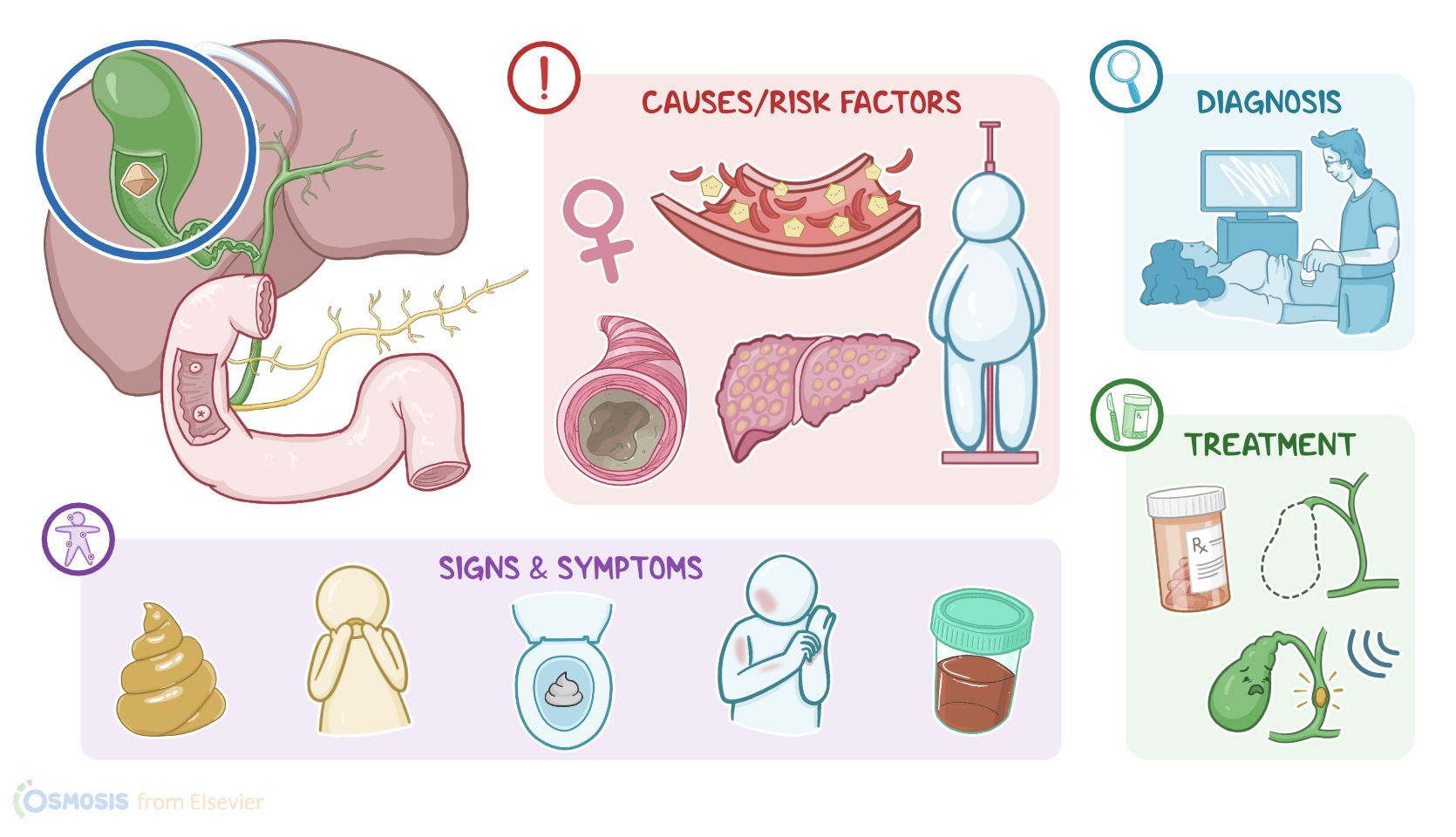
CAUSES AND RISK FACTORS
  • Causes
    • Precipitation of bile components
    • Any condition affecting terminal ileum
    • Gallbladder stasis
  • Risk factors
    • Assigned female at birth
    • Pregnancy
    • Oral contraceptive pills
    • Obesity
    • High cholesterol diet
    • Increasing age
    • Prolonged parenteral nutrition
    • Conditions that cause hemolytic anemia
    • Cirrhosis
    • Cystic fibrosis

PATHOPHYSIOLOGY
  • Cholesterol gallstones
    • Bile becomes supersaturated with cholesterol
    • Cholesterol precipitates
      • Forms solid crystals
        • Biliary stasis and hypersecretion further contribute 
  • Pigment gallstones
    • High concentration of unconjugated bilirubin in bile
      • Binds calcium to precipitate into calcium bilirubinate
  • Remain in gallbladder or move out and lodge in a duct
  • Complications
    • Acute cholecystitis
    • Cholestasis

SIGNS AND SYMPTOMS
  • Depend on gallstone's location
    • Gallbladder
      • Asymptomatic
    • Duct
      • Biliary colic
      • Nausea
      • Vomiting
      • Steatorrhea
      • Clay-colored stools
      • Dark urine
      • Jaundice
      • Pruritus

DIAGNOSIS
  • History
  • Physical assessment
  • Ultrasound
  • Endoscopic retrograde cholangiopancreatography (ERCP)
  • Percutaneous transhepatic cholangiography (PTC)
  • HIDA scan
  • Laboratory tests

TREATMENT
  • Asymptomatic
    • None
  • Symptomatic
    • Cholecystectomy
    • Medications
    • ERCP
    • Shock-wave lithotripsy

MANAGEMENT OF CARE
  • Goals of care
    • Monitoring for complications
    • Relieve symptoms
  • Assess pain
  • Assist to position of comfort
  • Administer analgesics, IV fluids, and antiemetics
  • Insert nasogastric (NG) tube 
  • Assist with mouth care
  • Provide psychosocial support

  • Post-cholecystectomy
    • Monitor vital signs and incisions
    • Report to HCP
      • Signs of bleeding or infection
    • Encourage coughing and deep breathing
    • Provide supplemental oxygen
      • Report to HCP
        • Tachypnea
        • Shallow respirations
        • Decreased oxygen saturation
        • Abnormal breath sounds
    • Encourage ambulation

PATIENT AND FAMILY TEACHING
  • Explain condition, plan of care, and how to safely self-administer medications
  • Eat a diet high in fiber, fruits, and vegetables; low in refined carbohydrates and fatty foods
  • Regular physical activity
  • Healthy weight
  • Refer to dietician as needed
  • Smoking cessation
  • Avoid strenuous activity
  • Incisional site care
    • Keep dry
    • Keep steri-strips or glue in place
  • Report to HCP
    • Redness
    • Swelling
    • Bleeding
    • Foul drainage
    • Increased pain
    • No bowel movement within 2-3 days
    • Fever
    • Chills
    • Dark urine
    • Jaundice
  • Maintain all follow-up appointments

Transcript

Watch video only

Cholelithiasis refers to the presence of gallstones, or calculi, in the gallbladder as a result of precipitation of bile components, such as cholesterol and bilirubin.

Now, let’s quickly review some anatomy and physiology of the hepatobiliary system, which is made of the liver, gallbladder, and bile ducts. The liver is in charge of producing bile, which is mostly made up of bile salts and acids, cholesterol, phospholipids, proteins, bilirubin and small amounts of various other compounds, like water, electrolytes, and bicarbonate.

Then, bile flows out of the liver through the hepatic ducts towards the gallbladder, where it’s stored. Now, eating fatty foods stimulates the cells in the small intestine to secrete cholecystokinin into the bloodstream.

Cholecystokinin, in turn, stimulates the gallbladder contraction, causing it to release bile through the cystic duct, then the common bile duct, and ultimately into the duodenum. Once in the duodenum, bile acts as a fat emulsifier, which essentially helps to digest lipids from food into small micelles, making them easier to absorb.

Now, gallstone formation is caused by precipitation of bile components, such as cholesterol and bilirubin, respectively leading to the formation of cholesterol gallstones and pigment gallstones.

That being said, the main risk factors for cholesterol gallstones include being assigned female at birth, pregnancy, and oral contraceptive pills are associated with higher estrogen levels, which then increases cholesterol synthesis in the liver. Other common risk factors include obesity and a high cholesterol diet; as well as increasing age, especially after 40. These can be remembered by the 3 Os for stooones, so ovulating, obesity, and older.

Next, anything affecting the terminal ileum, like Crohn’s disease, or ileal resection, can reduce the reabsorption of bile acids into the circulation and back to the liver, increasing the risk of cholelithiasis. In addition, gallbladder stasis, or inactivity, has also been linked to gallstone formation. Risk factors for that include pregnancy and oral contraceptives, since progesterone also slows gallbladder emptying; and prolonged parenteral nutrition, which decreases cholecystokinin release and leads to biliary stasis.

On the other hand, risk factors for pigment gallstones include conditions that cause extravascular hemolysis, such as sickle cell anemia. In these situations, an increased rate of red blood cells metabolism leads to higher levels of bilirubin in the blood, which then passes on to the biliary tract. Other risk factors include conditions like cirrhosis, and cystic fibrosis.

Alright so, cholesterol gallstones are formed when the bile becomes supersaturated with cholesterol. This means that there’s so much cholesterol that the bile salts and phospholipids can’t hold anymore in solution. As a result, cholesterol precipitates, forming solid cholesterol monohydrate crystals.

In addition to cholesterol supersaturation, there’s biliary stasis due to mucus hypomotility, and hypersecretion in the gallbladder. In this environment, more cholesterol is added to existing crystals, leading to the formation of gallstones.

On the other hand, pigment gallstones are formed when there’s a concentration of unconjugated bilirubin in the bile that is higher than normal. These will bind to calcium ions and precipitate into calcium bilirubinate.

Now, these gallstones can either remain in the gallbladder, or move out and get lodged in a duct along their way, obstructing its bile flow. If the gallstone obstructs the cystic duct, this can lead to serious complications like acute cholecystitis, or inflammation of the gallbladder due to bile buildup. If the gallstone gets lodged further down in the common bile duct, this also blocks the flow of bile from the liver, which is known as cholestasis.