Chronic obstructive pulmonary disease (COPD): Nursing process (ADPIE)
Client Report0:00–0:36
James Robin is a 67 year old male client who was brought to the emergency department or ED with a three-day history of exertional breathlessness, wheezing, fatigue, and a worsening productive cough.
He states he's been having increased difficulty with normal day to day. Day activities such as eating, talking, and going up the stairs.
He has a history of cigarette smoking, 2 packs per day, since he was 25 years old. However, he quit smoking a year ago after being diagnosed with chronic obstructive pulmonary disease, or COPD.
Pathology0:36–5:02
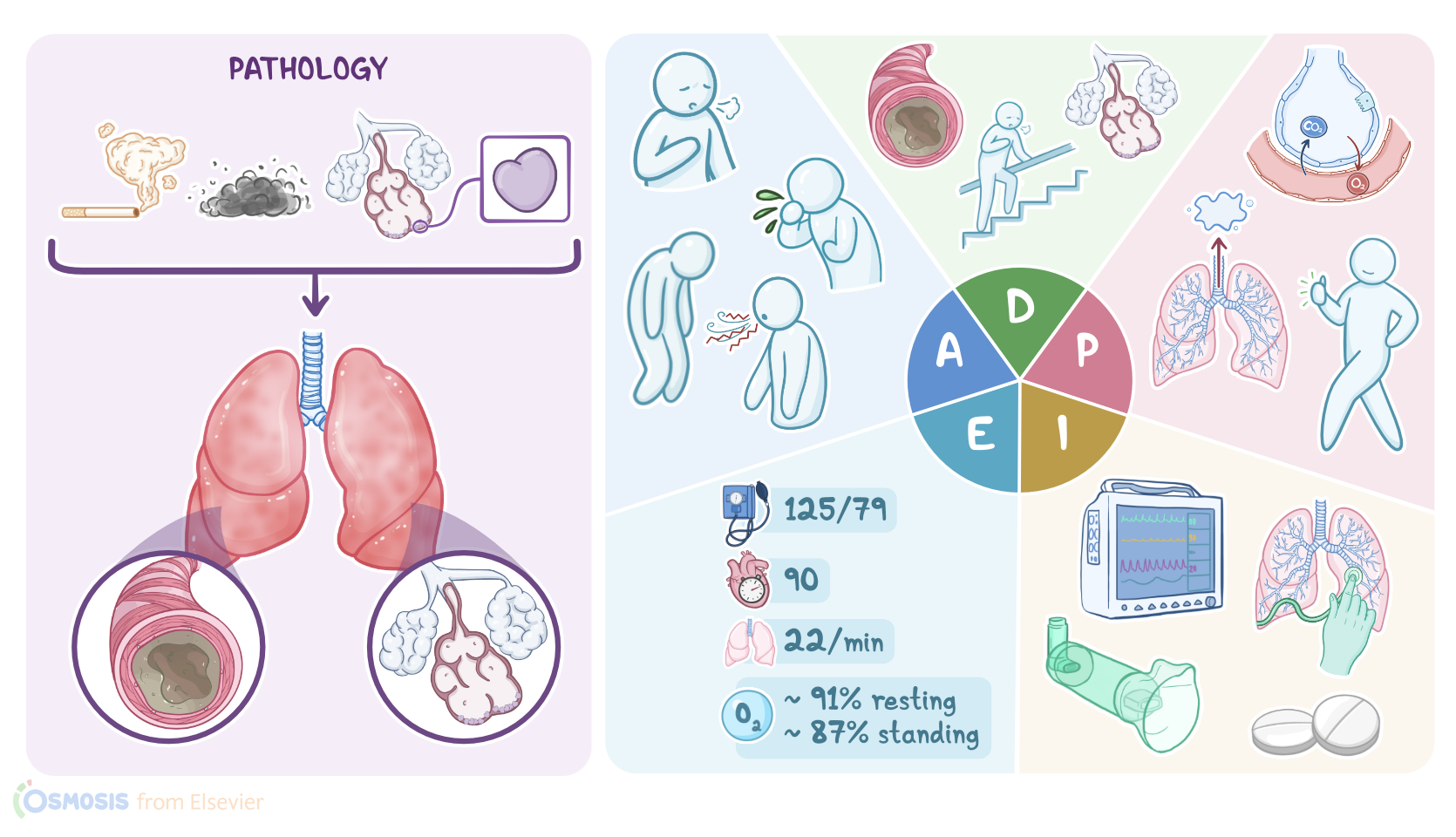
COPD or chronic obstructive pulmonary disease, is a type of lung disease where chronic inflammation causes damage to the lungs and obstructs airflow.
It's usually caused by inhalation of toxic substances like tobacco smoke, or occupational pollutants like dust and silica.
In some people, an autosomal dominant disorder called alpha-1 antitrypsin deficiency results in breakdown of the lung parenchyma by an enzyme called elastase.
COPD is characterized by long-term inflammation of the bronchial tubes, referred to as chronic bronchitis, and alveolar destruction, referred to as emphysema.
Most people diagnosed with COPD have elements of both chronic bronchitis and emphysema. Chronic inflammation of the bronchial tubes and COPD causes a hypersecretion of mucus by the respiratory goblet cells.
The mucus then forms a plug that obstructs the airways, causing air trapping, and it also causes chronic productive cough.
Destruction of the alveolar sacs impairs gas exchange, resulting in hypoxemia and hypercapnia. Loss of elastic recoil causes collapse of the airways during exhalation, trapping the air and dilating the airspaces.
To make breathing easier, they often use the tripod position, where they sit up and lean forward with their hands on their knees.
They may use pursed lip breathing to prolong expiration and produce positive end expiratory pressure, or peep, which allows them to breathe out as much air as possible.
It causes constriction of the pulmonary vessels and pulmonary hypertension. This increases the workload on the right side of the heart, leading to right-sided heart failure or core pulmonale.
Diagnosis of COPD is based on the client history, physical examination, and pulmonary function tests, or PFTs, to evaluate the degree of airway limitation.
The forced expiratory volume in 1 2nd, or FEV1, and the vital capacity or FVC are measured after the client is given a bronchodilator, such as albuterol.
A FEV1 to FVC ratio less than 70% indicates airway obstruction. Since COPD is an irreversible disease, giving a bronchodilator does not change the person's PFTs too much.
Finally, alpha-1 antitrypsin deficiency screening may also be done. Long-term management for stable COPD includes smoking cessation and the avoidance of other triggers such as pollution and allergens.
Influenza and pneumococcal vaccines should be administered to decrease the risk of respiratory infections. Although COPD is an irreversible disease, bronchodilators can help ease symptoms, and corticosteroids can decrease inflammation in the lungs.
Supplemental oxygen may be needed to maintain an oxygen saturation between 88 to 92%. For these clients, the goal is not 100% saturation, because hypoxemia is the main stimulus for their respiratory drive.
Finally, since these individuals expend much of their energy on simply breathing, dietary adjustments may be needed to maintain weight and muscle mass.
An exacerbation or a sustained deterioration of their respiratory symptoms beyond their normal day to day variability may manifest with increased dyspnea, cough, sputum production, and fatigue.
Increased wheezing may be noted, and increased hypoxia may result in confusion or decreased level of consciousness. Arterial blood gasses or ABGs may show decreased PAO2, increased PACO2, increased HCO, and decreased PH.
Assessment5:02–7:21
OK, let's get back to our client, Mr. Robin.
Since presenting to the ED, he has been admitted to the pulmonary ward for treatment of an acute exacerbation of COPD. You have been assigned to his care.
After entering his room, you introduce yourself, wash your hands, and confirm his identity. Mr.
Robin is sitting up on the side of the bed, leaning over his bedside table in a tripod position. You begin your assessment of Mr.
Robin by asking how he's feeling today. He states he's feeling short of breath and very tired.
You notice that he struggles to complete full sentences because he has to stop to breathe. You notice nasal flaring, and he's pursing his lips during expiration.
He states that he has had worsening respiratory symptoms for about a week, including breathlessness when doing activities such as getting up to go to the bathroom, talking, and eating.
He states he has had a chronic productive cough for years. He says he usually coughs up clear sputum.
However, in the last few mornings, it has increased in volume and is a thicker consistency. Upon visual inspection of Mr.
You auscultate his lungs, which reveals expiratory wheezing and coarse crackles to the lower lobes. Capillary refill is less than 3 seconds.
Throughout your assessment, Mr. Robin appears alert and oriented, but continues to be short of breath.
His vital signs are as follows. BP 135/80.
Heart rate, 80 BPM. Temperature, 98.6 °F or 37 °C.
Oxygen saturation, 87% on room air. Respiratory rate, 26 per minute.
Zero out of 10 pain. You review his latest lab values, which include complete blood count, basic metabolic panel, and arterial blood gasses.
You make a note of his ABG values. PH is 7.34.
PAO2 is 62 millimeters of mercury. PACO2 is 65 millimeters of mercury.
HCO3 is 32 milliequivalents per liter. You document your assessment findings before leaving the room.
Based on the assessment data you've collected, the nursing diagnoses include ineffective breathing pattern related to increased work of breathing, ineffective airway clearance related to increased production of secretions, impaired gas exchange related to airway destruction, activity intolerance related to imbalance between oxygen supply and demand, and deficient knowledge related to chronic disease management.
Diagnosis7:21–8:47
Now that you've gathered all the assessment data, relevant diagnostic information, lab values, and created some nursing diagnoses, you outline several important goals to achieve.
And he will maintain clear, open airways as evidenced by clear breath sounds and ability to effectively cough up secretions.
Optimal gas exchange will be demonstrated by unlabored respirations at 12 to 20 per minute, pulse oximetry at therapeutic levels during rest and exertion, and blood gasses closer to normal range.
Increased activity tolerance will be evidenced by enhanced capacity and energy to ambulate 25 ft without feeling breathless.
Finally, prior to discharge, Mr. Robin will verbalize an understanding of COPD, demonstrate how to use his inhaler, avoid triggers for exacerbations, and understand the long-term management of COPD.
After collaborating with Mr. Robin's healthcare team and receiving orders, you review the plan of care.
Implementation8:47–10:23
While completing Mr. Robins's vital signs, which are ordered every 2 hours, you continue to monitor his respiratory status by listening to his lungs and observing his breathing rate, depth, and use of accessory muscles.
Mr. Robins's other orders include supplemental oxygen therapy at 2 L via nasal cannula, with continuous monitoring of his saturations through pulse oximetry.
His target oxygen saturation is ordered to be between 88 and 92%. Several medications have been ordered, including albuterol, a bronchodilator administered via inhaler with a spacer, and prednisone, an oral corticosteroid.
While administering these medications, you review with Mister Robin the proper technique for using the inhaler, and remind him that he will need to adhere to his medication regimen after discharge.
You stress the importance of continued smoking cessation and measures to decrease the risk of infections, including hand washing and vaccinations.
You collaborate with the physical therapist, or PT who is helping Mr. Robin with techniques and exercises to help ease his work of breathing and conserve energy while completing ADLs.
The respiratory therapist, or RT helps him learn breathing and airway clearance techniques and draws blood for blood gas analysis.
Throughout your shift, you'll closely monitor for signs of deteriorating respiratory status. Any increased dyspnea, cyanosis, and decreased level of consciousness will be reported to the ordering physician immediately.
By now, it's near the end of your shift, and it's time to evaluate and see how Mister Robin is doing. His breathing appears less labored.
Evaluation10:23–11:37
He's no longer using accessory muscles, and he's been effectively coughing up his secretions. He has remained on 2 L of oxygen via nasal cannula throughout your shift.
His oxygen saturation remains at 91% while resting, but decreases to 87% when standing up or ambulating a few steps. He remains alert and oriented throughout the shift, but he tires quite easily.
His vital signs are BP 125/79, heart rate 90, temperature 98.6 °F or 37 °C, respiratory rate 22 per minute, and pain 0 out of 10.
His ABGs are PH 7.4, PAO2, 72 millimeters of mercury, PACO2, 48 millimeters of mercury, HCO3, 28 milliequivalents per liter.
So, it's pretty clear, Mr. Robin is improving.
You continue to reassess, re-evaluate, and document Mr. Robins's response to interventions to determine if his goals are being met, and if his plan of care should be revised.
All right, as a quick recap, your assigned client, James Robin, presented to the ED with an exacerbation of COPD which is characterized by inflammation, hypersecretion of mucus, airway obstruction, and alveolar destruction.
Summary11:37–13:08
Inhalation of toxic substances like tobacco smoke or environmental pollutants are common causes. An acute exacerbation of COPD is usually the result of an infection, but can also be caused by seasonal allergies or inhalation of irritants.
Signs and symptoms of an acute exacerbation include increased dyspnea, cough, and sputum production, along with wheezing, fatigue, confusion, and disorientation.
He had an increase in amount and consistency of secretion. He was tachypnic and had wheezing and crackles in his lungs.
Your nursing diagnoses were ineffective breathing pattern, ineffective airway clearance, impaired gas exchange, activity intolerance, and deficient knowledge.
The goals you identified when planning care for Mr. Robin included establishing an effective breathing pattern, maintaining clear airways, increased activity tolerance, and understanding his medication regimen, effective breathing techniques, and risk factors for exacerbations.
Interventions will continue to be implemented and evaluated to determine if his goals are being
| CHRONIC OBSTRUCTIVE PULMONARY DISEASE (COPD) | ||
| KEY POINTS | NOTES | |
| PATIENT REPORT |
| |
| PATHOPHYSIOLOGY |
| |
| DIAGNOSIS AND TREATMENT |
| |
| ASSESSMENT |
| |
| NURSING DIAGNOSES |
| |
| PLANNING |
| |
| IMPLEMENTATION |
| |
| EVALUATION |
| |
- "Ackley and Ladwig’s Nursing Diagnosis Handbook: An Evidence-Based Guide to Planning Care, 13th edition" Mosby (2022)
- "Update on Clinical Aspects of Chronic Obstructive Pulmonary Disease" N Engl J Med (2019)
- "The etiologic origins for chronic obstructive pulmonary disease" Int J Chron Obstruct Pulmon Dis (2019)
- "Harrison’s Principles of Internal Medicine, 21st edition" McGraw Hill / Medical (2022)
- "Definition, Causes, Pathogenesis, and Consequences of Chronic Obstructive Pulmonary Disease Exacerbations" Clin Chest Med (2020)
- "Critical Care Nursing: Diagnosis and Management, 9th edition" Elsevier (2021)
No notes for this video yet
Try adding a note below