Circumcision: Nursing
Circumcision is the surgical removal of the foreskin that covers the tip of the penis. It's a common procedure for infants with a penis.
Let’s first review the anatomy of the male external genitalia, which consists of the scrotum and the penis. The scrotum is a skin and muscle pouch that hangs outside the body and contains the testes. The penis is composed of the body, or shaft, which ends with an enlarged tip, the glans penis, that has an opening called the external urethral orifice at its very tip, where semen or urine are released outside the body. Around the glans penis, a cuff of loose skin makes up the foreskin or prepuce.
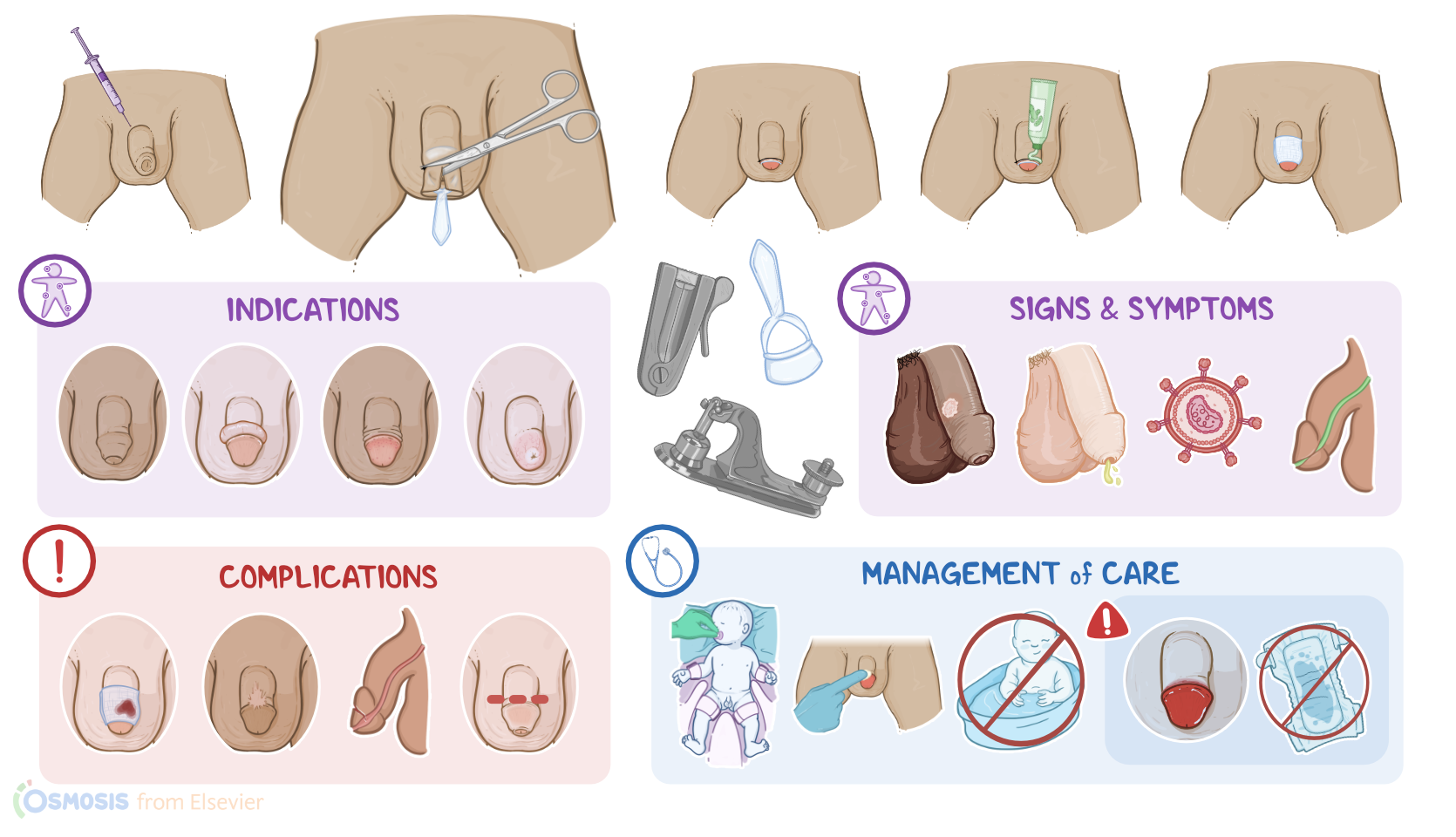
Now, there are various indications for circumcision, which can be religious, social, cultural, and personal. In fact, in some cultures, circumcision is a ceremony that is done outside the clinical setting, especially for those of the Jewish faith. On the other hand, other cultures have strong beliefs to keep the foreskin intact.
Other indications for circumcision include penile trauma and various deformities, such as phimosis, which is when the foreskin is too tight on the glans penis so that it can’t be pulled backward. A similar condition is paraphimosis, which is when the foreskin cannot be returned to its original position after retraction. Circumcision might also be indicated in clients with recurrent balanitis, which is inflammation of the glans penis, in addition to balanitis xerotica obliterans, which is a progressive inflammatory dermatosis of the foreskin and glans penis.
Finally, circumcision can also be done to prevent certain conditions, such as penile cancer, sexually transmitted diseases, including human immunodeficiency virus, or HIV, as well as to prevent urinary tract infections in infants with a type of congenital uropathy, where the flow of urine is obstructed..
The circumcision procedure starts under sterile conditions with the baby positioned on their back with arms and legs restrained. An anesthetic agent is then injected into the base of the penis, or it’s applied to the penis as a cream. Then, a device such as a Plastibell, or either a Mogen or Gomco clamp is used to remove the foreskin. After the procedure, an antibiotic or petroleum jelly ointment is applied onto the penis, which is then wrapped loosely with gauze.
When it comes to complications of circumcision, these include bleeding, penile adhesions, which is when the skin of the penile shaft sticks to the glans penis, damage to the urethral meatus, as well as removing too much or too little foreskin.
Okay, your priority goals of nursing care, when caring for a client undergoing circumcision, are to assist with the procedure and provide postprocedural care.
Prepare for the procedure by confirming that informed consent has been obtained and that the infant is in stable condition. Also ensure that vitamin K has been administered to prevent excess bleeding. If ordered, restrict feeding of the infant for 2 to 4 hours before the procedure to prevent aspiration.
Then, gather the needed supplies and set up the table. Ensure a bulb syringe is within reach and resuscitation equipment is readily available. Also, turn on a heat lamp or radiant warmer to prevent cold stress. Just before the procedure begins, perform a timeout with the healthcare provider to ensure you have the correct infant for the correct procedure. Then, during the procedure, assist as needed and comfort the infant with a pacifier dipped in sucrose.
Now, after the procedure, if a Gomco or Mogen clamp was used, apply petroleum jelly on the circumcision site to prevent the diaper from sticking. If a Plastibell was used, remember not to apply petroleum jelly, since it can cause the ring to be displaced.
Attach the diaper loosely to prevent irritation and pressure on the circumcision, swaddle the infant, return them to the mother, and encourage breastfeeding or holding to provide comfort. Continue to monitor for pain using your facility approved pain scale.
| CIRCUMCISION | ||
| KEY POINTS | NOTES | |
| DEFINITION |
| |
| ANATOMY |
| |
| INDICATIONS |
| |
| PROCEDURE |
| |
| COMPLICATIONS |
| |
| MANAGEMENT OF CARE |
| |
| PATIENT AND FAMILY TEACHING |
| |
No notes for this video yet
Try adding a note below