Epistaxis: Nursing process (ADPIE)
Client Report0:00–0:18
Ethan Porter is a 10-year-old student who was brought to the school nursing office by his gym teacher with a nosebleed. Ethan was newly diagnosed with von Willebrand disease, and about 5 minutes ago, his nose suddenly started bleeding while he was running the track outside in gym class.
Pathology0:18–6:23
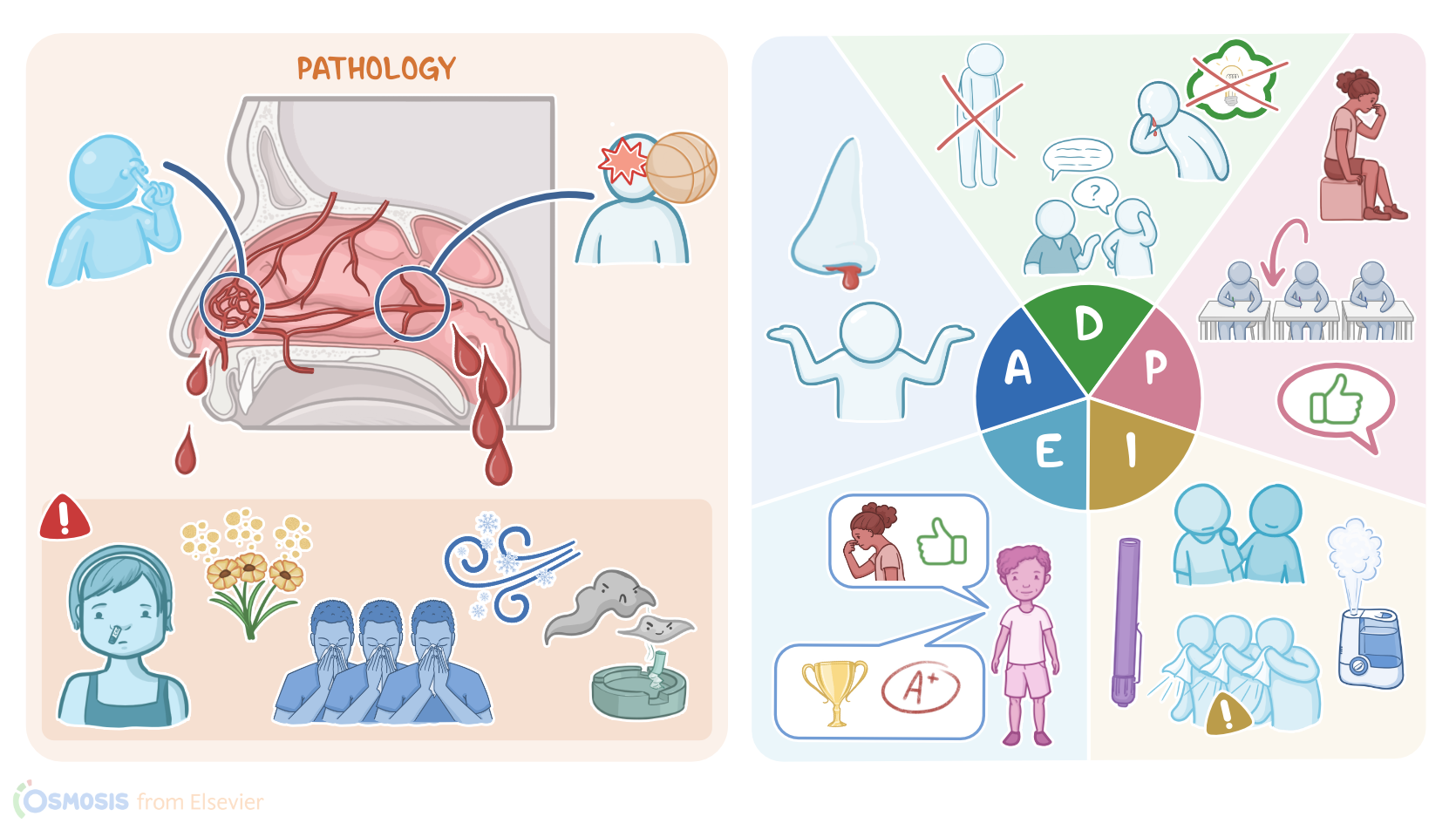
Epistaxis, or nosebleed is caused by ruptured blood vessels in the nasal mucosa. Up to 90% of epistaxis is anterior epistaxis, where the bleeding occurs in the anterior nasal cavity, and the blood typically comes out of the nares.
Posterior epistaxis occurs in the superior or posterior nasal cavity, so the blood usually goes down the throat. In the anterior nasal cavity, numerous arteries in the face connect together to form the Kesselbach plexus, also known as Little's area.
This blood vessel-rich area is located on the nasal septum and is covered by a thin mucous membrane that offers little protection.
So dryness, irritation, or even minor trauma like nose-picking can lead to bleeding. An intranasal mass and foreign bodies can also be causes.
The most common sign is visible bleeding, usually from one nostril. After having the person gently blow their nose to clear blood clots, the nasal cavity is typically assessed with a light source and a nasal speculum to look for signs of active bleeding, excoriation, or scabbing.
Posterior epistaxis occurs further back in the nose, and the most common site is where blood vessels come together in the lateral wall of the nasal cavity to form the Woodruff's plexus.
If blood goes down the trachea, it can cause coughing and hemoptysis, while swallowing blood can cause nausea, vomiting, and hematemesis.
If bleeding occurs frequently, it can even lead to anemia. Due to the posterior location of the bleeding.
A client with posterior epistaxis could appear asymptomatic or with very subtle signs like frequent swallowing. Sometimes the blood will come out of the nostrils and resemble an anterior epistaxis.
Now, let's look at the common risk factors for Epistaxis. Children, especially those between the ages of 2 and 10, are at higher risk.
Frequent nose-picking, playing contact sports, or the lack of proper protective equipment like a face guard can increase the risk of trauma.
Allergies, upper respiratory tract infections, tobacco smoke, and cold or dry environments can cause chronic irritation.
Also, frequent and forceful nose blowing could also cause damage to the blood vessels. There are also systemic risk factors like coagulopathies.
Common ones include hemophilia and von Willebrand disease. People 45 to 65 have decreased platelet levels, and they're more likely to be taking medications like aspirin and warfarin that can interfere with clotting.
Pregnant people can also be prone to epistaxis due to expansion of nasal blood vessels and increased venous pressure. Diagnosis of epistaxis can often be made based on the visualization of blood from the nose, especially for anterior epistaxis.
However, the oral cavity should always be checked to see if there are signs of posterior epistaxis. In cases of prolonged or recurrent bleeding, it's important to identify the cause.
Visual inspection with the use of a nasal speculum can help identify the source of bleeding, as well as potential causes, such as foreign objects.
An endoscope can be used to pinpoint the source of a posterior epistaxis. Coagulopathies like hemophilia and von Willebrand disease should also be suspected when there's prolonged or recurrent bleeding.
The first step is to make sure the client's airway is clear, and they are hemodynamically stable. Next, management of bleeding begins with having the person sit or stand upright, and tilt their head forward.
This prevents blood from draining backwards. Pressure is applied to the soft area just underneath the nasal bones with the thumb and forefinger.
The nares should be compressed firmly against both sides of the septum. The person should be breathing through an open mouth and continue holding pressure for 10 to 15 minutes.
A young child will likely need someone else holding pressure for them and helping them remain calm. If bleeding persists, keep holding pressure and apply ice packs to the nasal bridge, cheeks, upper lip, or back of the neck to aid in vasoconstriction.
If bleeding continues after 10 minutes of applying pressure, medical attention should be sought. If bleeding does resolve, the person should avoid laying down, bending over, straining, and sneezing.
If sneezing is unavoidable, it should be done with an open mouth to prevent recurrence of bleeding. In the healthcare setting, anterior epistaxis is often treated with nasal decongestants like oxymetazoline and continued pressure.
A topical anesthetic such as lidocaine, along with a vasoconstrictor such as phenylephrine can be applied to improve comfort and reduce bleeding.
Nasal tampons or epistaxis balloons may be used, which are inserted into the nasal cavity and expanded to exert pressure on the septum.
If bleeding continues, cauterization of the ruptured blood vessel using silver nitrate or thermal cautery can also be performed.
Treatment of posterior epistaxis may require deep packing with absorbent material or nasal balloons. Clients with posterior packing in place should be closely monitored for signs of aspiration or airway obstruction, including respiratory distress, tachypnea, decreasing oxygen saturation, or frequent coughing.
Surgical management like arterial ligation may be needed for bleeding that can't be managed with other measures. You start your assessment as soon as Ethan enters the nursing office.
Assessment6:23–7:11
Ethan is pinching his nose with his neck extended and his head tilted back. There is blood visible under his nose and on his mouth, chin, and t-shirt.
You encourage Ethan to take slow, deep breaths through his mouth. Ethan tells you that he gets nosebleeds often and that he bruises easily too.
He says he just found out that he has a bleeding disease called von Willebrand disease, and he tells you it makes him feel different from other kids.
You document your assessment findings and begin to develop a plan of care. Based on your assessment of Ethan, you identify the following priority nursing diagnoses to help guide your care.
Diagnosis7:11–7:28
Risk for bleeding related to deficient clotting, risk for situational low self-esteem related to altered body image, and deficient knowledge related to insufficient information.
Planning7:28–7:45
He will verbalize a positive self-perception, and he will demonstrate understanding of effective measures to prevent and manage epistaxis.
While continuing to monitor Ethan, you start to implement the plan of care. After a few minutes, you tell Ethan to release the pressure on his nose.
Implementation7:45–9:07
With a pen light, you examine his nares, noting blood clots in the anterior left nares. The right nares is patent and without clots, but there are scabs present on the nasal septum.
Examining his oropharynx with the pen light, you don't see any active dripping of blood. After helping Ethan wash the dried blood off his hands and face, you let him know that he'll need to stay in the office with you for a little longer, so you can watch for more bleeding.
Next, you explore his feelings about his diagnosis of von Willebrand disease. You validate his apprehension of feeling a little different, while encouraging him to identify his own strengths and abilities.
Finally, you provide education about preventing and managing epistaxis, including a reminder that he should sit or stand upright if bleeding occurs, and he should tilt his head forward and put pressure on the soft area underneath the nasal bones with his thumb and index finger for at least 10 minutes.
Moistening nasal passages by humidifying the air at home, applying petroleum jelly to the inside of his nares, and avoiding things that can irritate or damage the nasal tissue, such as picking or scratching the inside of his nose, or forcefully blowing his nose, can help prevent nosebleeds.
Now you evaluate the effectiveness of your interventions. Ethan's bleeding has stopped, and it is now safe for him to return to class.
Evaluation9:07–9:30
Before he leaves, Ethan shares some of his own personal strengths, like awards he's received in competitive swimming and high grades in his math and science classes.
He tells you he understands what to do if he notices his nose start to bleed in the future. All right, there's a quick recap.
Summary9:30–10:24
Your client, 10 year old Ethan, was brought to the school nursing office for epistaxis. Epistaxis, commonly referred to as a nosebleed, is an acute condition that can be caused by irritation from cold or dry air, nose-picking, allergies, or bleeding disorders.
You planned goals for Ethan to control the bleeding, identify individual strengths, and teach methods to prevent and manage epistaxis.
You implemented strategies to reach these goals and evaluated that these goals were met. As Ethan's school nurse, you will continue to reassess and modify his plan of care as needed.
| EPISTAXIS | ||
| KEY POINTS | NOTES | |
| PATIENT REPORT |
| |
| PATHOPHYSIOLOGY |
| |
| DIAGNOSIS AND TREATMENT |
| |
| ASSESSMENT |
| |
| NURSING DIAGNOSES |
| |
| PLANNING |
| |
| IMPLEMENTATION |
| |
| EVALUATION |
| |
- "Ackley and Ladwig’s Nursing Diagnosis Handbook: An Evidence-Based Guide to Planning Care, 13th edition" Mosby (2022)
- "Winter peaks in web-based public inquiry into epistaxis" Eur Arch Otorhinolaryngol (2020)
- "Harrison’s Principles of Internal Medicine, 21st edition" McGraw Hill / Medical (2022)
- "Nontraumatic Aneurysm-An Unusual Cause of Epistaxis" Ear Nose Throat J (2022)
- "Management of idiopathic epistaxis in adults: what's new?" Acta Otorhinolaryngol Ital (2019)
- "Epistaxis: Revisited" Indian J Otolaryngol Head Neck Surg (2020)
- "Epistaxis: the cause found beyond the nose" Autops Case Rep (2020)
No notes for this video yet
Try adding a note below