Failure to thrive (FTT): Nursing
Introduction0:00–0:17
Failure to thrive, or FTT for short, refers to inadequate growth, typically seen in infancy and childhood. This can happen because of an underlying disorder, insufficient caloric intake, or sometimes a mixture of both!
Physiology0:17–1:12
Let’s start by looking at the physiology of pediatric growth. A child’s growth is monitored by several parameters, including weight, length or stature, and head circumference, based upon what is considered typical for a given age.
This is done by plotting a child’s growth parameters on growth charts which show the percentile of the child on each parameter compared to a large representative population.
These charts are standardized by the Centers for Disease Control and Prevention or CDC. Separate charts are available for those assigned male and female at birth.
For infants between 0 and 36 months, the growth charts used are length for age and weight for age, head circumference for age, and weight for length.
Finally, between 2 and 20 years of age, the standard charts include stature for age and weight for length and body mass index or BMI for age.Now, the causes of failure to thrive can be classified into three broad categories; organic, non-organic, and mixed causes.
Causes & risk factors1:12–2:46
Organic causes are those that result from an underlying disorder interfering with bodily functions necessary for growth and development such as nutrient intake, absorption, and metabolism.
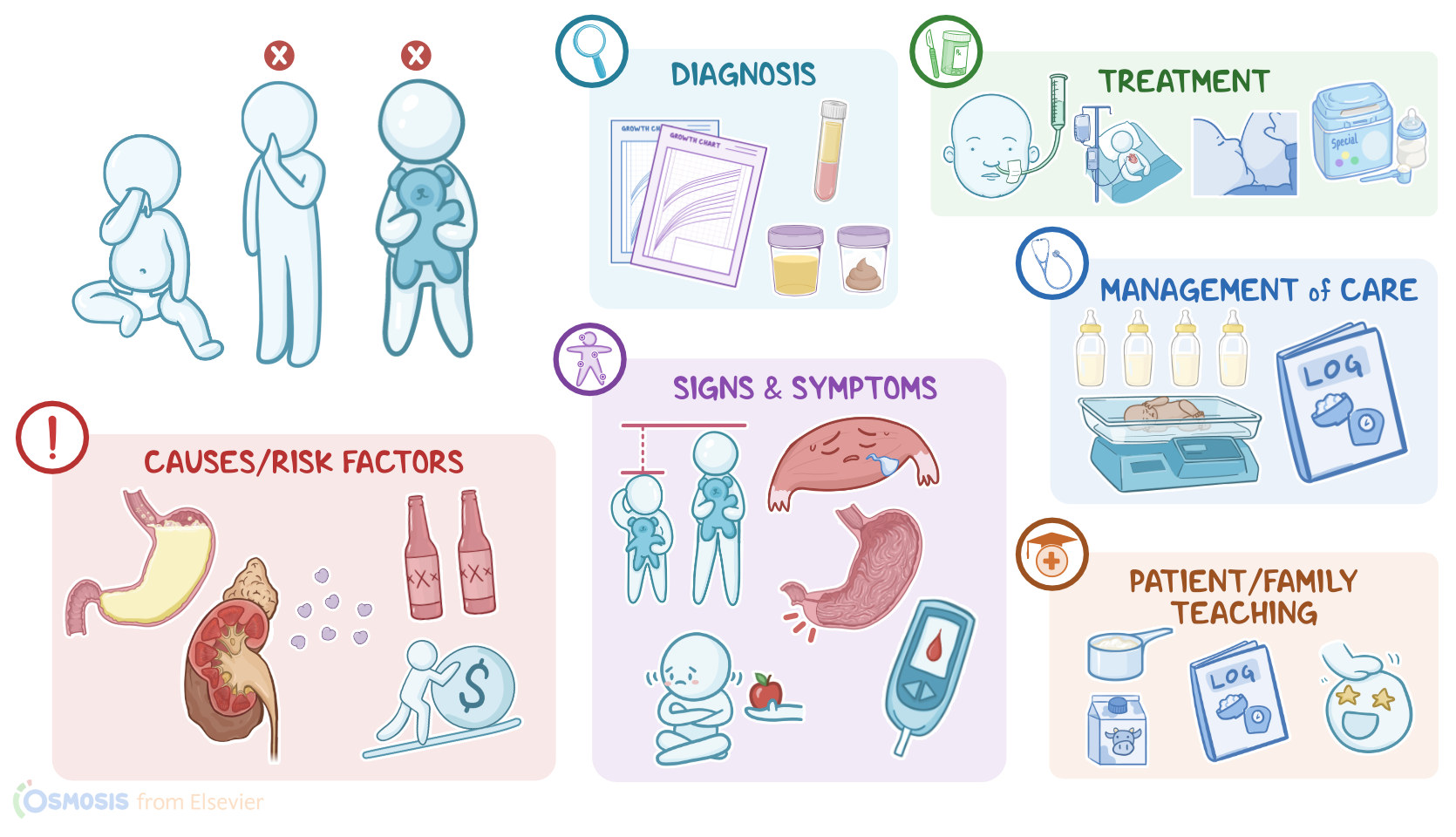
Such disorders include gastroesophageal reflux; celiac disease, which is when absorption in the small intestine is impaired; nephrotic syndrome, which is when the kidneys leak too many proteins in the urine; cystic fibrosis, which is a genetic condition that affects pancreatic enzyme secretion; as well as genetic syndromes like Down syndrome, or congenital malformations like hypertrophic pyloric stenosis or cleft lip and palate.
Non-organic causes result from external factors, particularly an insufficient calorie intake which initially affects weight and later on can affect stature.
Some causes that directly affect nutrition intake include inappropriate feeding methods and lower socioeconomic status or parental education level.
A major contributing factor is structural racism and practices like redlining that leads to inequality in income and access to healthcare.
Family stress or substance use disorder, as well as domestic abuse and violence can also indirectly cause failure to thrive.
And finally, mixed causes are a combination of organic, and non-organic causes. There are four main mechanisms involved in the pathology of failure to thrive, which all converge on the lack of adequate nutrients or calories to sustain typical growth.
Pathology2:46–3:49
First, an infant or child may not be eating enough nutrients or calories leading to undernutrition. Second, the body could be unable to use those nutrients because of conditions like celiac disease or nephrotic syndrome.
Third, they could have an increased caloric demand that they are not meeting, such as when there is heart failure. Fourth, a metabolic disease like diabetes mellitus can interfere with the body's ability to utilize the nutrients and calories from food that was eaten.
Complications of failure to thrive can arise when the underlying cause isn’t treated properly. These include recurrent infections like infectious diarrhea, sepsis, and respiratory tract infections, as well as permanent effects on growth and development.
Examples of these include short stature, poor cognitive development, and poor academic performance in late childhood and adulthood.Now, although the clinical manifestations of failure to thrive can vary based on the underlying cause, most children present with a failure to gain weight or height, compared to children of similar age.
Clinical manifestations3:49–4:34
They may also experience delays in reaching developmental milestones or lose acquired milestones. Some children may also have poor muscle tone and exhibit reduced activity, while others are easily irritable, refuse food, or are uninterested in feeding.
Additional signs and symptoms depend on the underlying cause. For example, with hypertrophic pyloric stenosis, there could be postprandial vomiting; while with diabetes mellitus, there could be polydipsia, polyuria and polyphagia, as well as weight loss.The diagnosis of failure to thrive starts with the child’s birth, medical and nutritional history, and physical assessment.
Diagnosis4:34–5:16
On the growth charts, a child can be under the 5th percentile on the weight for age, be under the 80th percentile for median weight for height ratio, weight deceleration crossing more than two major percentile lines on age and population, or have a body mass index or BMI for chronologic age less than 5th percentile.
Head circumference could also be decreased. Afterward, laboratory tests can be performed based on the suspected underlying causes.
Τhese tests may include a complete blood count, urinalysis, urine culture, and stool analysis.Treatment of failure to thrive focuses on stabilizing the child’s weight, helping them overcome their weight deficit, and treating the underlying cause.
Treatment5:16–6:01
If symptoms are more severe, it might be necessary to admit the client to the hospital to make it easier to monitor progress and adjust treatments.
If they are unable to eat, they can be given enteral feeds through a nasogastric or gastrostomy tubes. When enteral feeding fails or is not suitable, parenteral nutrition might be necessary.
Additionally, breastfeeding is typically encouraged, along with formula supplementation to help with catching up on growth.
If the cause is related to psychosocial factors, these also should be addressed through appropriate channels such as social worker support.All right, let’s look at the nursing care you’ll provide for a child diagnosed with FTT.
Management and care6:01–8:04
Your priority goals are to provide adequate caloric and nutritional intake to support normal growth and development, monitor for complications, and provide psychosocial support.
Begin providing the calories and nutrition the child needs by working with the interdisciplinary team to complete physical, developmental, and psychosocial assessment; and collaborate with the team to develop an individualized plan to support the child and their family.
Then, provide the prescribed diet based on the severity of the child’s malnutrition, their estimated energy needs, and the desired weight gain.
Remember to start the refeeding process slowly, and provide smaller amounts of food at frequent intervals. If the child is unable to feed orally, insert a nasogastric tube, as ordered.
During treatment, closely monitor their nutritional and fluid intake and output and weigh them daily. Lastly, work with the interdisciplinary team to identify and address the underlying cause.
Also monitor them closely for signs of refeeding syndrome by checking their vital signs and keeping a close eye on their laboratory test results, as well as assessing for signs of electrolyte imbalance, including hypophosphatemia, hypokalemia, and hypomagnesemia; and report symptoms such as hypotension, palpitations, paresthesias, nausea, vomiting, or confusion.
Hold the feedings, and administer the prescribed sodium phosphate and potassium phosphate, and continue to monitor them closely.
Lastly, provide emotional support for the child and their caregivers. Be sure to involve the caregivers while providing care; assess the parent-child interactions; and praise positive interactions.
Encourage them to express their feelings and concerns, and ensure referrals are in place for social work and home health nursing to provide the family with resources, guidance, and ongoing psychosocial support.
Okay, moving on to client and family teaching. Start by explaining that FTT is impaired growth and development due to inadequate nutrition.
General client and family teaching8:04–9:21
Review the plan of care, including the goals for their child’s weight gain. Stress the importance of ongoing care and monitoring to ensure their child maintains a steady pattern of weight gain.
Then, talk to them about how to support their child’s nutritional needs at home. Provide them a list of foods they can include in their child’s diet to increase nutrition density, such as adding dry milk to potatoes, puddings, and yogurt, as well as cream to casseroles, gravies, and sauces.
Remind them that mealtimes should be a pleasant experience with minimal distractions from television or phones. Also stress the importance of praising their child when they eat well, but to avoid forcing them to eat, and to never punish their child if they are not eating as expected.
Lastly, instruct them to keep a log of what their child eats each day along with their daily weight, and to bring it with them to their follow-up appointments.
Review9:21–11:05
FTT can have organic, non-organic and mixed causes. Organic causes are from an underlying disorder that interferes with the child's nutrient intake, absorption, or metabolism; while nonorganic causes result from insufficient calorie intake.
Failure to thrive involves four main mechanisms: not taking in enough calories or undernutrition; the body’s inability to use those calories; increased caloric demand; and metabolic diseases.
When not treated, FTT can have complications such as recurrent infections, short stature, poor cognitive development, and poor academic performance in late childhood and adulthood.
Signs of failure to thrive generally include poor weight gain, poor growth, delays in reaching developmental milestones, irritability, poor muscle tone, food refusal, and disinterest in feeding.
FTT is diagnosed through a history, physical exam, and growth chart review. Afterwards, labs can also be used to determine the underlying cause.
If enteral feeding is not successful, parenteral nutrition may be necessary. Goals of nursing care include providing adequate caloric and nutritional intake to support normal growth and development, monitoring for complications, and providing psychosocial support.
Client and family teaching is focused on providing adequate nutrition at home, and when to contact the healthcare provider.
| FAILURE TO THRIVE (FTT) | ||
| KEY POINTS | NOTES | |
| DEFINITION |
| |
| PHYSIOLOGY |
| |
| CAUSES AND RISK FACTORS |
| |
| PATHOPHYSIOLOGY |
| |
| SIGNS AND SYMPTOMS |
| |
| DIAGNOSIS |
| |
| TREATMENT |
| |
| MANAGEMENT OF CARE |
| |
| PATIENT AND FAMILY TEACHING |
| |
No notes for this video yet
Try adding a note below