Genomics - DNA mutations: Nursing
Introduction0:00–0:44
Nurse Andrea is working in the genetic counseling center at the local children’s hospital. Today she is meeting with George who was recently diagnosed with Duchenne muscular dystrophy and his mother Mrs.
Hasan. Mrs.
Hasan asks, “What could have caused this disease?” Nurse Andrea replies, “This condition can be the result of a DNA mutation known as deletion.” Mrs.
Hasan asks, “What’s a DNA mutation?” Nurse Andrea says, “Well a DNA mutation is when there is an alteration to genetic material.
Sometimes these alterations can result in diseases.” Let’s explore DNA mutations further to understand how they can lead to certain diseases.Okay, so, there are several different types of DNA mutations, many of which happen during DNA replication.
DNA Mutations0:44–6:02
Mutations can affect the chromosomes in somatic cells, meaning any cell in our body other than the gametes, or sex cells, and they can occur in the gametes.
If a mutation occurs in the gametes, these are called germline mutations, and this type of mutation can be passed on from one generation to the next.
Some mutations may not cause any obvious changes to health and may never be detected. These are known as ‘silent’ mutations.
Other mutations can alter function to the extent that it can be seen or felt with signs or symptoms. First, to better understand the major types of DNA mutations, let’s take a closer look at the structure of DNA.
DNA has three basic components: deoxyribose, a five-carbon sugar molecule; a phosphate molecule; and a nitrogenous base also called a nucleobase or, simply, a “base.” Together, these make up a sub-unit, or piece of DNA, called a nucleotide.
Now, there are four bases that make up DNA nucleotides: adenine and guanine, which are called purine bases; and thymine and cytosine, which are called pyrimidine bases.
Each of these bases are usually referred to by their first letters: A, G, T, and C. These bases form bonds according to the rule of “complementary base pairing” which states that in DNA, A always pairs with T, while C always pairs with G.
The resulting base pairs are linked together in a spiral strand known as the double helix. When strands of DNA are tightly packed together, they make up chromosomes, which are coded segments of DNA that supply the genetic information necessary to make the proteins that are needed for the body to function.
If these coded sections are altered by a mutation, this can potentially affect the process of protein production and the function of the body.Alright, the major types of DNA mutations include substitutions, deletions, insertions, deletion-insertions, inversions, duplications, and translocations.
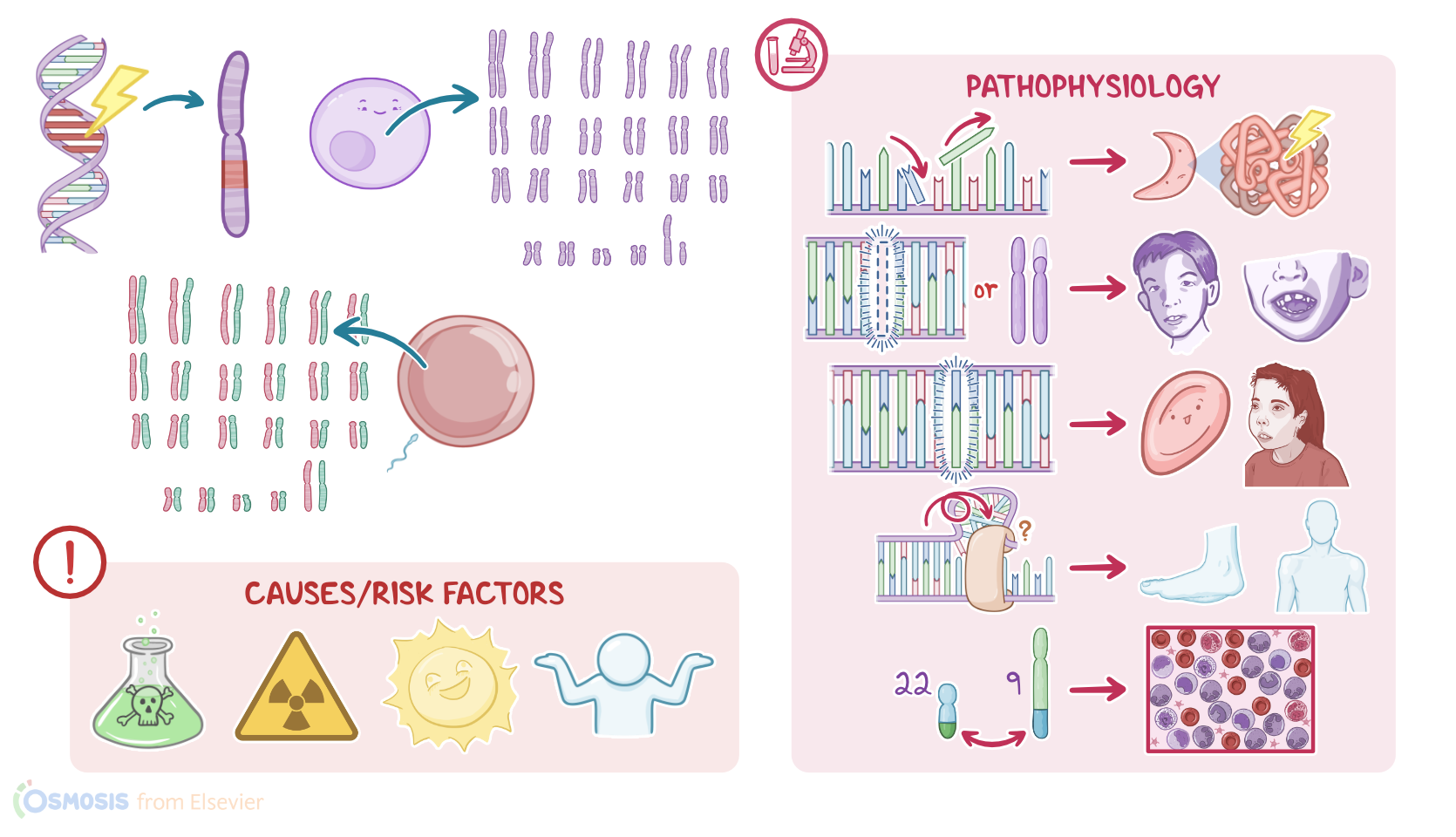
First, there are substitutions, sometimes called point mutations, which are the most common type of DNA mutation. These occur when one nucleotide is swapped for another.
Now, there are two types of substitutions: transitions and transversions. When a transition occurs, one purine is substituted for another purine, like when A is substituted for G in a DNA sequence; or when one pyrimidine is substituted for another pyrimidine, like when T is substituted for C in a DNA sequence.
Transition mutations are most likely to result in a silent mutation. On the other hand, when a transversion occurs, a purine is substituted for a pyrimidine or a pyrimidine is substituted for a purine.
For example, in sickle cell disease, A is replaced by T, which then codes for a completely different amino acid resulting in an abnormal hemoglobin.
The next type of DNA mutation is deletion. In a deletion, at least one of the base-pair in the DNA sequence goes missing.
There can be small deletions where only a few base pairs are deleted or there can be large deletions that result in the removal of an entire gene.
Examples of diseases caused by a DNA deletion are Cri du chat syndrome and Duchene muscular dystrophy, like George has.Then there are insertions.
An insertion occurs when at least one extra base pair occurs in the DNA sequence. Much like deletions, insertions can involve just an extra few base pairs or many extra base pairs could be added.
This type of DNA mutation is the cause of beta-thalassemia.Now, in some cases, deletions and insertions can occur together on the same gene at the same time.
This is known as a deletion-insertion mutation variant, and the outcomes of this mutation will vary, depending on the complexity of the mutation.Next, there are inversions, which occur when a chromosome breaks off and reattaches to the same chromosome, but it gets flipped around in the process.
So if the original order of genes in that chromosome was A-B-C-D, now it is A-B-D-C. Since the amount of genetic material remains the same, inversions most often result in silent mutations.
Then there are duplications, which occur when extra chunks of DNA are copied, so the chromosome now has duplicate segments.
An example of a condition caused by a duplication mutation is Charcot-Marie-Tooth disease. And finally, there are translocations, which is when a part of one chromosome breaks off and is exchanged for a part of another chromosome, resulting in a fusion between genes that were initially separated.
A classic example is the Philadelphia chromosome which is chromosome 22 with a bit of chromosome 9 on it, that results in a type of leukemia.
It’s not always possible to figure out why a DNA mutation occurs, but there are some things that are known to increase the chances of a mutation.
Causes of Mutation6:02–7:04
Mutations are more likely to occur during the process of DNA replication, and are usually spontaneous. Then there are mutagens, which can be anything that is capable of causing a mutation or making a mutation more likely to occur.
A mutagen can occur with ingestion or other exposure to a substance, such as ultraviolet radiation, certain chemical agents, or radioactive materials.
Alright, let’s check back with George, Mrs. Hasan, and Nurse Andrea who are finishing their appointment.
It can be challenging to understand how small changes in our DNA can make a big difference in our health.”Alright, as a quick recap… A DNA mutation is when there is an alteration to genetic material.
Review7:04–9:10
Mutations can affect the chromosomes in somatic cells, meaning any cell in our body other than the gametes, or sex cells, and they can occur in the gametes.
If a mutation occurs in the gametes, these are called germline mutations, and this type of mutation can be passed on from one generation to the next.
Sometimes mutations can result in diseases and other times the mutation is “silent” meaning it doesn’t cause any obvious changes.
The major types of DNA mutations include substitutions, deletions, insertions, deletion-insertions, inversions, inversions, duplications, and translocations.Substitutions occur when one nucleotide is swapped for another, and they can involve a transition, where one purine is substituted for another purine, or when one pyrimidine is substituted for another pyrimidine; or a transversion, where a purine is substituted for a pyrimidine or a pyrimidine is substituted for a purine.
In a deletion, at least one of the base-pairings in the DNA sequence goes missing; whereas in an insertion, at least one extra base pairing occurs in the DNA sequence.
Insertions and deletions can also occur together on the same gene at the same time. Next, there are inversions, which occur when a chromosome breaks off and reattaches to the same chromosome, but it gets flipped around in the process.
Duplications occur when extra chunks of DNA are copied. Finally, with translocation, a part of one chromosome breaks off and is exchanged for a part of another chromosome, which can result in a fusion between genes that were initially separated.
Mutations are more likely to occur during the process of DNA replication, and are usually spontaneous. Anything that might increase the likelihood of DNA mutation is known as a mutagen, and these can include ultraviolet radiation, certain chemical agents, or radioactive materials.
| GENOMICS - DNA MUTATIONS | ||
| KEY POINTS | NOTES | |
| DEFINITION |
| |
| DNA MUTATIONS |
| |
| PHYSIOLOGY |
| |
| SUBSTITUTIONS |
| |
| DELETIONS |
| |
| INSERTIONS |
| |
| DELETION-INSERTIONS |
| |
| INVERSIONS |
| |
| DUPLICATIONS |
| |
| TRANSLOCATIONS |
| |
| CAUSES AND RISK FACTORS |
| |
No notes for this video yet
Try adding a note below