Gout: Nursing process (ADPIE)
Client Report0:00–0:38
Hubert Symanski is a 49-year-old male client with a history of type 2 diabetes mellitus who presents to the clinic today with severe pain in the big toe of his right foot.
He explains that when he woke up this morning, his toe was red, swollen, and felt like it was on fire. He denies any recent injury to his toe or foot.
Walking around the house and putting on shoes is very painful, and the only shoes he can comfortably put on are sandals.
He reports that he had an episode of gout a year ago, confirmed by joint aspiration, and he is concerned that this may be another episode.
Pathology0:38–4:54
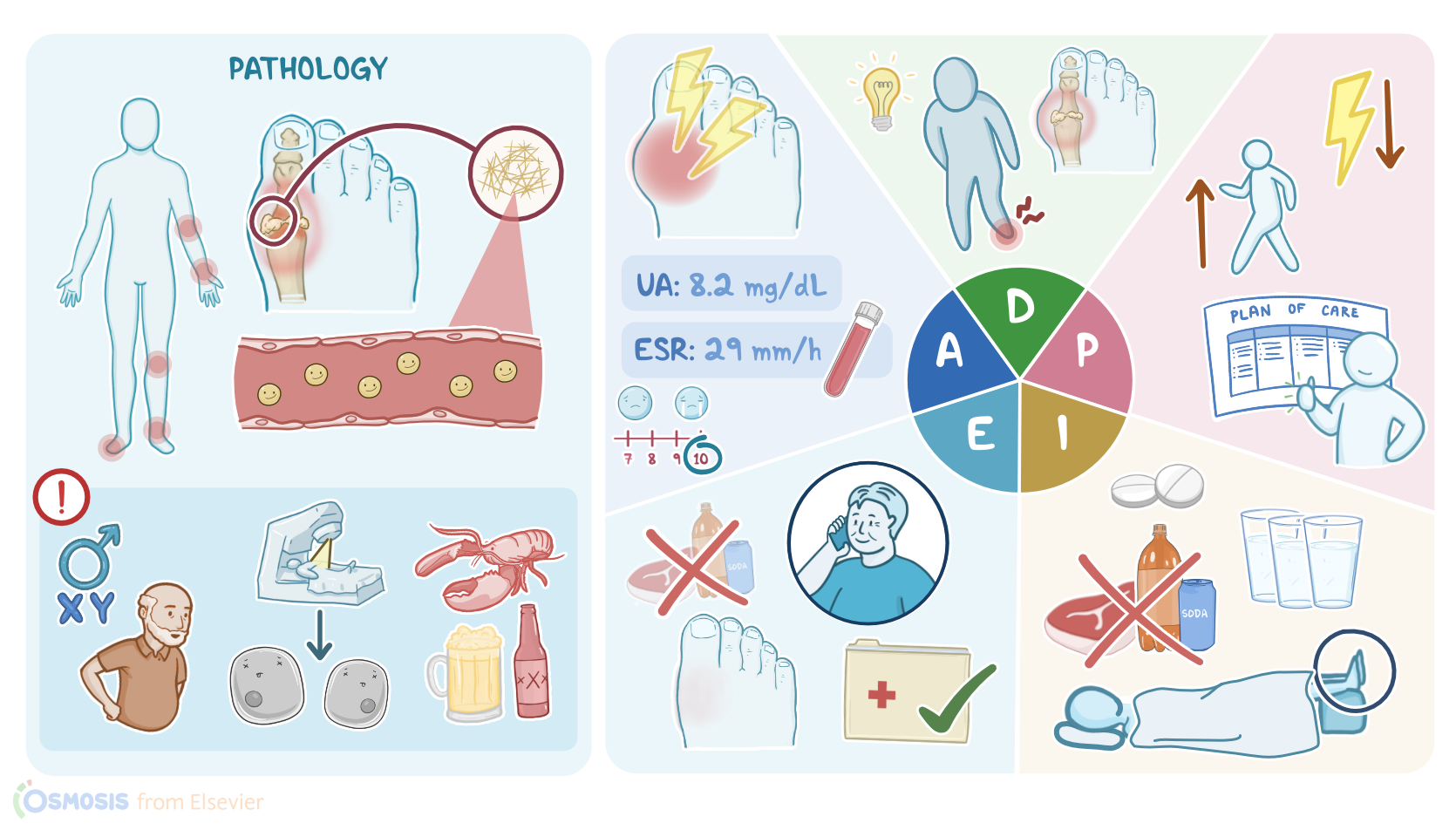
Gout is an inflammatory disease in which urate crystals deposit in a joint and cause damage. Typically, the underlying cause is hyperuricemia, or too much uric acid, also known as urate, in the blood.
Uric acid is a natural waste product of purines, which are one of the building blocks of DNA and RNA. Once produced, uric acid circulates in the bloodstream before it is filtered out and excreted by the kidneys to the urine.
Now, hyperuricemia is associated with several risk factors. An important risk factor is overproduction of purines, which is most common with increasing age, male sex, obesity, and alcohol use.
Overproduction of purines can also occur with increased consumption of purine-rich foods such as shellfish, alcohol, anchovies, and red meat, as well as high fructose corn syrup containing beverages such as sodas.
Hyperuricemia can also result when cells die at a faster than normal rate, resulting in increased breakdown of purines into uric acid.
For instance, as a result of chemotherapy or radiation treatment, as well as recent trauma or surgery. In addition, some individuals have a genetic predisposition to developing hyperuricemia, so an important risk factor is family history.
Finally, hyperuricemia can also occur when there's reduced excretion of uric acid by the kidney. Which can result from dehydration, diabetes, chronic kidney disease, and medications like thiazide diuretics or aspirin.
Now gout typically presents with acute attacks in which a joint becomes red, warm, tender, and swollen within hours. Gout can affect many joints such as those in the ankles, knees, wrists, and elbows, but most often it affects the first metatarsal joint of the foot or the base of the big toe, and this is called podagra.
Classically, in Pedaggra, the client will wake up from sleep feeling like their big toe is on fire. Even the weight of the sheets can be painful.
The pain is most severe in the hours immediately following the gout attack and then generally lessens over time, but the discomfort and swelling can last for a few days with treatment or weeks without treatment.
Chronic gout can eventually lead to permanent deposits of urate crystals called toi along the bones just beneath the skin.
Individuals with chronic gout are also at an increased risk for developing kidney stones made of uric acid, as well as urate nephropathy, which is when urate crystals deposit in the kidney tubules.
OK. Gout is usually diagnosed based on the client's history and physical examination.
Laboratory tests may reveal hyperuricemia or increased blood urate levels, as well as increased C-reactive protein or CRP and erythrocyte sedimentation rate or ESR, which indicate ongoing inflammation.
Diagnosis can be confirmed with a joint aspiration to verify the presence of urate crystals in the synovial fluid. And in the case of chronic gout, imaging techniques like X-rays may detect Toi.
Treatment of a gout attack is focused on decreasing the pain and swelling with NSAIDs like ibuprofen or naproxen sodium.
Occasionally, corticosteroids like prednisone and anti-gout agents like colchicine can be used as an alternative to NSAIDs.
After managing the acute attack, clients may also take medications that help decrease uric acid levels, such as xanthine oxidase inhibitors like allopurinol, as well as uricosuric medications like probenecid that increase excretion of uric acid by the kidneys.
Finally, it's important to address the underlying risk factors. This may include modifying the diet and reducing or eliminating soda, alcohol, red meat, and seafood, as well as staying hydrated and managing underlying disorders such as diabetes or chronic kidney disease, and avoiding certain medications like thiazide diuretics.
Assessment4:54–6:30
As you enter the room, you begin your assessment by asking what brings him into the clinic today. He points to his right toe, which is red and swollen at the first metatarsal joint.
He tells you his toe feels like it is on fire and that he can hardly walk due to the pain. You help Mr.
Symanski onto the exam table to take a closer look and observe that he grimaces when bearing weight on his right foot. When you palpate the toe, it feels warm, but there are no palpable or visible toi.
He says these symptoms are similar to his first attack, but he thinks it's worse this time. He is frustrated by having a 2nd attack and would like to know how he can prevent future episodes.
You ask about his diet, and he tells you he has been drinking more soda recently and that he enjoys eating red meat. His lab work shows a uric acid level of 8.2 mg per deciliter and an ESR rate of 29 millimeters per hour.
He is 71 inches tall and weighs 222 lbs. His vital signs are oral temperature 98.9 °F or 37.3 °C, heart rate 72 BPM, respiratory rate 16 breaths per minute, BP 138/80 millimeters of mercury, and SPO2 98% on room air.
He rates the pain in his toe as a 10 out of 10 when walking or when anything is touching his foot. Before leaving the room, you document your assessment findings and let him know his physician will be in shortly.
Your nursing diagnoses include acute pain related to joint inflammation, impaired physical mobility related to musculoskeletal pain, and readiness for enhanced knowledge related to interest in health management and disease prevention.
Diagnosis6:30–6:45
Planning6:45–7:03
All right. Together with the interdisciplinary team, you plan goals of care for Mister Symanski.
One week after treatment begins, he will report decreased pain and improved mobility. And before he leaves the office today, he will commit to making lifestyle modifications to help reduce his risk for gout.
OK, so now it is time to implement interventions to help Mr. Symansky meet his goals of care.
Implementation7:03–8:05
To reduce pain and inflammation, you explain his physician prescribed the anti-gout medication colchicine and the NSAID naproxen sodium.
Next, you encourage Mr. Symanski to elevate his foot and advise him to keep his toe open to air.
You suggest that he avoid covering it with sheets at night because even light contact can cause severe pain. Next, you discuss the importance of limiting foods that are high in purines, which include red meats, seafood, soda, alcohol, and aged cheeses.
You explain that and staying hydrated is also important for managing gout. He agrees to meet with a dietitian to help with overall weight management and food choices.
Before he leaves. You tell Mister Symanski you will call and check on him in a week, but instruct him to call the clinic if he develops symptoms like nausea, diarrhea, or abdominal pain, or if his symptoms do not improve.
Evaluation8:05–8:37
One week later you call Mister Symanski to see how he is doing. He says he feels much better.
His pain and swelling have decreased, and he has returned to his normal daily activities. With the help of the dietitian.
He's been avoiding foods that could trigger his gout, and he's making healthier food choices overall. You applaud Mister Symanski's efforts and encourage him to keep up the good work.
You revise his medical record with the results of your evaluation and update his physician. All right.
Summary8:37–9:39
As a quick recap, you have been caring for Mister Symanski, who presented to the office with an acute gout episode in his big toe.
Gout is an inflammatory disease in which urate crystals deposit in a joint and cause damage and pain. Gout can affect many joints, but it commonly affects the first metatarsal joint of the big toe.
Your nursing assessment revealed severe burning pain in Mr. Szymanski's right toe, along with redness and swelling around the metatarsal joint.
Your nursing diagnoses included acute pain, impaired physical mobility, and readiness for enhanced knowledge. His plan of care included pain reduction, improved mobility, and a commitment to dietary changes and weight loss to reduce the risk of repeated attacks.
Together with the interdisciplinary team, you implemented strategies to help Mr. Symanski reach these goals.
While providing care, you continually evaluate his response to your interventions and adjust the plan of care as needed.
| GOUT | ||
| KEY POINTS | NOTES | |
| PATIENT REPORT |
| |
| PATHOPHYSIOLOGY |
| |
| DIAGNOSIS AND TREATMENT |
| |
| ASSESSMENT |
| |
| NURSING DIAGNOSES |
| |
| PLANNING |
| |
| IMPLEMENTATION |
| |
| EVALUATION |
| |
- "Role of diet in hyperuricemia and gout" Best Pract Res Clin Rheumatol (2021)
- "Harrison’s Principles of Internal Medicine, 21st edition" McGraw Hill / Medical (2022)
- "The Challenges of Approaching and Managing Gout" Rheum Dis Clin North Am (2019)
- "Gout epidemiology and comorbidities" Semin Arthritis Rheum (2020)
- "The role of diet in hyperuricemia and gout" Curr Opin Rheumatol (2021)
- "Gout and Diet: A Comprehensive Review of Mechanisms and Management" Nutrients (2022)
No notes for this video yet
Try adding a note below