Hepatitis: Nursing
Introduction0:00–0:13
Hepatitis refers to an inflammation of the liver due to infection or injury, and it’s often self-limiting, but some cases can result in extensive liver damage.Now, let’s quickly review some anatomy and physiology.
Physiology0:13–0:41
The liver is a large, solid organ located in the right upper quadrant of the abdomen, which has several functions, including the production of bile, cholesterol, and certain blood proteins like albumin and clotting factors; as well as helping with glucose and fat metabolism; detoxification through medication and alcohol metabolism; and it also plays a big role in bilirubin metabolism.Now, hepatitis can be caused by a viral infection, called viral hepatitis, or other kinds of injury, in which case it’s called non-viral hepatitis.
Causes & risk factors0:41–2:44
The more common one is viral hepatitis, which is caused by hepatitis viruses A, B, C, D, or E. Hepatitis A virus is usually transmitted through the fecal-oral route, through contaminated food or water, or through person-to-person contact; and risk factors include living or working in nursing homes, daycare centers, and living in or traveling to countries with poor access to clean water, sanitation, and hygiene; as well as sexual contact with an infected individual.
Next, we have hepatitis B, C, and D viruses, which are primarily transmitted through blood and other body fluids; so the main risk factors include intravenous drug use, blood transfusions, hemodialysis, and working as a healthcare professional; as well as high-risk sexual behavior, such as having multiple partners or not using protection.
Hepatitis B can also be transmitted vertically to the baby before or after birth. Of note, the hepatitis D virus can’t cause an infection in the absence of hepatitis B virus.
So the most important risk factor for a hepatitis D infection is a hepatitis B infection. Lastly, hepatitis E is transmitted through the fecal-oral route, mostly through consuming contaminated food or water.On the other hand, non-viral hepatitis can be caused by alcohol, medications like acetaminophen, and exposure to certain chemicals like herbicides.
Another important cause is autoimmunity, where the client’s immune system attacks the liver, leading to autoimmune hepatitis.
Risk factors for autoimmune hepatitis include being assigned female at birth; as well as having other autoimmune diseases, such as thyroiditis or celiac disease; and a family history of autoimmunity.Now, the pathology of hepatitis can be classified as acute or chronic.
Pathology2:44–4:19
With acute hepatitis, the underlying cause leads to quick and severe damage to the liver, which is usually self-limiting, lasting less than 6 months.
However, some clients can develop complications like fulminant hepatitis, which is a life-threatening condition characterized by severe liver function impairment.On the other hand, with chronic hepatitis, there’s progressive damage to the liver that lasts more than 6 months.
So, initially, liver function remains intact, but as damage progresses over time, the liver starts to deteriorate. Liver damage can manifest as hepatic cytolysis, where liver cells are destroyed and leak out enzymes like aspartate transaminase, or AST; alanine transaminase, or ALT; and gamma glutamyl transferase, or GGT.
Now, in the long run, liver damage is followed by a regenerative process that eventually causes fibrosis and scarring of the liver, which can progress to cirrhosis.
This further impairs liver function, causing ammonia to build up in the blood. Ammonia buildup is quite dangerous because it can cross the blood-brain barrier, and impair central nervous system function, causing hepatic encephalopathy.
Finally, cirrhosis also represents a risk for developing hepatocellular carcinoma.The clinical manifestations associated with acute hepatitis include fatigue, malaise, nausea, and vomiting.
Clinical manifestations4:19–5:29
Additionally, clients can present with a low-grade fever, jaundice, skin rash, itching, particularly on the palms and soles, as well as dark urine.
They may also have right upper quadrant tenderness, as well as hepatomegaly. On the flip side, clients with chronic hepatitis can initially be asymptomatic, or present with mild symptoms like malaise and fatigue.
However, progressive liver damage can, over time, lead to jaundice; as well as ascites, or fluid accumulation in the peritoneal cavity, on account of reduced albumin production; and easy bruising or bleeding because of reduced clotting factors.
On rare occasions, chronic hepatitis can cause gynecomastia or breast enlargement in clients assigned male at birth; as well as skin manifestations, such as palmar erythema and spider angiomas.
Sometimes, there can be signs of encephalopathy, like tremor, confusion, somnolence or coma.Diagnosis of hepatitis starts with the client’s history and physical assessment.
Diagnosis5:29–8:13
Laboratory tests typically reveal elevated liver enzymes like aspartate transaminase, or AST and alanine aminotransferase or ALT; as well as elevated bilirubin levels; and prolonged bleeding time.
With chronic hepatitis, sometimes there can be increased ammonia levels in the blood. Additionally, lab tests can also help find the underlying cause of hepatitis.
With autoimmune hepatitis, there can be high titers of autoantibodies like ANA and SMA. On the flip side, in case of viral hepatitis, lab tests can reveal specific serologic findings.
First, acute hepatitis A infection is associated with anti-HAV IgM antibodies; while clients with resolved hepatitis A infection or immunization will have anti-HAV IgG antibodies; and HAV doesn’t cause chronic infection.
Next up, acute hepatitis B infection presents with hepatitis B surface antigen or HBsAg; as well as IgM antibodies against hepatitis B core antigen.
Clients with chronic hepatitis B infection present the same serologic markers, but instead of IgM antibodies, they have IgG antibodies against hepatitis B core antigen.
And lastly, clients with resolved hepatitis B infection present with positive IgG antibodies against hepatitis B core antigen and against HBs antigen, but negative HBs antigen.
It’s important to note that vaccinated clients only have IgG antibodies against HBs antigen, which composes the vaccine against hepatitis B virus.
Moving on, acute and chronic hepatitis C infection can be diagnosed using the HCV antibody test, which detects antibodies to the hepatitis C virus in both acute and chronic forms of infection.
In acute and chronic hepatitis D infection, serology reveals either IgM or IgG HDV antibodies, in addition to specific markers of hepatitis B infection.
Lastly, acute hepatitis E infection is associated with anti-HEV IgM antibodies; while clients with resolved infection or immunization will have anti-HEV IgG antibodies.
To confirm the diagnosis of viral hepatitis, PCR can be performed to detect the presence of viral genome. Finally, some cases of hepatitis may require additional diagnostic tests, such as imaging like ultrasound, CT scan, or MRI; as well as liver biopsy.The treatment of hepatitis primarily involves supportive care to relieve the symptoms; this can include medications like antiemetics, as well as antihistamines or diuretics.
Treatment8:13–9:42
In addition, the underlying cause should be addressed, when possible. For example, clients with autoimmune hepatitis can be treated with corticosteroids in order to stop the autoimmune response.
On the flip side, HBV infection can be treated with a class of antiviral medications called NRTIs, which include nucleotide reverse transcriptase inhibitors like adefovir and tenofovir, as well as nucleoside reverse transcriptase inhibitors like entecavir; while HCV infection can be treated with nucleotide polymerase inhibitors like sofosbuvir, as well as nucleoside analogues like ribavirin.
Lastly, clients with hepatitis B and C infections can also be treated with interferons like peginterferon alfa-2a.Finally, preventive measures include vaccination for viral hepatitis caused by hepatitis A virus and hepatitis B virus, which in turn protects from hepatitis C virus as well.
These vaccines can also be used as post-exposure prophylaxis or PEP for short, within 2 weeks after a possible exposure to hepatitis viruses.
PEP can be given in combination with specific immune globulins in certain high-risk cases.Now let’s look at the nursing care you’ll provide for a client with viral hepatitis.
The goals of care center on decreasing continued hepatic injury, preventing complications, and managing symptoms. Begin by reviewing your client’s most recent laboratory test results, including a complete blood count, PT, PTT, INR, liver enzymes, total bilirubin, and ammonia level.
Management and care9:42–11:51
Then, assess their level of consciousness and their vital signs. Assess the sclera of their eyes, skin, and mucous membranes for signs of jaundice, or any petechiae or bruising.
If jaundice is causing pruritus, provide comfort measures, and apply the prescribed emollients to the skin. Palpate their abdomen, and note if they have tenderness, ascites, or hepatomegaly.
Report to the healthcare provider any assessment findings that indicate advanced disease, including prolonged PT and INR; signs of bleeding, bruising, epistaxis, or hematemesis; as well as symptoms of encephalopathy, such as somnolence or tremor.
Administer the prescribed intravenous fluids as well as the medications to treat the underlying condition, as ordered. Next, assess your client for anorexia and malnutrition by taking their baseline weight and reviewing their diet history, including alcohol use.
Ask your client if they are experiencing nausea, anorexia, abdominal discomfort, or vomiting and administer the prescribed antiemetics as needed.
Then collaborate with the dietician to promote a diet specific to your client’s underlying condition. Lastly, ask your client about their level of fatigue, and assess their activity tolerance.
Encourage rest to promote healing, and coordinate with the physical therapist for supervised ambulation.Finally, as you provide care, be mindful of adhering to standard precautions and basic infection-control principles.
And ensure your client’s case has been reported to local public health authorities, as appropriate.Now, moving on to client and family teaching.
Begin by explaining how the virus is transmitted and infects their liver. Review the plan of care and the prescribed medications.
Emphasize the importance of adherence to their medication regimen and completing the full course of therapy, even if symptoms improve.
General client and family teaching11:51–14:10
Remind them of the significant risk for development of cirrhosis, liver failure, and hepatocellular cancer, and of the importance of regular follow-up with their healthcare provider for continued management of their underlying condition.Promote intake of fluids and nutrition by encouraging your client to eat high-calorie foods, as tolerated.
Recommend eating small, frequent meals to help minimize nausea and increase intake. Advise them to introduce high-fat foods slowly into their diet to prevent stomach upset, and instruct them to avoid alcohol because of it’s hepatotoxic effects.
Lastly, if your client smokes, talk to them about the benefits of stopping smoking, and provide them with resources to support smoking cessation.Then, teach your client the importance of balancing activity with rest.
Teach them to avoid strenuous activity and to return to their normal activities gradually. Encourage them to follow up with the physical therapist to develop an activity plan based on the severity of their symptoms.Next, teach them how they can reduce their risk for viral transmission.
Teach them about the importance of practicing good hand hygiene, to not share personal items like razors or toothbrushes, and to always cover cuts and open wounds with a bandage.
Promote the use of barrier protection during sexual contact, and remind them that they should not donate blood or sperm.
Counsel them to avoid getting tattoos or body piercings, and encourage your client and members of their household to get immunizations for hepatitis A and B.
Finally, instruct them to contact their healthcare provider immediately if they have new or worse abdominal pain, or if they notice fluid accumulation in their belly; if nausea and vomiting prevents them from eating, drinking or taking their medications; if they notice increased yellowing of their eyes, skin, or mucus membranes; or if they notice easy bruising, blood in their stools, or if they vomit up blood.
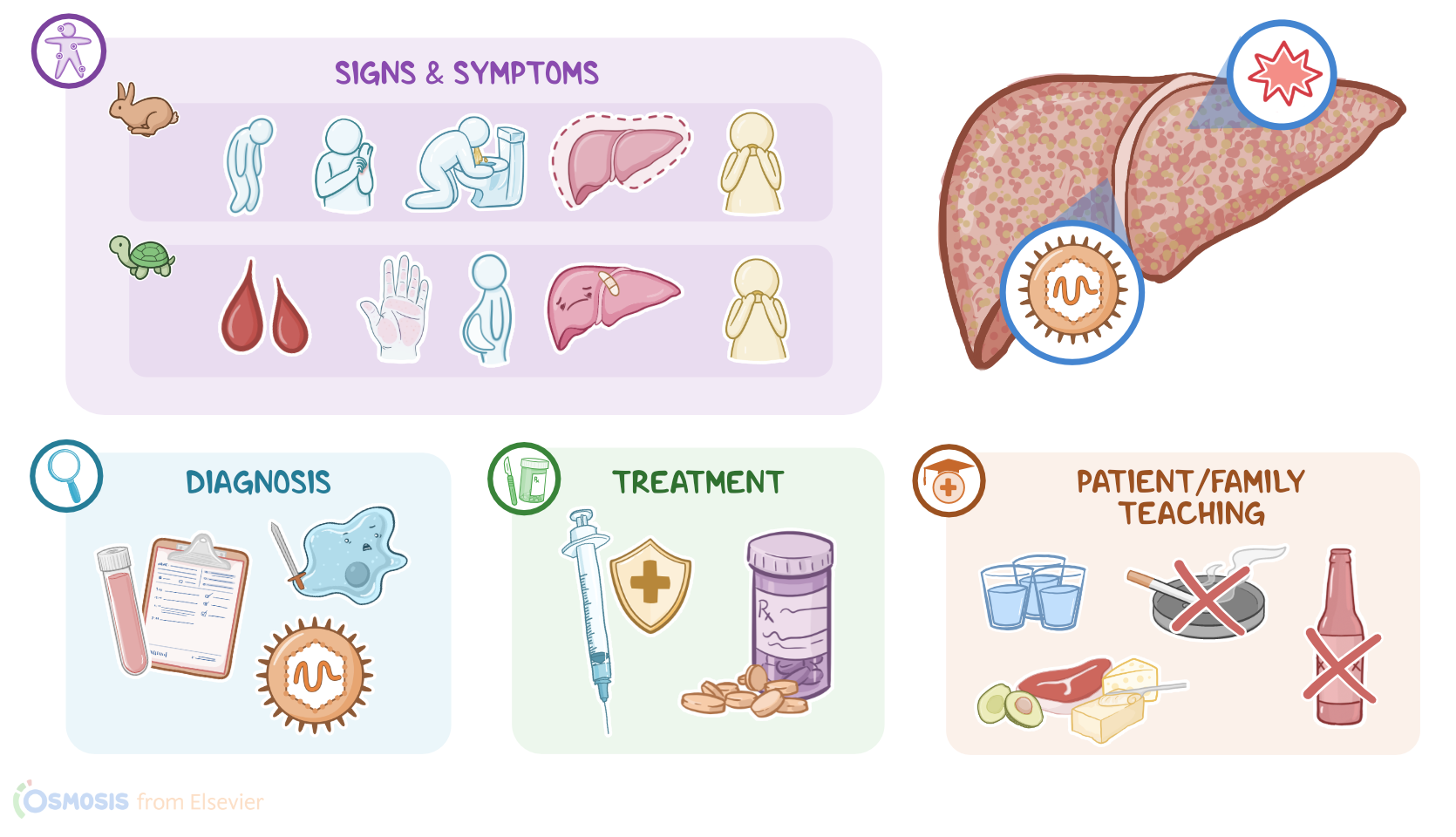
Alright, as a quick recap…. Hepatitis refers to an inflammation of the liver due to infection, called viral hepatitis, or other kinds of injury, called non-viral hepatitis.
Clinical manifestations associated with acute hepatitis include fatigue, malaise, nausea, and vomiting. Over time, liver function can deteriorate, leading to jaundice, hepatomegaly, ascites, and reduced clotting factors.
Diagnosis includes a history, physical, and laboratory tests which typically reveal elevated liver enzymes and bilirubin levels, prolonged bleeding time, and antibodies in the case of viral hepatitis.
Review14:10–15:09
Treatment is supportive, and involves addressing the underlying condition. Nursing care centers on decreasing continued hepatic injury, preventing complications, and managing symptoms.
Client and family education is focused on self care, promoting medication adherence, and on preventing transmission. Diagnosis, includes the history physical and laboratory tests, which typically reveal elevated, liver, enzymes and bilirubin levels, prolonged bleeding time, and antibodies in the case of viral, hepatitis treatment is supportive and involves addressing the underlying condition.
Nursing care centers on decreasing continue to Patek injury, preventing complications and managing symptoms, client and family.
Education is focused on self-care promoting medication
| HEPATITIS | ||
| KEY POINTS | NOTES | |
| DEFINITION |
| |
| PHYSIOLOGY |
| |
| CAUSES AND RISK FACTORS |
| |
| PATHOPHYSIOLOGY |
| |
| SIGNS AND SYMPTOMS |
| |
| DIAGNOSIS |
| |
| TREATMENT |
| |
| MANAGEMENT OF CARE |
| |
| PATIENT AND FAMILY TEACHING |
| |
No notes for this video yet
Try adding a note below