Hirschsprung disease: Nursing
Introduction0:00–0:22
Hirschsprung disease is a congenital condition in which neural ganglia or clusters of nerves from segments of the colon are missing, which ultimately leads to a blocked colon, causing it to enlarge.
This is why sometimes it’s also referred to as intestinal aganglionosis or just congenital megacolon.Okay, so the intestines move the waste through the bowels in one direction only, via coordinated wave-like smooth muscle contractions called peristalsis.
Physiology0:22–2:15
This is controlled by the autonomic nervous system, which is divided into two parts; the sympathetic, and the parasympathetic nervous systems.
The sympathetic nervous system is our fight or flight response and increases heart rate, while slowing down digestion through reducing peristalsis.
On the other hand, the parasympathetic nervous system is our rest and digest response and it slows down heart rate, and increases digestion by promoting peristalsis.Now, if we look closely at the intestinal smooth muscle layer, it’s actually composed of a circular and a longitudinal muscle layer.
Within these layers are two plexuses, or networks of nerves made up of ganglia, which are clusters of individual parasympathetic ganglion cells.
First there’s the myenteric plexus, also known as Auerbach’s plexus, which when activated, primarily causes smooth muscle relaxation.
The myenteric plexus connects with the submucous plexus, or also known as Meissner’s plexus, which is buried in the submucosa and is responsible for helping to control blood flow and epithelial cell absorption and secretion.
Now, these two nerve plexuses are formed during early stages of fetal development when a group of fetal cells called neural crest cells start differentiating into neuroblasts.
Around week 4 of development, these neuroblasts start migrating from the mouth towards the anus. Around week 8, they get to the proximal colon of the gut, and pass through the distal colon, and around week 12 they finally reach the rectum.
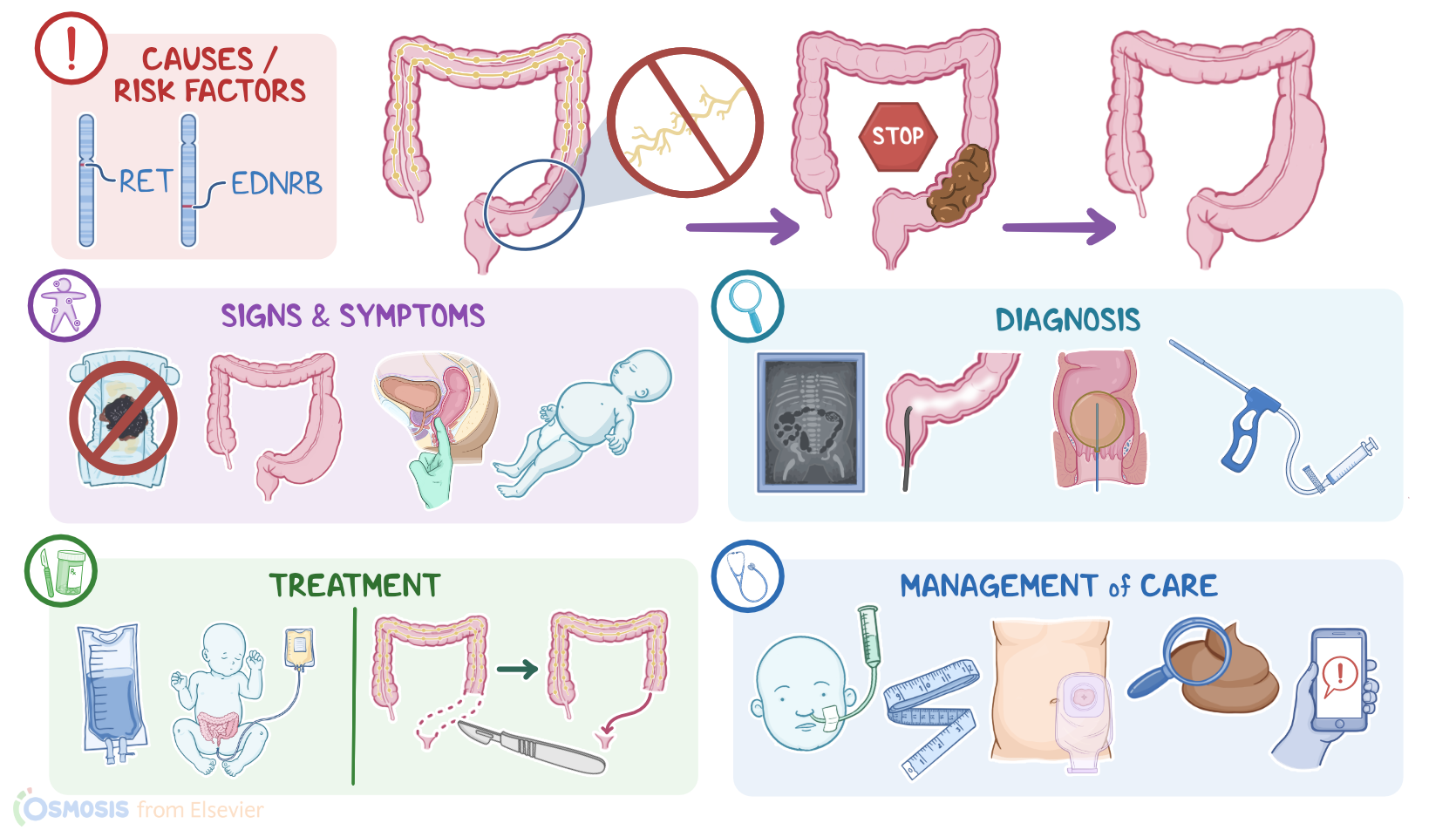
Two specific genes that are thought to be important for migration and development of these nerve fibers are RET and EDNRB.Hirschsprung disease can be caused by mutations in either the RET or EDNRB genes.
Causes & risk factors2:15–2:38
Also, mutations in these genes have been linked to Down syndrome, Multiple Endocrine Neoplasia type 2, or MEN 2, and Waardenburg syndrome, which might help explain why these syndromes are associated with Hirschsprung disease.So, these genetic mutations can cause disruption of the neuroblast journey towards the anus.
Pathology2:38–3:10
The absence of parasympathetic ganglion cells results in unopposed sympathetic stimulation of the intestines, which are unable to relax and remain in a state of sustained contraction.
Ultimately, this results in a lack of peristalsis, which essentially blocks the movement of feces.Clients that are born with Hirschsprung therefore fail to pass the meconium, their first stool, a process that usually happens within the first 2 days after birth.
Clinical manifestations3:10–4:05
The rectum and the distal sigmoid colon, which are the areas closest to the anus are usually affected, so feces builds up before the obstruction, which causes serious constipation.
Hence, a digital rectal examination of the newborn often leads to explosive passage of gas and watery stools known as squirt or blast sign.
Excessive constipation can also lead to massive colon dilation, or megacolon, which in turn causes abdominal distention, and increases the risk for rupture of the bowel.
infants may also present with bilious vomiting, poor feeding, refusal to feed and failure to gain weight, while older children can present with chronic constipation.
.Diagnosis of Hirschsprung disease starts with the client’s history and physical assessment, followed by an abdominal X-ray.
Diagnosis4:05–4:46
This might show an enormous megacolon full of stool with the possibility to localize the affected segment and determine its length.
Anorectal manometry can be also done to show the lack of relaxation of the internal anal sphincter. Finally, diagnosis can be confirmed by performing a rectal suction biopsy of the narrowed area in the colon which shows the absence of the ganglion cells.Treatment of Hirschsprung disease includes non-surgical and surgical options.
Non-surgical management involves relieving chronic constipation with stool softeners, as well as rectal irrigation with normal saline.
Treatment4:46–5:21
Hydration is maintained with IV fluids and electrolytes. In case of abdominal distention, a nasogastric tube is placed.
Finally, IV antibiotics are given to limit the risk of infections. The mainstay of treatment, though, is surgical resection of the aganglionic part of the colon, followed by connecting the healthy end to the anus.All right, let’s look at the nursing care you’ll provide for an infant client with Hirschsprung disease.
Your priority nursing goals are to promote adequate bowel elimination, monitor for complications, and provide supportive care, including the psychosocial needs of the child’s parents or caregivers.While caring for your client postoperatively, be sure to keep them NPO, or nothing by mouth; maintain their nasogastric tube, or NG tube, at low-intermittent suction; administer IV fluids, antibiotics, and pain medications as ordered; and provide emotional support for the child’s caregivers.
Management and care5:21–7:49
In addition, closely monitor your client’s vital signs, fluid intake and output, and measure your client’s abdominal circumference.
Immediately report if your client presents signs of enterocolitis, including fever, abdominal distension, or explosive, foul-smelling diarrhea.
Immediately report to the healthcare provider right away if you notice increased bleeding or swelling; signs of ischemia like a dusky or blue stoma; or if you notice signs of retraction, including a flattening of the stoma or if it starts to move below the level of the skin.
On the other hand, if the child does not have a colostomy, monitor their output from the bowel, and provide scrupulous care for the skin around the anus.
Be sure to report if your client presents signs of an obstruction, including vomiting, abdominal distension, or an absence of gas or stool.
Finally, be sure to attend to the psychosocial needs of the child’s parents or caregivers. Encourage them to participate in the child's care, to ask questions, and express their feelings about the diagnosis.
Be sure to collaborate with the case manager and pediatric wound, ostomy, and continence nurse to ensure ongoing care coordination during your client’s hospitalization, and after discharge.All right, let’s move on to client and family teaching.
Begin by explaining how the disease impairs the movement of feces through the bowel, and how the goal of the surgery is to remove the part of the bowel that was not working properly.If your client will be discharged home with a colostomy, let the parents or caregivers know that the colostomy will be needed for several months, and that the pediatric surgeon will let them know when it is no longer needed.
General client and family teaching7:49–10:44
Teach them how to care for the colostomy, and how to keep the surrounding skin protected from the irritating effects of the stool with the prescribed barrier cream.
Also, ensure they know how to remove, empty, and apply the collection pouch. Instruct them to contact their healthcare provider if they see excessive bleeding of the stoma, recurrent leaking, persistent diarrhea or blood in the stool, pain, fever, or nausea and vomiting.
On the other hand, if the child does not have a colostomy, let the parents or caregivers know that their child will have a lot of diarrhea initially, and teach them how to protect the skin around the anus using the prescribed barrier cream.
Also, stress the importance of monitoring for skin breakdown with each diaper change, and prompt them to let their healthcare provider know if excessive irritation occurs, or a rash develops that does not get better with cleaning and application of the prescribed creams.
In addition, remind them of the importance of ensuring their child is well hydrated until the diarrhea resolves.Next, teach the parents or caregivers to administer the prescribed pediatric acetaminophen as needed for pain; and instruct them to call their healthcare provider if their child continues to be uncomfortable.
Also teach them how to care for the incisional site. Show them the steri-strips covering the incisions, and let them know that it is okay to bathe their child with them in place, and that they usually fall off on their own in a couple of weeks.
Explain that there may be some redness and swelling present while the incisions are healing, and stress the importance of contacting their healthcare provider right away if they notice worsening redness or swelling; or if their child develops a fever.
Then, teach the parents or caregivers that, at first, the opening in their child's anus may not be large enough for stool to pass easily, and that the anus may need to be gently dilated, or stretched, for several weeks after surgery.
Reassure them that the home healthcare nurse will assist them so they can learn how to perform the procedure on their own as needed.
Also be sure to review other worrisome signs that should prompt them to immediately contact their healthcare provider, including a change in the number of bowel movements the child has each day, foul-smelling bowel movements, abdominal distension, or vomiting.
Finally, remind the parents or caregivers to keep all their child’s follow-up appointments, and reassure them that although children with Hirschsprung disease might be prone to constipation or fecal incontinence, that they can often live normal lives.All right, as a quick recap...
Hirschsprung disease is a congenital condition caused by mutations in the RET or EDNRB genes. It is characterized by the absence of parasympathetic ganglion cells in the Meissner and Auerbach plexuses in the rectum and parts of the colon.
Review10:44–12:25
This results in unopposed sympathetic stimulation of the intestines, which are unable to relax and remain in a state of sustained contraction.
Ultimately, this results in a lack of peristalsis, blocking the movement of feces and causing the colon to enlarge. Neonatal clients with Hirschsprung disease typically fail to pass meconium within the first 48 hours of life.
Older infants can present with constipation, poor feeding, abdominal distention, bilious emesis, and failure to thrive; while older children can present with chronic constipation.
Diagnosis is done through a history and physical assessment, as well as abdominal X-ray, anorectal manometry, and a rectal suction biopsy.
Treatment includes non-surgical management with fluids and antibiotics and by relieving constipation with stool softeners and rectal irrigation.
Surgical management involves resection of the aganglionic part of the colon. Nursing care of clients with Hirschsprung disease includes promoting adequate bowel elimination, monitoring for complications, providing supportive care, and attending to the psychosocial needs of the parents or caregivers.
Client teaching is focused on learning how to care for the child’s special needs at home, maintaining skin integrity, and learning when to contact the healthcare provider.
providing supportive care and attending to the psychosocial needs of the parents or caregivers client teaching is focused on learning how to care for the child special needs at home.
Maintaining skin integrity and learning when to contact the healthcare provider.
| HIRSCHSPRUNG DISEASE | ||
| KEY POINTS | NOTES | |
| DEFINITION |
| |
| PHYSIOLOGY |
| |
| CAUSES AND RISK FACTORS |
| |
| PATHOPHYSIOLOGY |
| |
| SIGNS AND SYMPTOMS |
| |
| DIAGNOSIS |
| |
| TREATMENT |
| |
| MANAGEMENT OF CARE |
| |
| PATIENT AND FAMILY TEACHING |
| |
No notes for this video yet
Try adding a note below