Hyperosmolar hyperglycemic state (HHS): Nursing process (ADPIE)
Client Report0:00–0:48
Malcolm Johnson is a 68-year-old male client with a history of poorly controlled type 2 diabetes mellitus who recently recovered from viral pneumonia.
Johnson’s blood sugar and the reading was 685 mg/dL. Kyrone promptly brought Mr.
Johnson to the emergency department. Lab results revealed elevated serum glucose, elevated serum osmolarity, and negative serum ketones.
Mr. Johnson is being admitted to the medical intensive care unit for hyperosmolar hyperglycemic state.
Hyperosmolar hyperglycemic state, or HHS for short, is a metabolic complication of diabetes mellitus, more often in type 2 than type 1 diabetes.
Pathology0:48–4:35
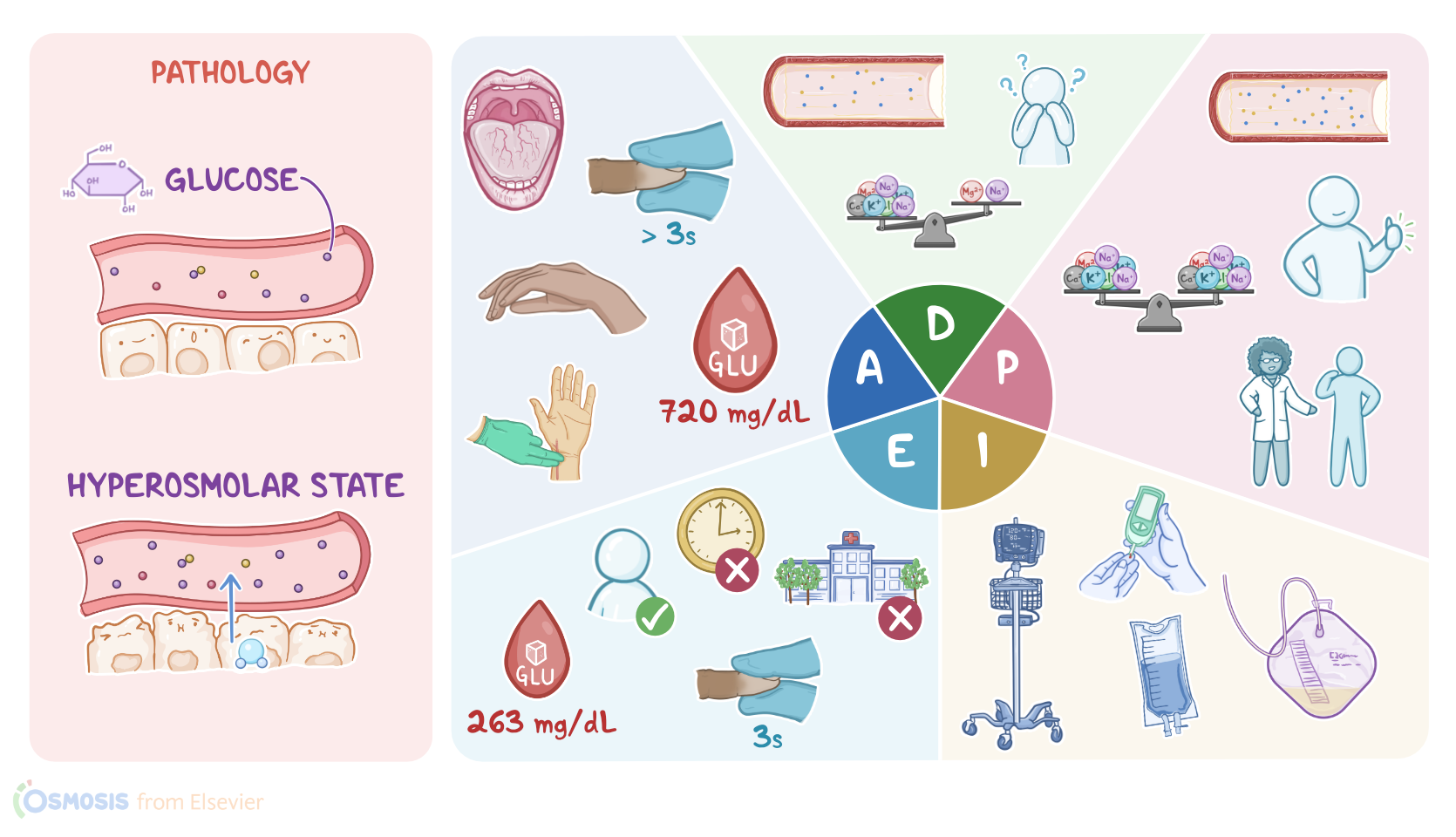
HHS occurs when the blood glucose levels go really high, over 600 mg/dL, which leads to extremely increased urination, or polyuria.
This ultimately causes severe dehydration, resulting in a blood osmolarity of over 320 mOsm/kg. Now, osmolality is the concentration of dissolved particles in the blood, and one of the major particles is glucose.
Normally, blood glucose levels should be lower than 100 mg/dL while fasting for over 8 hours, and lower than 140 mg/dL 2 hours after eating; so normal blood osmolality is maintained between 285 and 295 mOsm/kg.
Glucose is a polar molecule, which means it cannot passively diffuse across cell membranes, so it needs insulin to regulate its membrane transport into the cells.
As a consequence, when it is increased, it remains in the blood vessels and causes a hyperosmolar state that draws water into the blood.
As a result, water begins to leave the body’s cells and enter the blood vessels, leaving the cells relatively dry and shriveled.
The excess of water within blood vessels is eliminated via urination, which leads to polyuria and severe total body dehydration.
Now, HHS mainly occurs in clients with uncontrolled type 2 diabetes, leading to hyperglycemia, There’s a higher risk of HHS in older clients, especially those with impaired cognitive function or thirst perception, as well as those who do not adhere to their treatment regimen for diabetes.
Other risk factors include acute conditions, such as an infection, a stroke, or myocardial infarction. Finally, there’s increased risk of HHS among clients who take medications like glucocorticoids, which impair glucose tolerance, or diuretics, which increase urination, as well as having surgery, which puts the body under metabolic stress.
Okay, now HHS typically presents with polyuria associated with symptoms of severe dehydration, like extreme thirst, dry mouth, decreased skin turgor, anhidrosis or decreased sweating, and poor capillary refill.
In addition, clients may develop hypotension and tachycardia. If not promptly treated, severe dehydration can affect the brain, causing neurological symptoms that range from lethargy, weakness, confusion, and hallucinations, to severe complications, like seizures, and may quickly deteriorate to cerebral edema, potentially leading to coma.
Other complications of HHS include myocardial infarction, stroke, and even death.Okay, now the diagnosis of HHS typically starts with history and physical examination.
In addition, a blood test would show severe hyperglycemia and an increased blood osmolality. BUN and creatinine are also markedly elevated.
On the other hand, electrolytes like sodium and potassium can be decreased, and there’s usually no acidosis, and no or minimal ketone bodies in urine.
Treatment of HHS includes aggressive IV fluids and electrolyte replacement, followed by IV insulin to reduce glucose levels.
Assessment4:35–6:47
Okay, you’re ready to begin Mr. Johnson’s assessment.
Mr. Johnson appears fatigued with sunken eyes and is looking around the room asking where he is.
His oral mucous membranes are dry; he has warm, dry skin with poor turgor; capillary refill is more than 3 seconds. Heart sounds are normal while peripheral pulses are rapid and 2+.
Crackles are auscultated in the lung base bilaterally. Bowel sounds are active.
Throughout the exam, Mr. Johnson has difficulty recalling words and is drowsy.
Vital signs are temporal temperature 99.9°F or 37.7°C; heart rate 110 beats per minute; respirations 18 breaths per minute; blood pressure 97/68 mmHg; SpO2 96% on room air; and pain 0/10.
While reviewing his lab results, you note the following: glucose 720 mg/dL; hemoglobin A1C 10.5%; serum osmolarity 360 mOsm/kg; serum and urine ketones negative; serum pH 7.42 and bicarbonate 23 mEq/L; sodium 135 mEq/L; potassium 3.8 mEq/L; BUN 28 mg/dL; and creatinine 1.8 mg/dL.
You note his current medications include glyburide PO daily. Kyrone asks, “Will my dad be OK?
I’ve been telling him he needs to eat fewer carbs, check his blood sugar regularly, and take his medication, but he says his type of diabetes isn’t very serious.” You acknowledge that it’s probably frightening for Kyrone to see his father so ill but provide reassurance that Mr.
Johnson is in the right place to get the treatment he needs. Before leaving the room, you document your assessment findings.Alright, using your assessment findings you create the following nursing diagnoses for Mr.
Johnson: deficient fluid volume related to unstable glucose and osmotic diuresis; risk for electrolyte imbalance related to dehydration; acute confusion related to dehydration, electrolyte imbalance and elevated serum osmolarity; and ineffective health management related to nonadherence to health care regimen.Next, you develop a plan for Mr.
Diagnosis6:47–7:13
Johnson’s care along with the interdisciplinary team. By the end of your shift, Mr.
Johnson’s fluid balance will begin to normalize; his electrolyte balance will be maintained; and his mental status will improve; and before discharge, Mr.
Planning7:13–7:36
Johnson will agree to follow an agreed upon plan for health care maintenance.Now, let’s implement your interventions. Collecting capillary blood glucose levels, lab draws, vital signs, and intake and output are delegated to the patient care technician.
Normal saline and insulin are administered IV and an indwelling urinary catheter is inserted. You frequently assess Mr.
Implementation7:36–8:49
Johnson while keeping in mind to immediately notify the physician of worsening dehydration, neurologic symptoms, or changes in vital signs; abnormal laboratory results such hypoglycemia, hyponatremia, hypokalemia; respiratory distress; and signs of a thromboembolism.Keeping Mr.
Johnson’s future needs in mind, you construct a teaching plan for when Mr. Johnson is ready to be discharged, including routine self blood glucose monitoring, diet modifications, and taking his medication as prescribed; having a sick day plan; symptoms that warrant further evaluation, the importance of routine eye examinations and proper foot care; and community resources available to him.
Throughout your shift, you document nursing interventions. OK, it’s the end of your shift and you’re ready to evaluate how Mr.
Johnson is doing so far. Mr.
Johnson is less drowsy and oriented to person, but not to time, place or situation. Peripheral pulses are 3+ and capillary refill is 3 seconds.
Mr. Johnson’s most recent capillary blood glucose was 263 mg/dL.
Current lab results reveal a sodium level of 139 mEq/L and potassium level of 3.5 mEq/L. His vital signs are: temporal temperature 99.0°F or 37.2°C; heart rate 86 beats per minute; respirations 16 breaths per minute; blood pressure 110/70 mmHg; SpO2 96% on room air; and pain 0/10.You provide diabetes education materials to Kyrone and let him know nursing staff will go over the information in detail when Mr.
Evaluation8:49–9:54
Johnson is ready for discharge.Alright, as a quick recap, your client Mr. Johnson was treated for HHS, which is a complication of type 2 diabetes mellitus.
After assessing Mr. Johnson, you developed nursing diagnoses which included deficient fluid volume; risk for electrolyte imbalance; acute confusion; and ineffective health management.
Care planned and implemented focused on close monitoring, stabilizing Mr. Johnson’s glucose, fluid, and electrolytes, and developing health promotion education to improve his health maintenance.
At the end of your shift, you evaluated Mr. Johnson’s goals were partially met.
The team will continue to monitor Mr. Johnson and partner with him and his son Kyrone and adjust the plan of care as needed.
Summary9:54–10:42
mellitus after assessing. Mr.
Johnson, you develop? Nursing diagnosis.
Which include deficient fluid volume risk for electrolyte imbalance, acute confusion and ineffective Health Management care plan implemented focused on close monitoring stabilizing mr.
Johnson glucose fluid and electrolytes and developing health promotion, education to improve his health. Maintenance at the end of your shift, you evaluated that mr.
Johnson's goals were partially met, the team will continue to monitor mr. Johnson, and partner with him and his son cairone and adjust the plan of care as needed.
| HYPEROSMOLAR HYPERGLYCEMIC STATE (HHS) | ||
| KEY POINTS | NOTES | |
| PATIENT REPORT |
| |
| PATHOPHYSIOLOGY |
| |
| DIAGNOSIS AND TREATMENT |
| |
| ASSESSMENT |
| |
| NURSING DIAGNOSES |
| |
| PLANNING |
| |
| IMPLEMENTATION |
| |
| EVALUATION |
| |
No notes for this video yet
Try adding a note below