Infectious mononucleosis: Nursing

Last updated: February 25, 2022

Infectious mononucleosis: Nursing

Watch later

Watch later

Infection prevention and control - Precautions and personal protective equipment (PPE): Nursing skills
Urinary tract infections (UTIs): Nursing process (ADPIE)
Modes of infectious disease transmission
Epstein-Barr virus (Infectious mononucleosis)
Pneumonia
Wound healing
Palliative and hospice care: Nursing
Postoperative care: Nursing
Biology of cancer: Nursing
Biliary atresia: Nursing
Cholecystitis: Nursing
Cholelithiasis: Nursing
Colorectal cancer: Nursing
Diarrhea: Nursing
Diverticular disease: Nursing
Esophageal cancer: Nursing
Gastric cancer: Nursing
Hepatitis: Nursing
Inflammatory bowel disease - Crohn disease and ulcerative colitis: Nursing
Intestinal obstruction: Nursing
Irritable bowel syndrome (IBS): Nursing
Jaundice: Nursing
Laryngeal cancer: Nursing
Liver cancer: Nursing
Pancreatic cancer: Nursing
Esophageal atresia and tracheoesophageal fistula: Nursing
Geriatric considerations - Gastrointestinal: Nursing
Hirschsprung disease: Nursing
Hyperemesis gravidarum: Nursing
Necrotizing enterocolitis: Nursing
Omphalocele and gastroschisis: Nursing
Appendicitis: Nursing process (ADPIE)
Celiac disease: Nursing process (ADPIE)
Cirrhosis: Nursing process (ADPIE)
Gastroesophageal reflux disease (GERD): Nursing process (ADPIE)
Hiatal hernia: Nursing process (ADPIE)
Pancreatitis: Nursing process (ADPIE)
Peptic ulcer disease (PUD): Nursing process (ADPIE)
Antacids: Nursing pharmacology
Antidiarrheals: Nursing pharmacology
Antiemetics: Nursing pharmacology
Antispasmodics (GI): Nursing pharmacology
Gallstone-dissolving agents: Nursing pharmacology
Gastric mucosal protective agents: Nursing pharmacology
Histamine H2 antagonists: Nursing pharmacology
Laxatives: Nursing pharmacology
Medications for hepatic encephalopathy: Nursing pharmacology
Pancreatic enzyme replacements: Nursing pharmacology
Proton pump inhibitors (PPIs): Nursing pharmacology
Treatment for Helicobacter pylori: Nursing pharmacology
Weight loss medications: Nursing pharmacology
Bladder tumors: Nursing
Chronic kidney disease (CKD): Nursing
Dialysis care: Nursing
Epididymitis: Nursing
Glomerulonephritis: Nursing
Nephrotic syndrome: Nursing
Polycystic kidney disease (PKD): Nursing
Prostate cancer: Nursing
Pyelonephritis: Nursing
Renal and urinary calculi: Nursing
Renal cancer: Nursing
Testicular cancer: Nursing
Urinary retention: Nursing
Bladder exstrophy: Nursing
Circumcision: Nursing
Cryptorchidism: Nursing
Enuresis: Nursing
Geriatric considerations - Urinary: Nursing
Hypospadias and epispadias: Nursing
Acute kidney injury (AKI): Nursing process (ADPIE)
Benign prostatic hyperplasia (BPH): Nursing process (ADPIE)
Urinary incontinence - Stress: Nursing process (ADPIE)
Antispasmodics (GU): Nursing pharmacology
Cholinergic therapy (GU): Nursing pharmacology
Diuretics - Osmotic and carbonic anhydrase inhibitors: Nursing pharmacology
Diuretics - Thiazide, thiazide-like, loop, and potassium-sparing diuretics: Nursing pharmacology
Anemia - Aplastic: Nursing
Anemia - Iron-deficiency: Nursing
Anemia - Macrocytic: Nursing
Arterial blood gas (ABG) - Overview: Nursing
Arterial blood gas (ABG) - Metabolic acidosis: Nursing
Arterial blood gas (ABG) - Metabolic alkalosis: Nursing
Arterial blood gas (ABG) - Respiratory acidosis: Nursing
Arterial blood gas (ABG) - Respiratory alkalosis: Nursing
Blood cultures: Nursing
Cardiac biomarkers - Creatine kinase (CK): Nursing
Cardiac biomarkers - Troponin: Nursing
Coagulation studies - Partial thromboplastin time (PTT): Nursing
Complete blood count (CBC) - Hemoglobin and hematocrit: Nursing
Complete blood count (CBC) - Platelets: Nursing
Complete blood count (CBC) - Red blood cells (RBC): Nursing
Complete blood count (CBC) - White blood cells (WBC) and differential: Nursing
Complete metabolic panel (CMP) - Blood urea nitrogen (BUN) and creatinine (Cr): Nursing
Complete metabolic panel (CMP) - Chloride: Nursing
Complete metabolic panel (CMP) - Estimated glomerular filtration rate (eGFR): Nursing
Complete metabolic panel (CMP) - Glucose: Nursing
Complete metabolic panel (CMP) - Liver function tests (LFT): Nursing
Complete metabolic panel (CMP) - Potassium: Nursing
Complete metabolic panel (CMP) - Sodium: Nursing
Complete metabolic panel (CMP) - Total protein: Nursing
Disseminated intravascular coagulation (DIC): Nursing
Multiple myeloma: Nursing
Neutropenia: Nursing
Polycythemia: Nursing
Thalassemia: Nursing
Thrombocytopenia: Nursing
Leukemia: Nursing process (ADPIE)
Anticoagulants - Direct thrombin and factor Xa inhibitors: Nursing pharmacology
Anticoagulants - Heparin: Nursing pharmacology
Anticoagulants - Warfarin: Nursing pharmacology
Antihyperlipidemics - Bile acid sequestrants and cholesterol absorption inhibitors: Nursing pharmacology
Antihyperlipidemics - Fibrates: Nursing pharmacology
Antihyperlipidemics - Miscellaneous: Nursing pharmacology
Antihyperlipidemics - Statins: Nursing pharmacology
Antiplatelet agents: Nursing pharmacology
Blood products: Nursing pharmacology
Hematopoietic growth factors: Nursing pharmacology
Hemostatics: Nursing pharmacology
Iron preparations: Nursing pharmacology
Thrombolytics: Nursing pharmacology
Autoimmunity: Nursing
Human immunodeficiency virus (HIV) and acquired immunodeficiency syndrome (AIDS): Nursing
Hypersensitivity reactions - Type I: Nursing
Hypersensitivity reactions - Type II: Nursing
Hypersensitivity reactions - Type III: Nursing
Hypersensitivity reactions - Type IV: Nursing
Immune response - Adaptive: Nursing
Immune response - Innate: Nursing
Immunodeficiency disorders - Primary: Nursing
Immunodeficiency disorders - Secondary: Nursing
Inflammatory process: Nursing
Scleroderma: Nursing
Shock - Anaphylactic: Nursing
Sjögren syndrome: Nursing
Systemic lupus erythematosus (SLE): Nursing
Toxic shock syndrome (TSS): Nursing
Erythema infectiosum (Fifth disease): Nursing
Fever: Nursing
Infectious mononucleosis: Nursing
Mumps (Parotitis): Nursing
Neonatal sepsis: Nursing
Pertussis: Nursing
Poliomyelitis: Nursing
Postpartum infections: Nursing
Roseola (Exanthem subitum): Nursing
Rubella (German measles): Nursing
Rubeola (Measles): Nursing
Smallpox: Nursing
Zika virus: Nursing
Anaphylaxis: Nursing process (ADPIE)
Lyme disease: Nursing process (ADPIE)
Rheumatoid arthritis (RA): Nursing process (ADPIE)
Antirejection immunosuppressants: Nursing pharmacology
Biologic agents: Nursing pharmacology
Disease-modifying therapy for multiple sclerosis: Nursing pharmacology
Immunoglobulins: Nursing pharmacology
Immunomodulators: Nursing pharmacology
Immunosuppressants for autoimmune diseases: Nursing pharmacology
Non-biologic disease-modifying antirheumatic drug (DMARD) therapy: Nursing pharmacology
Vaccines: Nursing pharmacology
Acne: Nursing
Animal and snake bites: Nursing
Burn injury: Nursing
Cutaneous fungal infections: Nursing
Erysipelas and cellulitis: Nursing
Folliculitis, carbuncles, and furuncles: Nursing
Herpes simplex virus (HSV): Nursing
Herpes zoster: Nursing
Impetigo: Nursing
Insect stings and bites: Nursing
Pediculosis and scabies: Nursing
Psoriasis: Nursing
Rocky Mountain spotted fever (RMSF): Nursing
Skin cancer - Basal cell carcinoma, squamous cell carcinoma, and melanoma: Nursing
Urticaria: Nursing
Geriatric considerations - Integumentary: Nursing
Atopic dermatitis: Nursing process (ADPIE)
Frostbite: Nursing process (ADPIE)
Methicillin-resistant Staphylococcus aureus (MRSA): Nursing process (ADPIE)
Pressure injury: Nursing process (ADPIE)
Antibiotics - Topical: Nursing pharmacology
Antifungals - Topical: Nursing pharmacology
Corticosteroids - Topical: Nursing pharmacology
Debridement agents: Nursing pharmacology
Keratolytics: Nursing pharmacology
Medications for acne vulgaris: Nursing pharmacology
Osteoarthritis: Nursing
Osteomyelitis: Nursing
Osteoporosis: Nursing
Hip fractures: Nursing
Developmental dysplasia of the hip: Nursing
Acute compartment syndrome: Nursing process (ADPIE)
Fractures: Nursing process (ADPIE)
Gout: Nursing process (ADPIE)
Musculoskeletal injuries: Nursing process (ADPIE)
Buerger disease: Nursing
Raynaud phenomenon: Nursing
Peripheral arterial disease (PAD): Nursing process (ADPIE)
Peripheral venous disease (PVD): Nursing process (ADPIE)
Atelectasis: Nursing
Geriatric considerations - Respiratory: Nursing
Venous thromboembolism (VTE): Nursing process (ADPIE)
Asthma: Nursing process (ADPIE)
Bacterial pneumonia: Nursing process (ADPIE)
Bronchiolitis and respiratory syncytial virus (RSV): Nursing process (ADPIE)
Carbon monoxide poisoning: Nursing process (ADPIE)
Chronic obstructive pulmonary disease (COPD): Nursing process (ADPIE)
Epiglottitis: Nursing process (ADPIE)
Foreign body aspiration and upper airway obstruction: Nursing process (ADPIE)
Laryngotracheobronchitis (LTB) and croup: Nursing process (ADPIE)
Smoke inhalation injury: Nursing process (ADPIE)
Papulosquamous and inflammatory skin disorders: Pathology review

Notes

INFECTIOUS MONONUCLEOSIS

KEY POINTS
NOTES
DEFINITION
  • Highly contagious, self-limiting viral infection

PHYSIOLOGY
  • Immune response
    • Innate
      • Natural barriers
      • Natural killer (NK) cells
      • Phagocytes
      • Responds quickly to pathogens entering body
    • Adaptive
  • Infection
    • Macrophages and neutrophils fight pathogen and secrete cytokines
    • Cytokines produce inflammatory proteins
    • Dendritic cells engulf and digest pathogen
    • T helper cells recognize pathogen fragments
    • B lymphocytes activated and produce antibodies

CAUSES AND RISK FACTORS
  • Causes
    • Epstein-Barr virus (EBV)
  • Risk factors
    • Kissing
    • Sharing food, beverages, or personal items

PATHOPHYSIOLOGY
  • Virus enters body and infects epithelial cells of pharynx
  • Virus replicates and releases new viral particles
  • New viral particles spread to lymphoid tissue
  • B cells in lymphoid tissue infected with virus
  • Virus spreads throughout body via B cells
  • Complications
    • Erythema multiforme
    • Pancytopenia
    • Autoimmune hemolytic anemia
    • Mild hepatocellular hepatitis
    • Guillian-Barre
    • Aseptic meningitis
    • Upper airway obstruction
    • Peritonsillar abscess

SIGNS AND SYMPTOMS
  • Fever
  • Chills 
  • Malaise 
  • Anorexia
  • Tonsillar pharyngitis
  • Lymphadenopathy
  • Upper airway obstruction
  • Headache
  • Fatigue
  • Palatal petechiae
  • Tonsillitis 

DIAGNOSIS
  • History
  • Physical assessment
  • Peripheral smear
  • Monospot

TREATMENT
  • Supportive care

MANAGEMENT OF CARE
  • Goals of care
    • Provide supportive care
  • Assess vital signs
  • Ask about symptoms
  • Administer medications as prescribed

PATIENT AND FAMILY TEACHING
  • Explain condition, plan of care, and how to safely administer medications
  • Teach how to prevent spread
  • Encourage rest
  • May return to school/work when feeling better
  • Review prescribed medications
  • Teach about throat lozenges and gargling salt water
  • Recommend soft diet
  • Encourage fluids
  • Avoid alcohol, strenuous activities/sports
  • Seek emergency care
    • Symptoms of ruptured spleen
  • Notify HCP
    • Difficulty swallowing or breathing
    • Abdominal pain or chest pain
    • Worsening sore throat
    • New rash
    • Yellowing eyes, skin, or mouth

Transcript

Watch video only

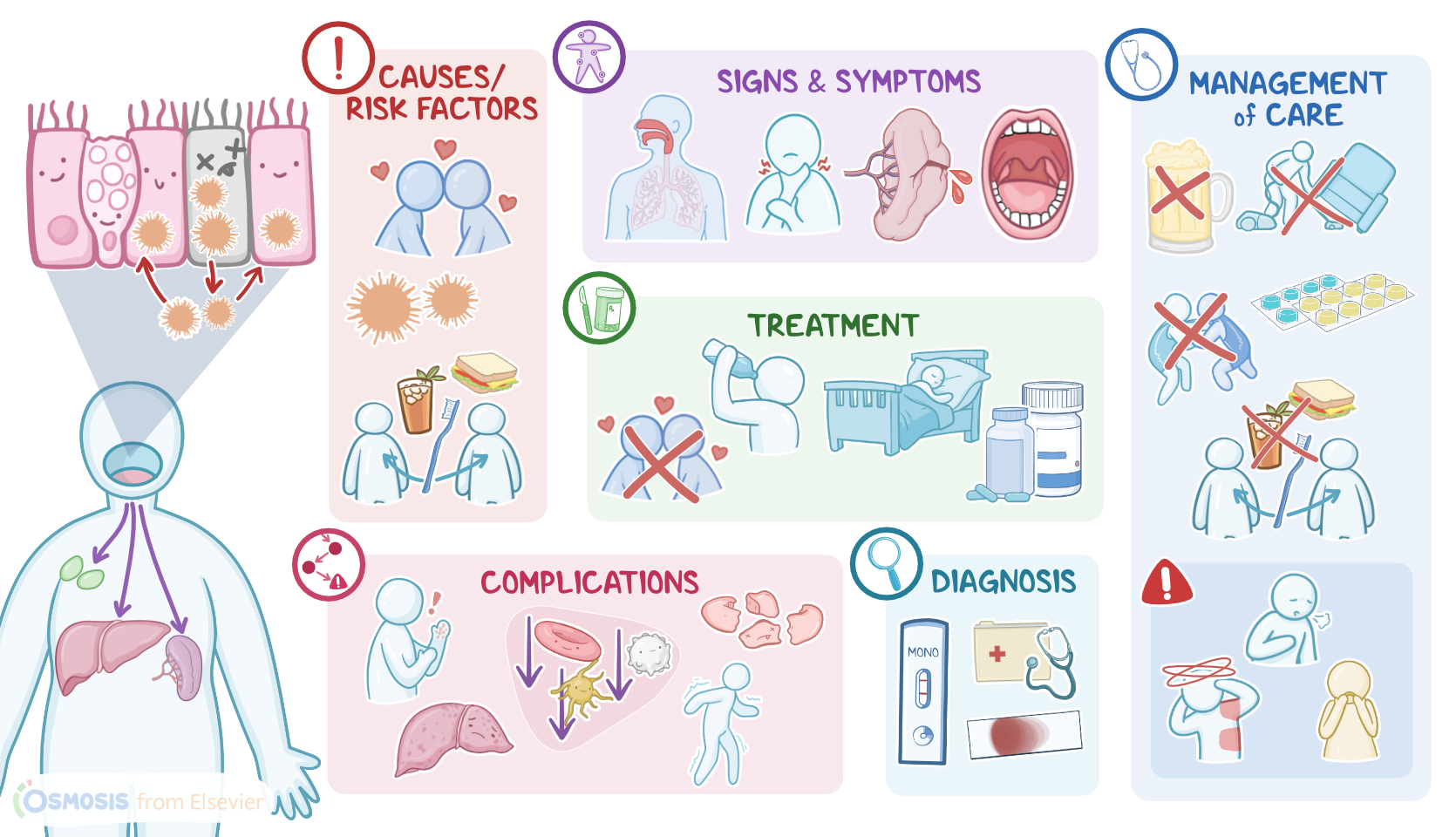
Infectious mononucleosis, or simply mono, is a highly contagious, but self-limiting viral infection caused by the Epstein-Barr virus. Infectious mononucleosis is typically seen in young clients and adolescents and is often referred to as “the kissing disease” because the Epstein-Barr virus primarily spreads through saliva.

First, let’s quickly review the physiology of normal immune response, which is subdivided into innate and adaptive immunity. Innate immunity consists of natural barriers, like skin and mucous membranes; natural killer cells, which help fight virus-infected and tumor cells; and phagocytes, such as macrophages, neutrophils, and dendritic cells.

Now, when a pathogen, like a virus, reaches a person’s mouth, breaches the mucosal barrier, and enters the body, the innate immune system reacts quickly. The first cells on the scene are macrophages and neutrophils, which directly fight the pathogen. At the same time, they also secrete small molecules called cytokines to increase the permeability of local blood vessels and message other immune cells that there’s an active fight in the body. Additionally, cytokines induce the production of acute inflammatory proteins and cause systemic effects, such as fever.

Simultaneously, dendritic cells engulf and digest the pathogen, eventually presenting small fragments of it on their surface. At this point, the adaptive immune system, which relies on B and T lymphocytes, comes to the rescue. Specifically, T helper cells recognize these fragments and help activate B lymphocytes, primarily in pharyngeal lymph tissue, tonsils, and regional cervical lymph nodes. Once stimulated, B cells start to produce antibodies, which circulate throughout the body and bind to pathogens, eventually enabling cytotoxic T lymphocytes and NK cells to recognize and destroy them.

The most common cause of infectious mononucleosis is the Epstein-Barr virus, also known as human herpesvirus 4 or HHV-4. This is a small DNA virus that belongs to the Herpesviridae family. Important risk factors associated with Epstein-Barr infection include kissing, sharing drinks and food, as well as utensils or personal items, like toothbrushes.

Now, let’s look at the pathology of infectious mononucleosis, which starts when the virus-containing saliva or respiratory secretions reach the mouth of a healthy person. Once inside the mouth, the Epstein-Barr virus infects the epithelial cells of the pharynx and starts replicating, eventually forming new viral particles. At one point, newly formed viral particles destroy the host’s cell, eventually spreading the infection and reaching the lymphoid tissue of the pharynx, tonsils, and cervical lymph nodes. Here, the virus infects B lymphocytes. But the Epstein-Barr virus does not kill the B lymphocyte; instead, it enters the latent phase and uses the lymphocyte as a vehicle to spread throughout the body. Eventually, the virus reaches distant sites and causes enlargement of lymph nodes, liver, and spleen, which are conditions also known as lymphadenopathy, hepatomegaly, and splenomegaly, respectively.

Okay, now, important complications that may occur in clients with infectious mononucleosis include erythema multiforme, pancytopenia, and autoimmune hemolytic anemia. Mild hepatocellular hepatitis is also a potential complication. Neurologic complications, such as Guillain-Barre syndrome and aseptic meningitis can also occur. In severe cases, the enlargement of lymph nodes can eventually lead to upper airway obstruction; a peritonsillar abscess can also cause respiratory compromise and dysphagia; while an enlarged spleen can rupture and cause life-threatening bleeding.

Clinical manifestations typically occur 4 to 8 weeks after the infection. First, there can be a prodromal period that includes a gradual onset of fever, chills, malaise, and anorexia. This is followed by the classical triad of symptoms of continued fever, tonsillar pharyngitis, and lymphadenopathy. In severe cases, cervical lymphadenopathy can lead to upper respiratory airway obstruction. Clients also present with nonspecific symptoms, such as headache and fatigue, which can persist even 6 months after the infection. Other important clinical features include palatal petechiae, or red spots on the palate, and tonsillitis that can involve whitish exudates.

Diagnosis of infectious mononucleosis is based on the client’s history, and physical assessment, followed by a peripheral blood smear, which typically reveals lymphocytosis and elevated aminotransferases. Another important diagnostic method is the Monospot test, which can detect the presence of heterophile antibodies. It’s important to note though the Monospot test can be negative during the first 7 to 10 days of the infection.