Insect stings and bites: Nursing

Last updated: August 02, 2022

Insect stings and bites: Nursing

223 Content

223 Content

Hypersensitivity reactions - Overview: Nursing pathophysiology
Community health case study - Rural healthcare: Nursing
Critical care case study - Septic shock: Nursing
Critical care case study - Cardiogenic shock: Nursing
Critical care case study - ST elevation myocardial infarction (STEMI): Nursing
Critical care case study - Disseminated intravascular coagulation (DIC): Nursing
Critical care - Burns: Nursing
Critical care - Multiple organ dysfunction syndrome (MODS): Nursing
Critical care case study - Intracranial hypertension: Nursing
Acute and chronic: Clinical decision making
Airway, breathing, circulation: Clinical decision making
Clinical judgment: Clinical decision making
Maslow's hierarchy of needs: Clinical decision making
Nursing process: Clinical decision making
Overview: Clinical decision making
Restrictive and invasive: Clinical decision making
Safety: Clinical decision making
Aortic aneurysm: Nursing process (ADPIE)
Cardiac biomarkers - Creatine kinase (CK): Nursing
Cardiac biomarkers - Troponin: Nursing
Cardiomyopathy: Nursing
Case study - Hypovolemic shock: Nursing
Myocardial infarction (MI): Nursing process (ADPIE)
Myocarditis: Nursing
Pericardial effusion and cardiac tamponade: Nursing process (ADPIE)
Pericarditis: Nursing
Shock - Anaphylactic: Nursing
Shock - Cardiogenic: Nursing
Shock - Hypovolemic: Nursing
Shock - Neurogenic: Nursing
Shock - Obstructive: Nursing
Shock - Septic: Nursing
Valvular heart disease: Nursing
Testicular cancer: Nursing
Case study - Leukemia: Nursing
Disseminated intravascular coagulation (DIC): Nursing
Leukemia: Nursing process (ADPIE)
Multiple myeloma: Nursing
Neutropenia: Nursing
Immunodeficiency disorders - Secondary: Nursing
Burn injury: Nursing
Case study - Burn injury: Nursing
Frostbite: Nursing process (ADPIE)
Skin cancer - Basal cell carcinoma, squamous cell carcinoma, and melanoma: Nursing
Lymphoma - Hodgkin and non-Hodgkin: Nursing
Biology of cancer: Nursing
Care of a client in the emergency department: Nursing
Complications of cancer: Nursing
Tumor lysis syndrome (TLS): Nursing Process (ADPIE)
Case study - Stroke: Nursing
Encephalitis: Nursing
Hemorrhagic stroke - Intracranial hemorrhage (ICH) and subarachnoid hemorrhage (SAH): Nursing
Increased intracranial pressure (ICP): Nursing
Meningitis: Nursing process (ADPIE)
Stroke: Nursing process (ADPIE)
Breast cancer: Nursing process (ADPIE)
Case study - Breast cancer: Nursing
Lung cancer: Nursing
Leukemia: Nursing pathophysiology
Burns: Nursing pathophysiology
Skin cancer: Nursing pathophysiology
Multiple organ dysfunction syndrome (MODS): Nursing pathophysiology
Stroke: Nursing pathophysiology
Breast cancer: Nursing pathophysiology
Types of leadership: Nursing
Quality and safety: Nursing
Legal issues: Nursing
Health promotion and illness prevention: Nursing
Health literacy: Nursing
Ethics: Nursing
Disaster management: Nursing
Delegation and supervision: Nursing
Decision-making: Nursing
Environmental emergencies: Nursing
Social determinants of health (SDOH): Nursing
Case study - Accidental ingestion: Nursing
Poisoning: Nursing process (ADPIE)
Smoke inhalation injury: Nursing process (ADPIE)
Insect stings and bites: Nursing
Atrophy, aplasia, and hypoplasia
Hyperplasia and hypertrophy
Metaplasia and dysplasia
Oncogenes and tumor suppressor genes
Aneurysms
Aortic valve disease
Mitral valve disease
Chronic kidney disease (CKD): Nursing
Dialysis care: Nursing
Polycystic kidney disease (PKD): Nursing
Acute kidney injury (AKI): Nursing process (ADPIE)
Critical care case study - Acute kidney injury: Nursing
Kidney disease: Nursing pathophysiology

Notes

INSECT STINGS AND BITES

KEY POINTS
NOTES
DEFINITION
  • Sting
    • Insect introduces toxic venom into the body
  • Bite
    • Insect pierces skin to feed on blood

PHYSIOLOGY
  • Skin layers
    • Epidermis
    • Dermis
    • Sit on hypodermis
  • Skin
    • Physical barrier to external environment
    • Immune cells

CAUSES AND RISK FACTORS
  • Causes - Strings
    • Bees
    • Wasps
    • Hornets
    • Yellowjackets
    • Fire ants
    • Spiders
    • Scorpions
  • Causes - Bites
    • Mosquitoes
    • Chiggers
    • Bed bugs
    • Lice
    • Ticks
  • Risk factors
    • Disturbing insects
    • Spending time outdoors
    • Warmer climates or wetlands and forested areas
    • Collecting insects
    • Not using protective clothing or repellent

PATHOPHYSIOLOGY
  • Stings
    • Insect introduces toxic venom through stingers
    • Immune system reacts
    • Mild: local skin reaction
  • Bites
    • Insect pierces skin during a blood meal
    • Injects small amount of anticoagulant saliva
    • Activates immune response
  • Complications
    • Spread vector-borne diseases
    • Anaphylaxis
    • Secondary bacterial infections

SIGNS AND SYMPTOMS
  • Insect stings
    • Irritation
    • Pruritis
    • Swelling
    • Redness
    • Allergic reaction
      • Intense pain and swelling
  • Insect bites
    • Less swelling
    • Bump or blister
    • Intense pruritis
    • Anaphylaxis
      • Angioedema
      • Respiratory symptoms

DIAGNOSIS
  • History
  • Physical assessment
  • Blood tests
  • ECG

TREATMENT
  • Supportive measures
    • Clean area
    • Ice 
    • Elevate
    • Pain management
    • Calamine lotion or topical steroids
    • Systemic corticosteroids or oral antihistamines
  • Secondary infection
    • Antibiotic therapy
  • Anaphylaxis
    • Medical emergency
    • IM epinephrine

MANAGEMENT OF CARE
  • Goals of care
    • Promote comfort
    • Monitor for complications
  • Assess site and for pain and itching
  • Check for stinger and remove it
  • Clean area
  • Remove restrictive clothing
  • Elevate area
  • Ice compress
  • Administer prescribed medications
  • Monitor for complications
  • Report to HCP
    • Flushing
    • Swelling of lips, gums, or tongue
    • Hoarseness
    • Dyspnea
    • Chest tightness or pain
    • Hypotension
  • For anaphylaxis - administer epinephrine

PATIENT AND FAMILY TEACHING
  • Explain condition, plan of care, and how to safely administer medications
  • Home management
    • Remove stinger
    • Wash area
    • Ice, elevation, calamine lotion or topical steroid
    • Oral antihistamine
    • Pain management
  • Report to HCP
    • Swelling spreads
    • Fever, wheezing, difficulty breathing, chest tightness
  • Ways to prevent insect stings and bites

Transcript

Watch video only

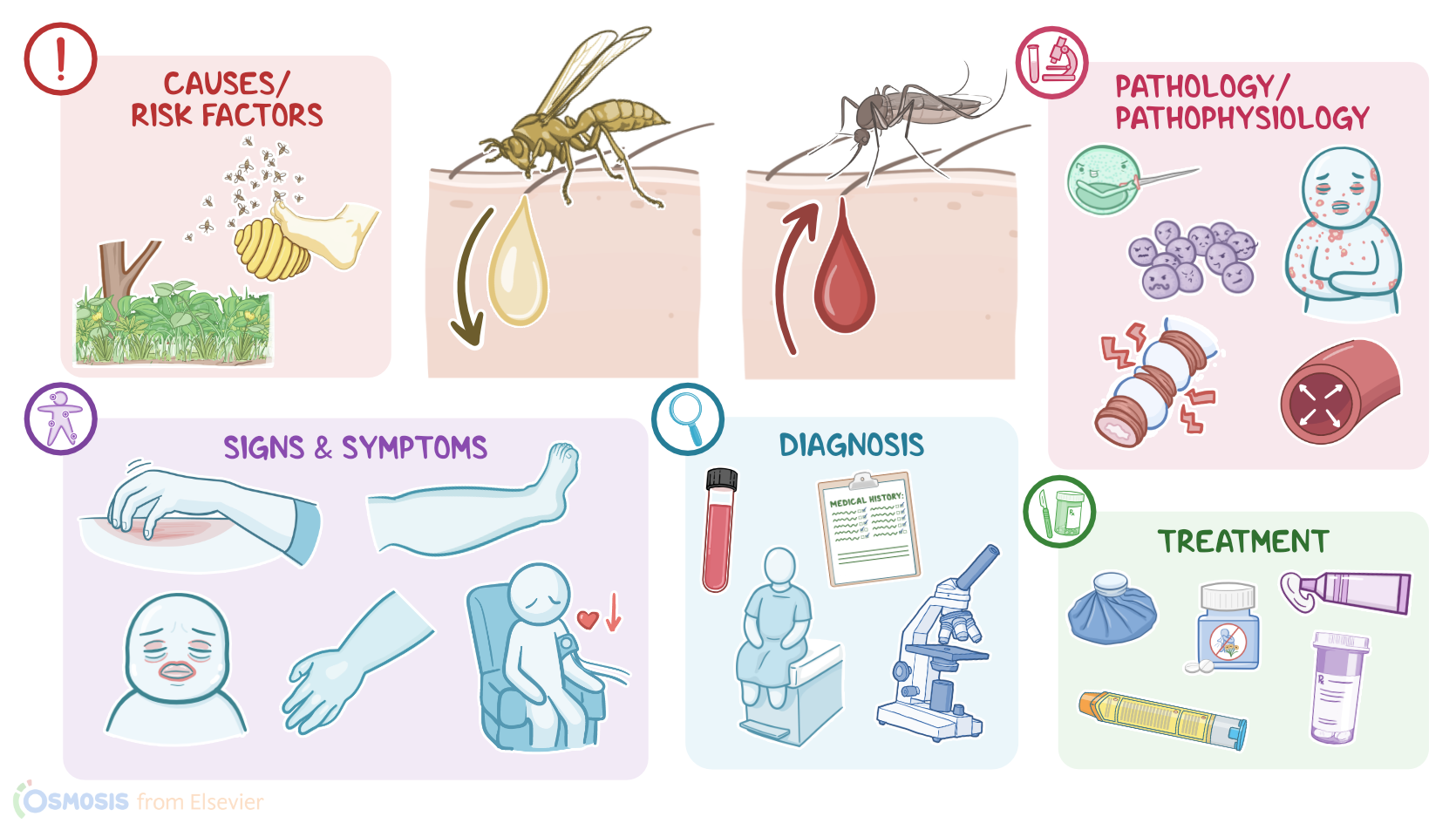
Insect stings and bites are relatively common injuries; the difference between them is that stings happen when an insect introduces toxic venom into someone's body, often as a self-defense mechanism; whereas bites happen when an insect pierces someone’s skin in order to feed on their blood.

Let’s start by looking at the anatomy and physiology of the skin. The skin is made of the epidermis, which is an outer layer that acts as a protective barrier against the environment; the dermis, which primarily contains blood vessels and nerve endings; and the hypodermis, which is a layer of connective tissue that provides structural support to the skin.

In addition to being a physical barrier against the external environment, the skin harbors several types of immune cells that participate in the body’s immune response. Normally, the immune system recognizes and acts against pathogens that cause disease, but in some clients, it can overreact and start targeting harmless molecules that don’t cause any problems for most people, including certain foods, medications, as well as the venom or saliva of some insects.

Now, insect stings are caused by stinger insects of the Hymenopteran family, which includes bees, wasps, hornets, yellow jackets, and fire ants; as well as other animals like spiders and scorpions. On the other hand, insect bites are most commonly caused by insects that feed on the host's blood to survive, and these include mosquitoes, chiggers, bedbugs, lice, and ticks.

Since many insects only sting when provoked, risk factors for getting stung include disturbing the animals, such as stepping on a bee-hive, for example. Additionally, insect stings and bites are more likely to happen in clients who spend a lot of time outdoors, especially those who live in warmer climates or near wetlands and forested areas with lots of wood, bushes, and tall grass. Other risk factors include collecting insects as a hobby and not using protective clothes or repellent when spending time outdoors.

Now, while insect stings and bites can result in similar injuries, their pathology is quite different. Stings occur when an insect introduces toxic venom through their stingers into the client’s skin. Here, the problem isn’t really the venom, but rather the immune system’s reaction to it. In mild cases, there may be a local skin reaction around the sting site due to the activation of neighboring immune cells and subsequent release of proinflammatory molecules, like histamine and bradykinin.

With insect bites, on the other hand, the insect pierces the client’s skin during a blood meal. Typically, the insect injects a small amount of anticoagulant saliva that prevents blood from clotting during the blood meal, and that saliva can also activate the immune system’s response. Although most insect bites only cause maddening itches, some can spread vector-borne diseases, including malaria, Lyme disease, and Rocky Mountain Spotted Fever.

In addition, it’s important to be aware that some clients may develop a potentially life-threatening reaction in response to insect stings or bites called anaphylaxis. In anaphylaxis, increased amounts of histamine and other proinflammatory molecules leak into the bloodstream and reach multiple organs, causing generalized swelling, widespread vasodilation, and constriction of the airways. Finally, scratching stings and bites creates more tissue injury, which can serve as an entryway for secondary bacterial infections.

Alright, now the clinical manifestations of insect stings and bites range from mild local skin reactions to potentially life-threatening anaphylaxis. With mild insect stings, clients can present irritation, pruritus, swelling, and redness around the sting site. Severe allergic reactions, on the other hand, can cause intense pain and swelling of a larger part of the body, such as the whole face or limbs.

On the other hand, insect bites generally cause less swelling, but there might be a bump or blister around the bite mark, as well as intense pruritus. Finally, anaphylaxis can cause angioedema, which is when tissues all over the body start swelling up; as well as respiratory symptoms, like shortness of breath, coughing, or wheezing; abdominal cramps, vomiting, or diarrhea; and hypotension.

The diagnosis of insect stings and bites starts with the client’s history and physical assessment. In most cases, no other laboratory or imaging tests are necessary to confirm the diagnosis. However, additional studies, like blood tests, microbiological studies, and an EKG, may be necessary in cases of secondary infection or if a vector-borne disease is suspected.

Now, most insect stings and bites can be treated with simple supportive measures, including cleaning the area with soap and water, applying ice compresses, elevating the area in cases of swelling, and pain management with acetaminophen or NSAIDs. Mild pruritus can be treated with calamine lotion or topical corticosteroids, and for moderate or severe pruritus, a short course of systemic corticosteroids and oral antihistamines, including both H1 and H2 blockers, can be used.