Kawasaki disease: Nursing
Introduction0:00–0:13
Kawasaki disease is a condition associated with acute inflammation of medium-sized arteries; and it’s typically seen in children between the ages of 6 months and 5 years.First, let’s cover some basic physiology of arteries.
Physiology0:13–0:49
There are three main types of arteries: large arteries, like the aorta; medium arteries, like the coronary arteries that supply the heart; and finally, small arteries.
Now, each artery consists of three layers: from outside in, there’s the tunica adventitia, which has loose connective tissue; then the tunica media, which mainly contains smooth muscle cells but also some elastic tissue; and finally the tunica intima, or endothelium, which consists of a single layer of endothelial cells on top of a layer of connective tissue, called lamina propria.The exact cause of Kawasaki disease remains unknown, but some sources suggest that it might be triggered by an infection or autoimmune process.
Causes & risk factors0:49–1:08
The most important risk factors associated with Kawasaki disease include being below 5 years of age, being assigned male at birth, and having Asian or Pacific Islander ancestry.Now let’s look at the pathology of Kawasaki disease.
Pathology1:08–2:49
Typically the client’s immune system is activated to fight off an infection. Then, for reasons we still don’t understand, the immune cells like neutrophils, macrophages and even B cells and T cells start attacking the endothelial lining of medium sized blood vessels, most commonly the coronary arteries of the heart.
Now, these cells cause inflammation within the artery which damages the endothelial lining. They can even invade into the tunica media where they destroy the elastin and collagen fibers that make up the arterial wall.
Now, Kawasaki disease can cause serious life-threatening cardiovascular complications. First, damage to the endothelium exposes collagen and tissue factors in the tunica media, which can trigger coagulation.
Clots forming on the arterial wall reduce blood flow to heart tissue, causing ischemia. Next, inflammation leads to fibrosis within the arterial wall, which makes the walls thicker and the arterial lumen narrower, reducing blood flow even more.
Finally, damage to the arterial wall weakens it, so it can balloon out forming an aneurysm. If the aneurysm ruptures, blood flow will be further reduced.
So all three processes reduce blood flow to the heart; this causes ischemia, and potentially myocardial infarction or even death.
In addition, the immune cells causing arterial inflammation can move beyond the arterial wall into nearby cardiac tissue causing valvulitis, meaning inflammation of the heart valves; myocarditis, or inflammation of the heart muscle; and pericarditis, or inflammation of the fibrous heart sac called the pericardium.
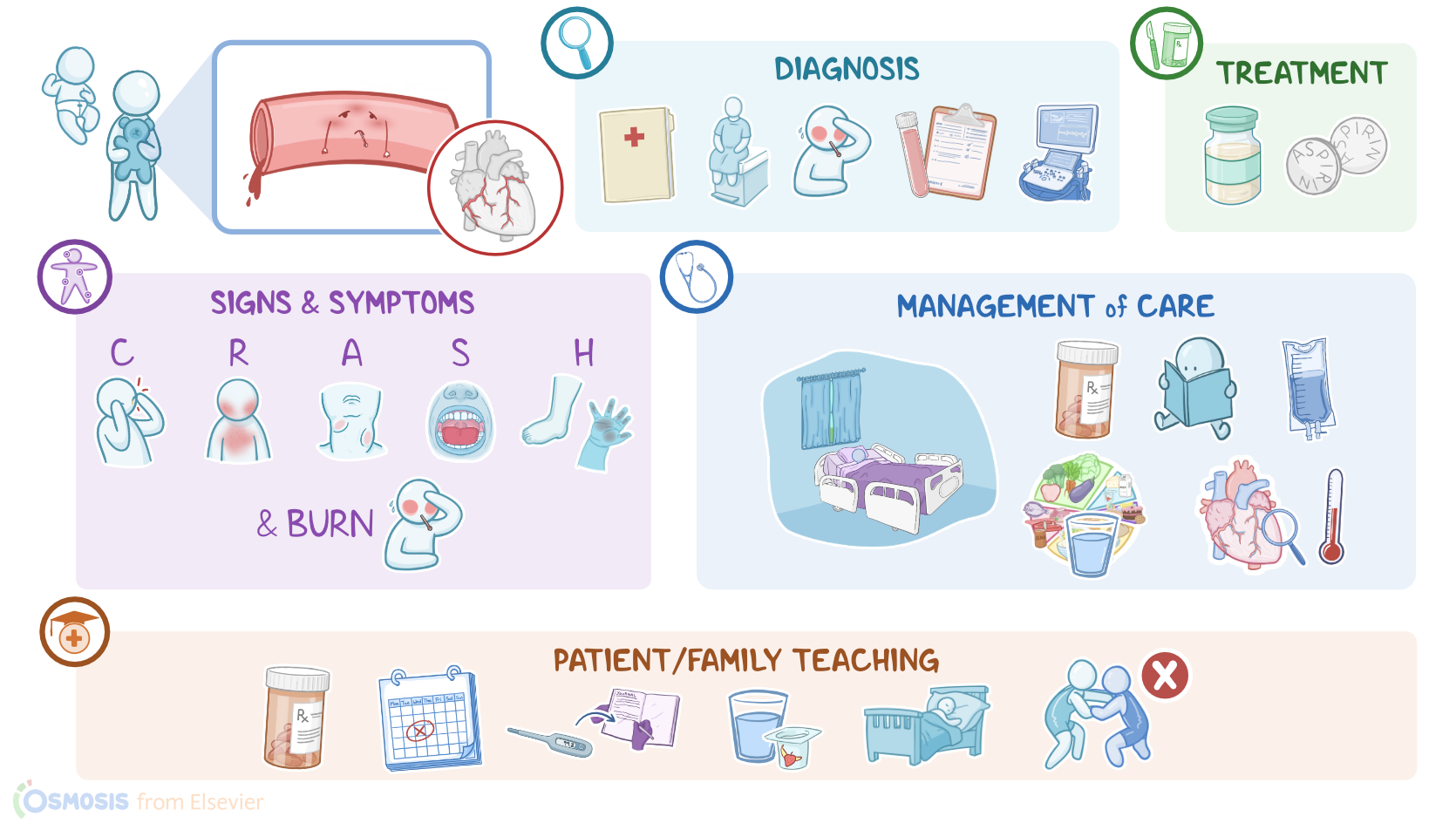
Now, the most important clinical manifestations of Kawasaki disease can be remembered with the mnemonic CRASH and burn. “C” stands for Conjunctival hyperemia or eye redness that can be associated with photophobia, meaning increased sensitivity of the eyes to light.
Clinical manifestations2:49–3:43
Next, there is “R” for Rash, described as polymorphous exanthem; while “A” stands for Adenopathy, more specifically lymphadenopathy of cervical lymph nodes.
Other clinical manifestations include malaise, joint pain, diarrhea, thrombocytosis, and cardiac manifestations such as cardiac arrhythmias.Diagnosis is based on medical history and physical examination.
Diagnosis3:43–4:08
A client must have a fever that lasts for over 5 days and at least four of the five clinical features of Kawasaki disease.
Additional diagnostic methods that can help include CBC, CRP, ESR, serum transaminase levels, as well as echocardiography, to assess degree of cardiac involvement.Treatment includes supportive care and minimization of the risk of the coronary aneurysm.
Treatment4:08–4:40
Clients should receive intravenous immunoglobulin, as well as high-dose aspirin, to prevent thrombosis. Normally, aspirin should be avoided in children because it can cause Reye syndrome, which is a condition characterized by liver failure and rapidly progressive encephalopathy; however, with Kawasaki disease, aspirin is permitted because its anti-thrombotic effects outweigh the risk of Reye syndrome.All right, let’s take a look at the nursing care you’ll be providing for a child with Kawasaki disease.
Management and care4:40–7:06
Your priority nursing goals are to promote comfort and healing, and to monitor for complications. Start by assisting your client into a position of comfort and create a calm environment by decreasing external stimulation.
Also dim the lights in their room to ease the photophobia and discomfort caused by their conjunctivitis. Apply lip balm to their chapped lips and a mild lubricant to areas of rash and peeling skin.
Lastly, monitor their pain level, administer the prescribed analgesics, and collaborate with the Child Life Specialist for nonpharmacologic pain management strategies like distraction and quiet age-appropriate activities.
Next, promote healing by initiating IV access and infusing the prescribed IVIG. During the infusion, watch for reactions to the medications, and immediately report to the healthcare provider if your client experiences dizziness, flushing, headache, diaphoresis, nausea and vomiting, or upper abdominal pain.
Stop the infusion, administer antihistamines or other prescribed treatments, and restart the infusion at a lower rate once symptoms have resolved.
Promote nutrition by providing small, frequent, nourishing meals consisting of soft, bland foods. Be sure to watch closely for potential cardiac complications.
Listen to heart sounds, initiate ECG monitoring as ordered, and institute bed rest to decrease cardiac workload. Immediately report the presence of arrhythmias or abnormal heart sounds to the health care provider.
Finally, keep a close eye on your client’s vital signs, paying particular attention to their temperature. Institute seizure precautions, administer the prescribed PO aspirin, and institute cooling measures, as needed, such as cool compresses or tepid sponge baths.
General client and family teaching7:06–9:02
Immediately report to the healthcare provider if fever continues despite cooling measures.Okay, moving on to client and family teaching.
Begin by explaining that Kawasaki disease is a condition that causes inflammation of the walls of the blood vessels, rash, and sore mucus membranes like the mouth, lips, and tongue.
Review the treatment plan, and each of their child’s prescribed medications; and remind them to delay live vaccinations such as measles and varicella until at least 11 months after the final dose of IVIG.
Lastly, stress the importance of keeping all scheduled follow-up appointments, including ECGs and echocardiograms, for continued monitoring and care.Next, teach them how to monitor their child’s temperature and recommend that they keep a log of each temperature reading.
Instruct them to give acetaminophen for fever, and remind them not to use NSAIDs like ibuprofen while their child is on aspirin therapy.
Advise them to notify their healthcare provider immediately for a fever of 100.4˚F or 38˚C or above. Also, provide them with teaching related to their child’s activities.
Talk to them about the importance of keeping their child well hydrated and to offer small frequent meals and snacks. Advise them to provide their child with plenty of opportunities for rest, and to encourage quiet activities like coloring, reading, or playing with puzzles.
Instruct them to notify the healthcare provider immediately if they notice unusual bleeding such as bruising, nose bleeds, or blood in the urine, stool or vomit.Finally teach them to recognize signs and symptoms of cardiac problems, and to immediately seek medical care if their child is more tired than usual; if they are not eating and seem to have a decreased appetite; or if their child is having trouble breathing or is experiencing chest pain.
Review9:02–9:45
All right as a quick recap…. Kawasaki disease is a condition usually seen in children between the ages of 6 months and 5 years, and is characterized by acute inflammation of medium-sized arteries, most commonly the coronary arteries of the heart.
Clinical manifestations can be remembered with the “CRASH and burn” mnemonic, which stands for conjunctivitis, rash, adenopathy, strawberry tongue, hand and feet changes, and fever.
Treatment consists of supportive measures and preventing risks of coronary complications. Priority nursing goals include promoting comfort and healing, and monitoring for complications.
Client and family teaching is focused on care of their child at home.
| KAWASAKI DISEASE | ||
| KEY POINTS | NOTES | |
| DEFINITION |
| |
| PHYSIOLOGY |
| |
| CAUSES AND RISK FACTORS |
| |
| PATHOPHYSIOLOGY |
| |
| SIGNS AND SYMPTOMS |
| |
| DIAGNOSIS |
| |
| TREATMENT |
| |
| MANAGEMENT OF CARE |
| |
| PATIENT AND FAMILY TEACHING |
| |
No notes for this video yet
Try adding a note below