Left-sided heart failure: Nursing process (ADPIE)

2,108views

Left-sided heart failure: Nursing process (ADPIE)

Medical Surgical

Medical Surgical

Arrhythmias - Asystole: Nursing
Arrhythmias - Atrial fibrillation (Afib): Nursing
Arrhythmias - Atrial flutter (Aflutter): Nursing
Arrhythmias - Heart blocks: Nursing
Arrhythmias - Premature atrial contractions (PACs): Nursing
Arrhythmias - Premature ventricular contractions (PVCs): Nursing
Arrhythmias - Sinus tachycardia and sinus bradycardia: Nursing
Arrhythmias - Supraventricular tachycardia (SVT): Nursing
Arrhythmias - Ventricular fibrillation (Vfib): Nursing
Arrhythmias - Ventricular tachycardia (Vtach): Nursing
Arterial embolism: Nursing
Electrocardiogram (ECG) - Normal sinus rhythm (NSR): Nursing
Cardiomyopathy: Nursing
Congenital heart defects - Acyanotic: Nursing
Congenital heart defects - Cyanotic: Nursing
Endocarditis: Nursing
Heart defects that decrease pulmonary blood flow - Nursing considerations & client education: Nursing
Kawasaki disease: Nursing
Myocarditis: Nursing
Pericarditis: Nursing
Shock - Anaphylactic: Nursing
Shock - Cardiogenic: Nursing
Shock - Hypovolemic: Nursing
Shock - Neurogenic: Nursing
Shock - Obstructive: Nursing
Shock - Septic: Nursing
Valvular heart disease: Nursing
Geriatric considerations - Cardiac: Nursing
Aortic aneurysm: Nursing process (ADPIE)
Coronary artery disease (CAD) and angina pectoris: Nursing process (ADPIE)
Hypertension: Nursing process (ADPIE)
Left-sided heart failure: Nursing process (ADPIE)
Myocardial infarction (MI): Nursing process (ADPIE)
Pericardial effusion and cardiac tamponade: Nursing process (ADPIE)
Rheumatic heart disease: Nursing process (ADPIE)
Alpha-1 adrenergic blockers: Nursing pharmacology
Alpha-2 adrenergic agonists: Nursing pharmacology
Angiotensin II receptor blockers (ARBs): Nursing pharmacology
Angiotensin-converting enzyme (ACE) inhibitors: Nursing pharmacology
Antiarrhythmics: Nursing pharmacology
Antihyperlipidemics - Fibrates: Nursing pharmacology
Antihyperlipidemics - Miscellaneous: Nursing pharmacology
Antihyperlipidemics - Statins: Nursing pharmacology
Beta-adrenergic blockers: Nursing pharmacology
Calcium-channel blockers: Nursing pharmacology
Cardiac glycosides: Nursing pharmacology
Direct-acting vasodilators: Nursing pharmacology
Nitrates: Nursing pharmacology
Sympathomimetic medications: Nursing pharmacology
Adrenal insufficiency (Addison disease): Nursing
Cushing syndrome and Cushing disease: Nursing
Hyperparathyroidism: Nursing
Hypoparathyroidism: Nursing
Hypopituitarism: Nursing
Infant of a diabetic mother (IDM): Nursing
Phenylketonuria (PKU): Nursing
Diabetes insipidus: Nursing process (ADPIE)
Diabetes mellitus (DM): Nursing process (ADPIE)
Diabetic ketoacidosis (DKA): Nursing process (ADPIE)
Hyperosmolar hyperglycemic state (HHS): Nursing process (ADPIE)
Hyperthyroidism: Nursing process (ADPIE)
Hypothyroidism: Nursing process (ADPIE)
Syndrome of inappropriate antidiuretic hormone (SIADH): Nursing process (ADPIE)
Glucocorticoids and mineralocorticoids: Nursing pharmacology
Insulin: Nursing pharmacology
Medications affecting the parathyroid glands: Nursing pharmacology
Medications for antidiuretic hormone (ADH) disorders: Nursing pharmacology
Medications for thyroid disorders: Nursing pharmacology
Medications for growth hormone disorders: Nursing pharmacology
Oral antidiabetic medications - Alpha-glucosidase inhibitors: Nursing pharmacology
Oral antidiabetic medications - Biguanides and thiazolidinediones: Nursing pharmacology
Oral antidiabetic medications - DPP-4 inhibitors: Nursing pharmacology
Oral antidiabetic medications - Sodium-glucose co-transporter-2 (SGLT-2) inhibitors: Nursing pharmacology
Oral antidiabetic medications - Sulfonylureas and meglitinides: Nursing pharmacology
Amblyopia: Nursing
Cataracts: Nursing
Detached retina: Nursing
Hearing impairment and otosclerosis: Nursing
Legal blindness: Nursing
Macular degeneration: Nursing
Meniere disease: Nursing
Pharyngitis: Nursing
Strabismus: Nursing
Geriatric considerations - Sensory: Nursing
Otitis media: Nursing
Epistaxis: Nursing process (ADPIE)
Eye injury: Nursing process (ADPIE)
Glaucoma: Nursing process (ADPIE)
Tonsillitis: Nursing process (ADPIE)
Antiglaucoma medications: Nursing pharmacology
Eye anesthetics: Nursing pharmacology
Mydriatics and cycloplegics: Nursing pharmacology
Ophthalmic anti-inflammatories and anti-infectives: Nursing pharmacology
Biliary atresia: Nursing
Cholecystitis: Nursing
Cholelithiasis: Nursing
Diarrhea: Nursing
Diverticular disease: Nursing
Hepatitis: Nursing
Inflammatory bowel disease - Crohn disease and ulcerative colitis: Nursing
Intestinal obstruction: Nursing
Irritable bowel syndrome (IBS): Nursing
Jaundice: Nursing
Esophageal atresia and tracheoesophageal fistula: Nursing
Geriatric considerations - Gastrointestinal: Nursing
Hirschsprung disease: Nursing
Hyperemesis gravidarum: Nursing
Necrotizing enterocolitis: Nursing
Omphalocele and gastroschisis: Nursing
Appendicitis: Nursing process (ADPIE)
Celiac disease: Nursing process (ADPIE)
Cirrhosis: Nursing process (ADPIE)
Gastroesophageal reflux disease (GERD): Nursing process (ADPIE)
Hiatal hernia: Nursing process (ADPIE)
Pancreatitis: Nursing process (ADPIE)
Peptic ulcer disease (PUD): Nursing process (ADPIE)
Antacids: Nursing pharmacology
Antidiarrheals: Nursing pharmacology
Antiemetics: Nursing pharmacology
Antispasmodics (GI): Nursing pharmacology
Gallstone-dissolving agents: Nursing pharmacology
Gastric mucosal protective agents: Nursing pharmacology
Histamine H2 antagonists: Nursing pharmacology
Laxatives: Nursing pharmacology
Medications for hepatic encephalopathy: Nursing pharmacology
Pancreatic enzyme replacements: Nursing pharmacology
Proton pump inhibitors (PPIs): Nursing pharmacology
Treatment for Helicobacter pylori: Nursing pharmacology
Weight loss medications: Nursing pharmacology
Chronic kidney disease (CKD): Nursing
Dialysis care: Nursing
Epididymitis: Nursing
Glomerulonephritis: Nursing
Nephrotic syndrome: Nursing
Polycystic kidney disease (PKD): Nursing
Pyelonephritis: Nursing
Renal and urinary calculi: Nursing
Urinary retention: Nursing
Bladder exstrophy: Nursing
Circumcision: Nursing
Cryptorchidism: Nursing
Enuresis: Nursing
Geriatric considerations - Urinary: Nursing
Hypospadias and epispadias: Nursing
Acute kidney injury (AKI): Nursing process (ADPIE)
Benign prostatic hyperplasia (BPH): Nursing process (ADPIE)
Urinary incontinence - Stress: Nursing process (ADPIE)
Urinary tract infections (UTIs): Nursing process (ADPIE)
Diuretics - Osmotic and carbonic anhydrase inhibitors: Nursing pharmacology
Diuretics - Thiazide, thiazide-like, loop, and potassium-sparing diuretics: Nursing pharmacology
Antispasmodics (GU): Nursing pharmacology
Cholinergic therapy (GU): Nursing pharmacology
Anemia - Aplastic: Nursing
Anemia - Iron-deficiency: Nursing
Anemia - Macrocytic: Nursing
Disseminated intravascular coagulation (DIC): Nursing
Neutropenia: Nursing
Polycythemia: Nursing
Thalassemia: Nursing
Thrombocytopenia: Nursing
Arterial blood gas (ABG) - Overview: Nursing
Arterial blood gas (ABG) - Metabolic acidosis: Nursing
Arterial blood gas (ABG) - Respiratory alkalosis: Nursing
Blood cultures: Nursing
Cardiac biomarkers - Creatine kinase (CK): Nursing
Cardiac biomarkers - Troponin: Nursing
Coagulation studies - Partial thromboplastin time (PTT): Nursing
Complete blood count (CBC) - Hemoglobin and hematocrit: Nursing
Complete blood count (CBC) - Platelets: Nursing
Complete blood count (CBC) - Red blood cells (RBC): Nursing
Complete blood count (CBC) - White blood cells (WBC) and differential: Nursing
Complete metabolic panel (CMP) - Blood urea nitrogen (BUN) and creatinine (Cr): Nursing
Complete metabolic panel (CMP) - Chloride: Nursing
Complete metabolic panel (CMP) - Estimated glomerular filtration rate (eGFR): Nursing
Complete metabolic panel (CMP) - Glucose: Nursing
Complete metabolic panel (CMP) - Liver function tests (LFT): Nursing
Complete metabolic panel (CMP) - Potassium: Nursing
Complete metabolic panel (CMP) - Sodium: Nursing
Hemolytic disease of the fetus and newborn: Nursing
Hemolytic uremic syndrome: Nursing
Hemophilia: Nursing process (ADPIE)
Leukemia: Nursing process (ADPIE)
Sickle cell disease: Nursing process (ADPIE)
Anticoagulants - Direct thrombin and factor Xa inhibitors: Nursing pharmacology
Anticoagulants - Heparin: Nursing pharmacology
Anticoagulants - Warfarin: Nursing pharmacology
Antihyperlipidemics - Bile acid sequestrants and cholesterol absorption inhibitors: Nursing pharmacology
Antiplatelet agents: Nursing pharmacology
Blood products: Nursing pharmacology
Hematopoietic growth factors: Nursing pharmacology
Hemostatics: Nursing pharmacology
Iron preparations: Nursing pharmacology
Thrombolytics: Nursing pharmacology
Immune response - Adaptive: Nursing
Autoimmunity: Nursing
Human immunodeficiency virus (HIV) and acquired immunodeficiency syndrome (AIDS): Nursing
Hypersensitivity reactions - Type I: Nursing
Hypersensitivity reactions - Type II: Nursing
Hypersensitivity reactions - Type III: Nursing
Hypersensitivity reactions - Type IV: Nursing
Inflammatory process: Nursing
Immune response - Innate: Nursing
Immunodeficiency disorders - Primary: Nursing
Scleroderma: Nursing
Immunodeficiency disorders - Secondary: Nursing
Sjögren syndrome: Nursing
Systemic lupus erythematosus (SLE): Nursing
Toxic shock syndrome (TSS): Nursing
Erythema infectiosum (Fifth disease): Nursing
Fever: Nursing
Infectious mononucleosis: Nursing
Mumps (Parotitis): Nursing
Neonatal sepsis: Nursing
Pertussis: Nursing
Poliomyelitis: Nursing
Postpartum infections: Nursing
Roseola (Exanthem subitum): Nursing
Rubella (German measles): Nursing
Rubeola (Measles): Nursing
Smallpox: Nursing
Zika virus: Nursing
Anaphylaxis: Nursing process (ADPIE)
Lyme disease: Nursing process (ADPIE)
Rheumatoid arthritis (RA): Nursing process (ADPIE)
Antirejection immunosuppressants: Nursing pharmacology
Biologic agents: Nursing pharmacology
Vaccines: Nursing pharmacology
Immunoglobulins: Nursing pharmacology
Immunosuppressants for autoimmune diseases: Nursing pharmacology
Immunomodulators: Nursing pharmacology
Disease-modifying therapy for multiple sclerosis: Nursing pharmacology
Acne: Nursing
Animal and snake bites: Nursing
Burn injury: Nursing
Cutaneous fungal infections: Nursing
Erysipelas and cellulitis: Nursing
Herpes simplex virus (HSV): Nursing
Herpes zoster: Nursing
Impetigo: Nursing
Insect stings and bites: Nursing
Pediculosis and scabies: Nursing
Psoriasis: Nursing
Rocky Mountain spotted fever (RMSF): Nursing
Skin cancer - Basal cell carcinoma, squamous cell carcinoma, and melanoma: Nursing
Urticaria: Nursing
Geriatric considerations - Integumentary: Nursing
Atopic dermatitis: Nursing process (ADPIE)
Frostbite: Nursing process (ADPIE)
Methicillin-resistant Staphylococcus aureus (MRSA): Nursing process (ADPIE)
Pressure injury: Nursing process (ADPIE)
Debridement agents: Nursing pharmacology
Keratolytics: Nursing pharmacology
Antibiotics - Topical: Nursing pharmacology
Antifungals - Topical: Nursing pharmacology
Corticosteroids - Topical: Nursing pharmacology
Medications for acne vulgaris: Nursing pharmacology
Amputation: Nursing
Carpal tunnel syndrome: Nursing
Herniated intervertebral disc: Nursing
Hip fractures: Nursing
Muscular dystrophies - Duchenne and Becker: Nursing
Myasthenia gravis: Nursing
Osteoarthritis: Nursing
Osteomyelitis: Nursing
Osteoporosis: Nursing
Paget disease of bone: Nursing
Craniosynostosis: Nursing
Developmental dysplasia of the hip: Nursing
Juvenile idiopathic arthritis: Nursing
Scoliosis: Nursing
Acute compartment syndrome: Nursing process (ADPIE)
Fractures: Nursing process (ADPIE)
Gout: Nursing process (ADPIE)
Musculoskeletal injuries: Nursing process (ADPIE)
Acetylcholinesterase inhibitors for myasthenia gravis: Nursing pharmacology
Analgesics: Nursing pharmacology
Skeletal muscle relaxants: Nursing pharmacology
Altered level of consciousness (LOC): Nursing
Amyotrophic lateral sclerosis (ALS): Nursing
Bell palsy: Nursing
Cerebral palsy: Nursing
Encephalitis: Nursing
Guillain-Barré syndrome: Nursing
Head injury: Nursing
Hemorrhagic stroke - Intracranial hemorrhage (ICH) and subarachnoid hemorrhage (SAH): Nursing
Epidural and subdural hematoma: Nursing
Huntington disease: Nursing
Increased intracranial pressure (ICP): Nursing
Intracranial aneurysm: Nursing
Migraines: Nursing
Multiple sclerosis (MS): Nursing
Physiology of pain: Nursing
Spinal cord injury (SCI): Nursing
Delirium: Nursing
Dementia: Nursing
Brachial plexus injury: Nursing
Neurological assessment - Neonate: Nursing
Neural tube defects: Nursing
Meningitis: Nursing process (ADPIE)
Parkinson disease: Nursing process (ADPIE)
Seizure disorder: Nursing process (ADPIE)
Stroke: Nursing process (ADPIE)
Trigeminal neuralgia: Nursing process (ADPIE)
Antiepileptics: Nursing pharmacology
Medications for Alzheimer disease: Nursing pharmacology
Medications for migraines: Nursing pharmacology
Biology of cancer: Nursing
Bladder tumors: Nursing
Bone tumors: Nursing
Brain tumors: Nursing
Cervical cancer: Nursing
Colorectal cancer: Nursing
Esophageal cancer: Nursing
Gastric cancer: Nursing
Laryngeal cancer: Nursing
Liver cancer: Nursing
Lung cancer: Nursing
Lymphoma - Hodgkin and non-Hodgkin: Nursing
Multiple myeloma: Nursing
Neuroblastoma: Nursing
Ovarian cancer: Nursing
Pancreatic cancer: Nursing
Prostate cancer: Nursing
Renal cancer: Nursing
Retinoblastoma: Nursing
Testicular cancer: Nursing
Breast cancer: Nursing process (ADPIE)
Tumor lysis syndrome (TLS): Nursing Process (ADPIE)
Alkylating agents: Nursing pharmacology
Angiogenesis inhibitors: Nursing pharmacology
Antimetabolites: Nursing pharmacology
Antitumor antibiotics: Nursing pharmacology
Hormones and hormone modulators for cancer: Nursing pharmacology
Other antineoplastics: Nursing pharmacology
Plant extracts for chemotherapy: Nursing pharmacology
Platinum-based agents: Nursing pharmacology
Buerger disease: Nursing
Raynaud phenomenon: Nursing
Peripheral arterial disease (PAD): Nursing process (ADPIE)
Peripheral venous disease (PVD): Nursing process (ADPIE)
Contraception - Barrier methods: Nursing
Contraception - Hormonal methods: Nursing
Contraception - Natural methods: Nursing
Contraception - Permanent methods: Nursing
Endometriosis: Nursing
Genital warts: Nursing
Infertility: Nursing
Syphilis: Nursing
Gestational trophoblastic disease: Nursing
Precocious puberty: Nursing
Candidiasis: Nursing process (ADPIE)
Gonorrhea and chlamydia: Nursing process (ADPIE)
Pelvic inflammatory disease (PID): Nursing process (ADPIE)
Acute respiratory distress syndrome (ARDS): Nursing
Anthrax: Nursing
Aspergillosis: Nursing
Atelectasis: Nursing
Chest tube care: Nursing
COVID-19: Nursing
Cystic fibrosis: Nursing
Flail chest: Nursing
Influenza: Nursing
Pleural effusion: Nursing
Pleurisy: Nursing
Pneumothorax and hemothorax: Nursing
Pulmonary contusion: Nursing
Pulmonary edema: Nursing
Rib fracture: Nursing
Rupture of diaphragm: Nursing
Sarcoidosis: Nursing
Tuberculosis (TB): Nursing
Bronchopulmonary dysplasia (BPD): Nursing
Congenital diaphragmatic hernia: Nursing
Geriatric considerations - Respiratory: Nursing
Neonatal respiratory distress syndrome (NRDS): Nursing
Asthma: Nursing process (ADPIE)
Bacterial pneumonia: Nursing process (ADPIE)
Bronchiolitis and respiratory syncytial virus (RSV): Nursing process (ADPIE)
Carbon monoxide poisoning: Nursing process (ADPIE)
Chronic obstructive pulmonary disease (COPD): Nursing process (ADPIE)
Epiglottitis: Nursing process (ADPIE)
Foreign body aspiration and upper airway obstruction: Nursing process (ADPIE)
Laryngotracheobronchitis (LTB) and croup: Nursing process (ADPIE)
Smoke inhalation injury: Nursing process (ADPIE)
Venous thromboembolism (VTE): Nursing process (ADPIE)
Antihistamines: Nursing pharmacology
Bronchodilators: Nursing pharmacology
Corticosteroids - Inhaled: Nursing pharmacology
Mast cell stabilizers - Inhaled: Nursing pharmacology
Leukotriene modifiers: Nursing pharmacology
Medications to control airway secretions: Nursing pharmacology
Oxygen therapy: Nursing pharmacology
Respiratory stimulants: Nursing pharmacology
Preoperative care: Nursing
Postoperative care: Nursing
Palliative and hospice care: Nursing
Postmortem care and considerations: Nursing

Notes

LEFT-SIDED HEART FAILURE

KEY POINTS
NOTES
PATIENT REPORT
  • 63-year-old man
  • History chronic left-sided heart failure and hypertension
  • Recent shortness of breath, dry cough, and severe fatigue
  • Last hospitalization 6 months ago

PATHOPHYSIOLOGY
  • Heart failure
    • Heart unable pump effectively to maintain cardiac output to meet body's demands
    • Risk factors
      • Uncontrolled hypertension
      • Ischemic heart disease
      • Valvular heart disease
      • Cardiomyopathy
      • Endocarditis
      • Acute myocardial infarction
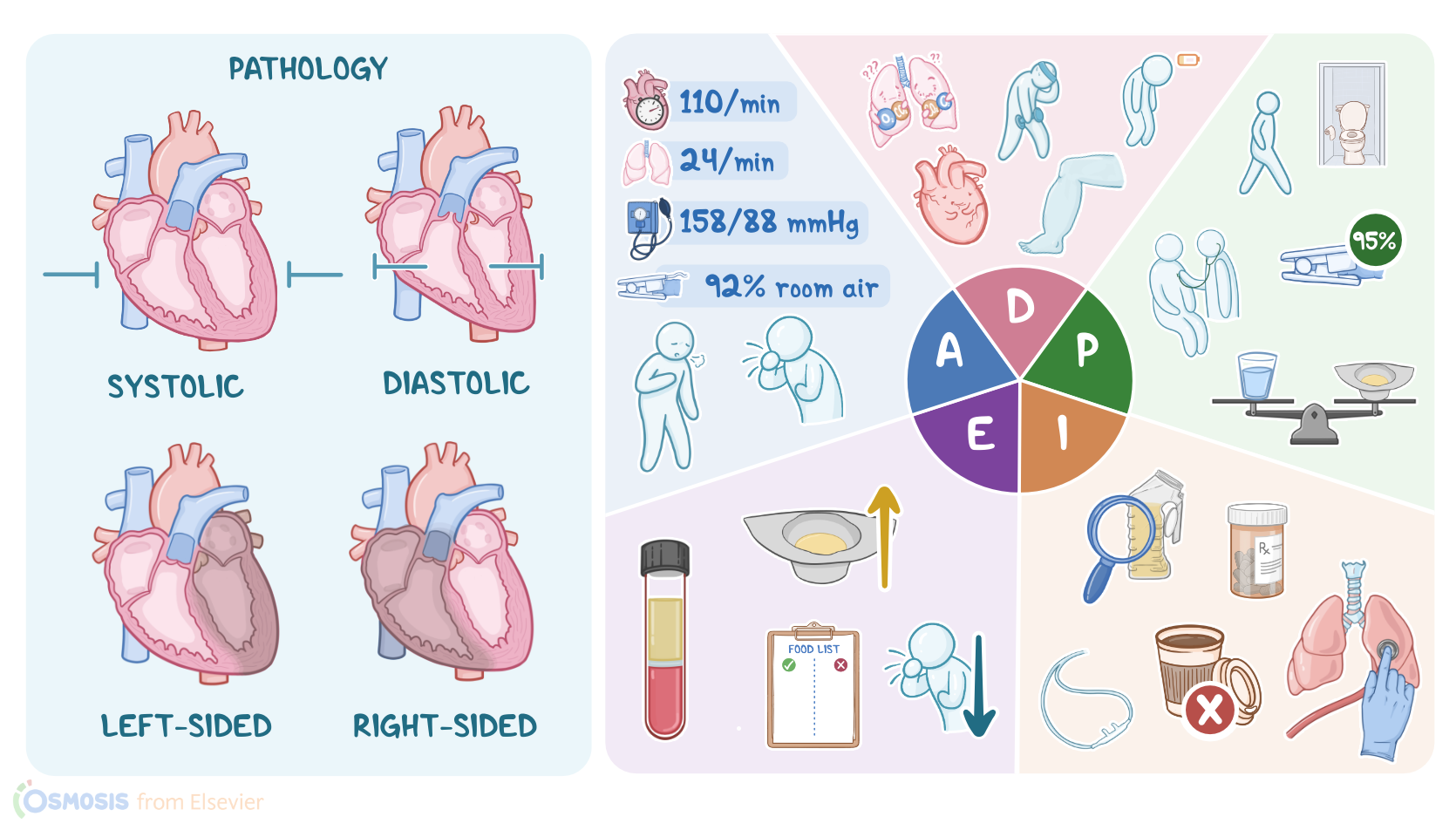
  • Systolic dysfunction
  • Diastolic dysfunction
  • Left ventricle unable to pump with enough force to push blood into aorta
    • Blood backs up into lungs
    • Can result in pulmonary edema
  • Right-sided heart failure
    • right ventricle unable to move blood forward into lungs
    • Blood backs up in to vena cava
  • Compensation
    • Myocardial contractility increases
    • Heart rate increases
    • Peripheral vascular resistance increases
    • Sodium and water retained
    • Myocytes remodel

ASSESSMENT
  • Short of breath, tired, fatigued
  • Non-productive cough
  • Wakes up in sleep, sleeps well in recliner
  • Urinating less than normal
  • 30 mL clear, yellow urine in bedside urinal
  • Nasal flaring
  • Diaphoretic
  • Wheezing and crackles
  • Prolonged capillary refill
  • Heart rate: 110
  • Respiratory rate: 24
  • Blood pressure: 158/88 mmHg
  • Oxygen saturation: 92% room air
  • Temperature: 98.2 F (36.7 C)
  • Pain: 0/10
  • ECG: normal sinus rhythm
    • Previous ejection fraction: 45%
  • Chest X-ray: mild left ventricle enlargement

NURSING DIAGNOSES
  • Impaired gas exchange related to alveolar-capillary changes
  • Decreased cardiac output related to altered myocardial contractility 
  • Activity intolerance related to imbalanced oxygen supply/demand
  • Excess fluid volume related to decreased cardiac output
  • Fatigue related to decreased oxygenation

PLANNING
  • Decrease in periods of dyspnea
  • Clear breath sounds and stable vital signs
  • Balance fluid intake and output
  • Understand risk factors for exacerbations
  • Verbalize appropriate dietary choices 

IMPLEMENTATION
  • Delegate strict intake and output to nursing assistant
  • Apply oxygen
  • Provide education
  • Administer medications as prescribed
  • Teach about avoiding large amounts of caffeine and sodium
  • Identify foods for a low cholesterol, low-fat diet
  • Review fluid restrictions
  • Instruct to weigh daily

EVALUATION
  • Increased urinary output
  • Minimal wheezing and crackles
  • Walks further
  • Decreased nasal flaring
  • Minimal coughing
  • Heart rate: 95
  • Respiratory rate: 20
  • Blood pressure: 142/82 mmHg
  • Oxygen saturation: 94% on 2L nasal cannula
  • Temperature: 98.2 F (36.7 C)
  • Verbalizes dietary guidelines

Transcript

Watch video only

Jamal Hendrick is a 63-year-old male client who was admitted to the Medical-Surgical floor yesterday.

Mr. Hendrick has a history of chronic left-sided heart failure and hypertension.

He was directly admitted by his cardiologist after complaints of shortness of breath, dry cough, and severe fatigue.

He states his last hospitalization was around 6 months ago for similar symptoms.

Heart failure, also called congestive heart failure, is when the heart is unable to pump effectively enough to maintain cardiac output to meet the demands of the body.

Common risk factors for heart failure include uncontrolled hypertension, ischemic heart disease, valvular heart disease, cardiomyopathy, endocarditis, and acute myocardial infarction.

The onset of heart failure can be acute, which occurs suddenly and resolves in a short period of time, but usually develops slowly over a long period of time and persists as a chronic disease.

Often an individual can live with chronic heart failure, but then suddenly develop an acute exacerbation.

Heart failure can be the result of either systolic dysfunction, which is due to inadequate contractility, or diastolic dysfunction, when the heart is unable to relax and fill with blood.

Heart failure can affect the right side, the left side, or both sides of the heart.

The left and right sides of the heart are two separate pumping systems, and one side can remain functional for some time even if the other side is failing.

Most cases of heart failure initially start on the left side, and then eventually progress to include both sides.

With left-sided heart failure, the left ventricle is unable to pump with enough force to push blood into the aorta and the rest of the body.

When this happens, the blood remaining in the left side of the heart will back up into the lungs, causing pulmonary problems such as dyspnea, tachypnea, crackles, dry cough, paroxysmal nocturnal dyspnea, pulmonary edema, and pulmonary hypertension.

Pulmonary edema is a life-threatening emergency where the lungs fill up with fluid causing very high pressure.

Someone with pulmonary edema will present with a large amount of blood-tinged frothy sputum, severe dyspnea, tachycardia, profuse sweating, and cyanosis.

With right-sided heart failure, the right ventricle is not able to move blood forward into the lungs, causing it to back up into the superior and inferior vena cavae and the rest of the venous system.

Right-sided heart failure is almost always caused by left-sided heart failure, because increased pulmonary pressure from blood backing up into the lungs from the left side makes it more difficult for the right side to pump blood into the lungs.

As the right side works harder to overcome the increased pressure it eventually wears out and fails.

Symptoms of right heart failure include dependent edema, jugular venous distension, abdominal distension, splenomegaly, anorexia, weight gain, nocturnal diuresis, and hypertension or hypotension.

Certain mechanisms kick in to try to compensate for the decreased cardiac output.

Through the Frank-Starling mechanism, myocardial contractility is increased, which helps push blood forward.

The sympathetic nervous system also responds by increasing heart rate, increasing peripheral vascular resistance, and further enhancing cardiac contractility.

Sodium and water is retained through the actions of the renin-angiotensin-aldosterone system, which provides additional circulating volume.

The ventricular cells, or myocytes, undergo remodeling, resulting in changes such as increased muscle mass and thickening of the ventricular wall.

These compensatory efforts will initially lead to an increase in cardiac output, but over time the heart will be overburdened and less efficient.

When this happens, clinical symptoms of heart failure will appear. Without treatment, heart failure will progress and result in complications such as pleural effusion, cardiac dysrhythmias, and renal failure.

Okay, let’s get back to our client.

Upon entering Mr. Hendrick’s room, you introduce yourself, confirm his identity, and wash your hands.

You begin your assessment of Mr. Hendrick by asking him how he is feeling today.

He tells you he feels short of breath, but better than when he was admitted.

Mr. Hendrick goes on to say he is extremely tired today, and that he has been feeling fatigued for several days.

You ask Mr. Hendrick what caused him to start feeling short of breath, and he replies he just walked to the bathroom.

You notice he pauses several times during your chat to cough, but it’s non-productive.

You ask Mr. Hendrick if he has issues breathing at night, he replies he wakes up every night with difficulty breathing and that he sleeps better in his recliner.

You ask Mr. Hendrick if he has been using the bathroom regularly, he states he has been urinating less than normal.

You check the bedside portable urinal and document 30 milliliters of clear yellow urine.

Upon visual inspection of Mr. Hendrick, you notice that in addition to appearing slightly short of breath, nasal flaring is present, he’s using his accessory muscles to breathe, and he’s diaphoretic.

You auscultate his lungs and hear wheezing on inhalation and crackles throughout both lobes.

You assess capillary refill and note that it is decreased.

Skin color and turgor are normal.

Mr. Hendrick’s vital signs are HR: 110, RR: 24, BP: 158/88, oxygen saturation: 92% on room air, oral temp.: 98.2° F, pain: 0/10.