Mood disorders: Nursing
Introduction0:00–0:13
Mood disorders are mental health conditions that affect a client’s emotional state, which can range from depression or extreme sadness to mania or excessive excitement.
Physiology0:13–1:09
This network includes structures such as the prefrontal cortex, the cingulate cortex, the amygdala, the hippocampus, and the basal ganglia.
The neurons in these structures communicate through neurotransmitters like dopamine, serotonin, and norepinephrine, which are released from one neuron and bind to receptors of another neuron to modulate its activity.
Finally, norepinephrine is involved in mood, focus, attention, and sleep.Okay, so mood disorders are thought to be caused by neurotransmitter imbalances in the brain.
Causes & risk factors1:09–1:36
Risk factors for mood disorders include genetic predisposition; personal or family history of a mood disorder; history of trauma or psychosocial stressors; substance misuse; age under 40; being assigned female at birth; and giving birth; among many others.Now, the mechanisms underlying the pathology of mood disorders are poorly understood, but there seems to be abnormal neurotransmitter release or receptor availability.
Pathology1:36–2:06
As a result, communication between neurons in the emotion processing network is impaired. Neurotransmitters can either be decreased, leading to reduced neuron activation and depression; or they can be increased, leading to excessive neuron activation and mania.So mood disorders can have a spectrum of clinical manifestations that may cause significant impairment at school, work, or social life.
Clinical manifestations2:06–4:35
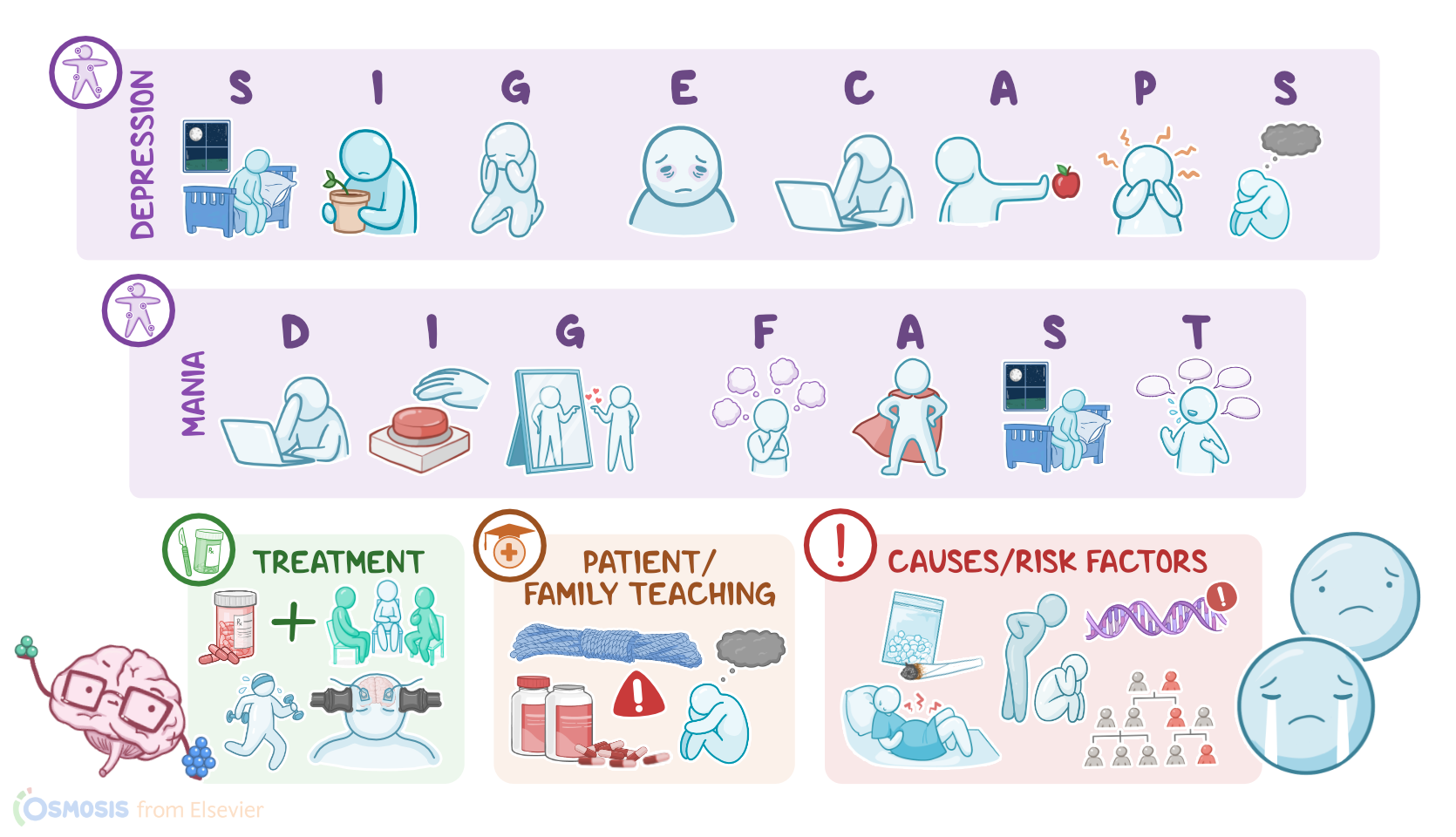
On one end of the spectrum, there’s depression, where the main clinical manifestations can be summarized with the mnemonic SIG E CAPS.
So, many clients experience Sleep disturbances, such as an increase in sleep during the day, or decreased sleep at night.
Then there’s Interest loss, or anhedonia, which refers to a diminished interest in everyday activities that used to be pleasurable, like their hobbies.
Additionally, clients may experience Guilt or feel sad, hopeless, and worthless; as well as lack of Energy and feeling extremely fatigued.
Some clients may also have Concentration difficulty, and slowing down of their thoughts or emotional reactions. Clients may also experience changes in Appetite; as well as Psychomotor agitation with anxiety, or lethargy.
So, many clients experience Distractibility and poor focus; as well as Irresponsibility and Impulsivity, showing reckless behavior, without any regard for later consequences.
In addition, mania is characterized by Grandiosity, where clients might have a really high self-esteem or self-image. Also, they might have Flight of ideas or racing thoughts; as well as increased Activity, since these clients may feel the need to engage in extreme goal-directed activities to achieve certain things.
Clients with mania often have a Sleep deficit, or a severely decreased need for sleep, sometimes staying awake for days; and lastly, they often exhibit Talkativeness or pressured speech.
On the same spectrum, some clients may experience a hypomanic episode, which is characterized by the same clinical manifestations, but they’re more mild than in a manic episode.
Diagnosis4:35–6:13
Diagnosis of mood disorders is based on detailed history and physical assessment. Particular attention should be given to the evaluation of suicidal thoughts.
Diagnosis is confirmed using the Diagnostic and Statistical Manual for Mental Disorders fifth edition or DSM-5 criteria, which is a set of diagnostic criteria indicating the symptoms that must be present, and for how long, to diagnose a mental health condition.
Now, based on the DSM-5 criteria, mood disorders can be categorized into two broad groups, which include depressive disorders and bipolar disorders.
To diagnose a depressive disorder, the client must experience at least one depressive episode that lasts for at least two weeks and includes five depressive symptoms, one of which should be either depressed mood or anhedonia.
Depressive disorders include major depressive disorder; major depressive disorder with seasonal pattern; major depressive disorder with psychotic features; major depressive disorder with peripartum onset; depression with atypical features, and persistent depressive disorder.
On the other hand, to diagnose a bipolar disorder, the client must present at least one manic or hypomanic episode, which tends to last for several weeks or months.
Treatment6:13–8:30
Typically, these episodes fluctuate with depressive episodes, and in between, the client may even have periods of remission and stable mood.Treatment of mood disorders usually involves a combination of psychotherapy and pharmacotherapy.
Psychotherapy, including cognitive-behavioral therapy, focuses on teaching the client strategies to better cope with stress and social pressures, as well as to identify the patterns of thought that might be influencing their disorder.
In addition, clients may benefit from lifestyle modifications like physical activity, yoga, meditation, deep-breathing exercises, and acupuncture.
Regarding pharmacotherapy for depression, the first line antidepressant medications are selective serotonin reuptake inhibitors or SSRIs, such as fluoxetine, paroxetine, or sertraline.
These should be titrated up according to response and be continued for at least 6 months post symptom resolution. Other antidepressant classes include serotonin and norepinephrine reuptake inhibitors or SNRIs like duloxetine, venlafaxine, or desvenlafaxine; atypical antidepressants like mirtazapine or bupropion; tricyclic antidepressants or TCAs like amitriptyline or nortriptyline; and monoamine oxidase inhibitors or MAOIs like isocarboxazid or selegiline.
On the other hand, in bipolar disorder, antidepressants should be avoided; so pharmacotherapy can involve the mood stabilizer lithium; an antiepileptic medication like valproate or lamotrigine, or a second generation antipsychotic like olanzapine.
Lastly, clients with either depression or bipolar disorder who don’t respond to pharmacotherapy can be treated with electroconvulsive therapy or ECT for short.
Management and care8:30–11:10
This is when a small and controlled amount of electric current is passed through the brain while the client is under general anesthesia and neuromuscular blockade, and this induces a brief seizure.
Okay, let’s look at the nursing care you will provide for a client with a mood disorder. The priority goals of care are to maintain the safety of your client and other people around them, as well as to promote positive coping skills.
Begin by providing a safe environment for your client. Use a tool like the Suicide Assessment Five-Step Evaluation and Triage, or SAFE-T for short, to assess suicide risk, determine the level of suicide precautions, and guide interventions.
Immediately report if your client makes statements that indicate suicidal ideation, such as “I just can’t take it anymore” or “I want to go to sleep and never wake up."
Also, be sure to ask them if they have thoughts of harming themselves, or if they have plans for suicide, and immediately report if your client clearly intends self-harm.
Then, continue to observe your client at regular intervals, as indicated, noting any changes in behavior that could indicate an increase in their risk of suicide, and be sure to work toward a plan for safety and support in the community.Then, assess self-care deficits related to nutrition, hydration, sleep, and hygiene that your client may present.
Institute interventions to promote maintenance of physiologic and personal needs, and administer the antidepressants or mood stabilizers as prescribed.
During care, communicate with your client using a moderate tone of voice; remembering to use simple, direct sentences; and allow extra time for them to respond.
In addition, encourage your client to discuss their feelings; and use therapeutic techniques like active listening and silence.
General client and family teaching11:10–12:25
Guide them to discuss coping skills they have used successfully in the past, and also encourage them to participate in psychotherapy sessions, and assist them to practice newly learned coping skills.
For clients diagnosed with mania, implement additional measures to decrease hyperactivity, restlessness, and anxiety. If they become agitated and potentially violent, use de-escalation techniques, call for assistance, and administer PRN medication to decrease anxiety, as indicated.All right, moving on to client and family education.
Review with your client the signs and symptoms of their disorder, and the importance of having a plan in place, including community resources and a list of contacts for your client to reach out to as needed.
Emphasize the importance of contacting their healthcare provider if they feel their condition is getting worse or if they feel they are not getting better as expected.
Review12:25–14:26
Moreover, if they feel they may hurt themselves or someone else, instruct them to immediately call the national suicide prevention lifeline at 1-800-273-8255, call for emergency services, or go the nearest emergency department.Also teach your client the importance of lifestyle modifications like eating a healthy diet and engaging in regular exercise like yoga, or walking to help reduce stress, to take their medication as directed, and to continue to meet regularly with their therapist.
Lastly, provide information on local support groups, to promote positive relationships with others who have similar shared experiences.All right, as a quick recap… Mood disorders are mental health conditions that range from depression or extreme sadness, to mania or excessive excitement.
Mood disorders seem to be caused by an imbalance in neurotransmitters like dopamine, serotonin, and norepinephrine; ultimately resulting in impaired communication between neurons in different parts of the brain that form an emotional processing network.
Risk factors include family history, trauma, psychosocial stressors, and substance misuse. Symptoms of depression can be summarized with the mnemonic SIG E CAPS: Sleep disturbances; Interest loss, or anhedonia; Guilt or feeling sad, hopeless, or worthless; Energy lack; Concentration difficulty; Appetite changes; Psychomotor
| MOOD DISORDERS | ||
| KEY POINTS | NOTES | |
| DEFINITION |
| |
| PHYSIOLOGY |
| |
| CAUSES AND RISK FACTORS |
| |
| PATHOPHYSIOLOGY |
| |
| SIGNS AND SYMPTOMS |
| |
| DIAGNOSIS |
| |
| TREATMENT |
| |
| MANAGEMENT OF CARE |
| |
| PATIENT AND FAMILY TEACHING |
| |
No notes for this video yet
Try adding a note below