Multiple sclerosis (MS): Nursing
Introduction0:00–0:25
Multiple sclerosis or MS is an autoimmune degenerative nerve disorder that causes demyelination of the nerve fibers of neurons in the brain and the spinal cord.
This demyelination occurs when the body's own immune system inappropriately attacks and gradually destroys the myelin sheath, slowing down the communication between neurons.Let’s start by looking at the physiology of neurons.
Physiology0:25–0:58
Remember that neurons are the cells of the brain and spinal cord that transmit electrical signals throughout the central nervous system and the body.
These signals are transmitted as nerve impulses, which move across a branch of the neuron called axon, which is covered by a protective myelin sheath.
The role of this sheath is to speed up the transmission of electric impulses, allowing information to travel quickly from one neuron to another in order for us to perceive sensations and perform movements.
Just like other autoimmune diseases, the exact cause of MS is unknown, but it is linked to both genetic and environmental factors.
Causes & risk factors0:58–1:49
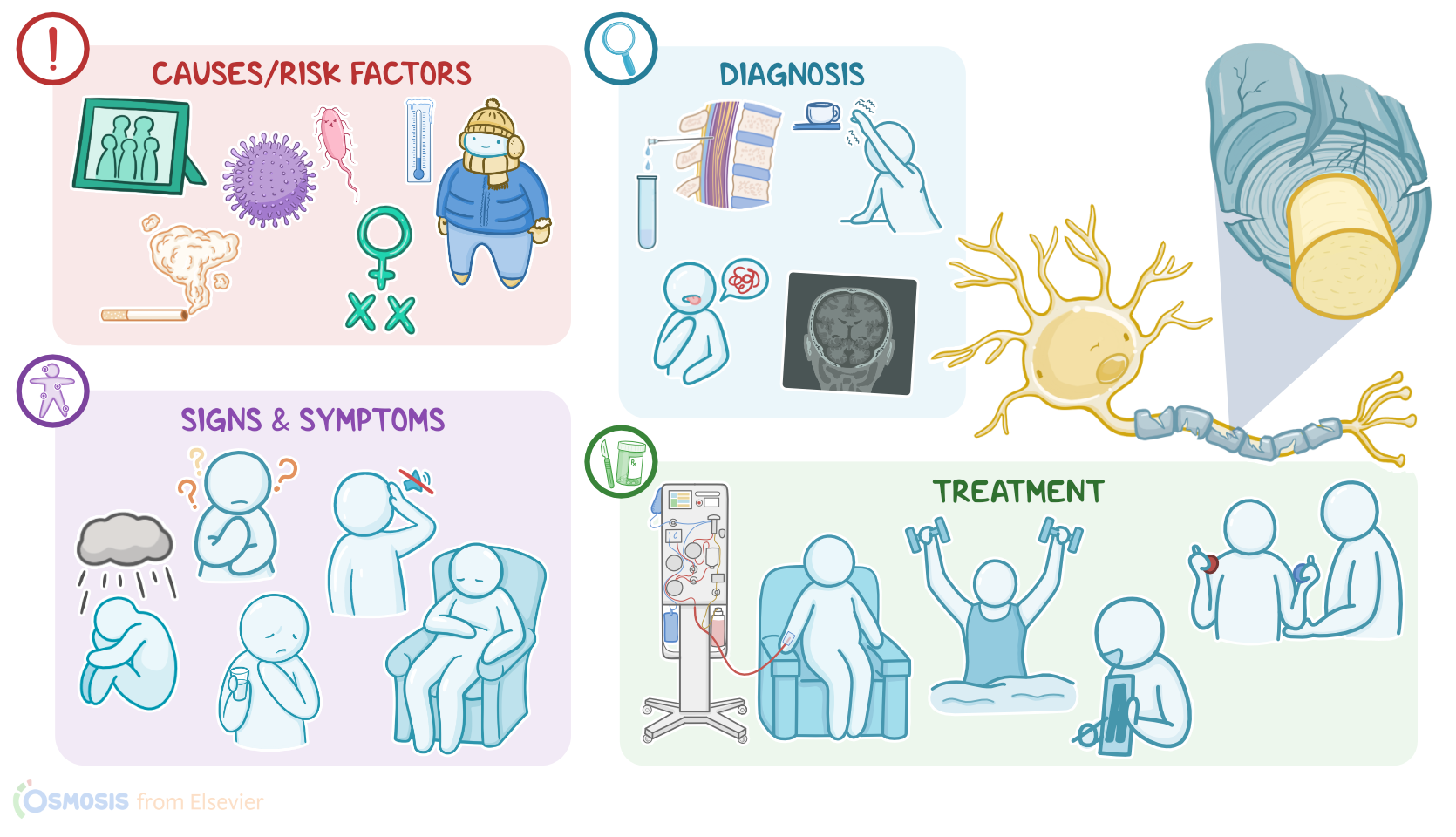
Multiple sclerosis typically affects clients between the ages of 20 and 40, and genetic risk factors include a family history of MS, clients assigned female at birth, as well as genes that encode a specific type of immune molecule, called HLA-DR2, which is used to identify and bind to foreign molecules.
Environmental risk factors might include infections, smoking, and living in a colder climate, as well as vitamin D deficiency.
This is an interesting one, because it might help explain why the rates of multiple sclerosis are higher among the clients living at higher latitudes, compared to the clients living closer to the equator where there’s a lot more sunlight.Together, these genetic and environmental factors trigger the activation of the body’s own immune cells that enter the CNS, target the myelin and cause widespread inflammation.
Pathology1:49–2:13
As inflammation progresses, it gradually damages the axons as well. This impairs the transmission of nerve impulses leading to all sorts of sensory, motor, and cognitive problems.
Clinical manifestations2:13–3:46
Now, when it comes to clinical manifestations, it’s worth noting that the onset of MS is very slow and gradual, so specific signs and symptoms vary a lot from clients to clients depending on the severity of the disease.
One common trio of signs is called Charcot’s neurologic triad, including dysarthria, which is difficult or unclear speech; nystagmus, which is involuntary rapid eye movements; and an intention tremor.
Other symptoms include double vision or blurred vision, hearing loss, short term memory loss, fatigue, generalized weakness, impaired swallowing, and loss of sensation and coordination, as well as impaired bowel and bladder function.
Clients may also develop anxiety, and depression.Now, based on the pattern of symptoms, MS is classified into four main types: relapsing-remitting, primary-progressive, secondary-progressive and progressive-relapsing.
With relapsing-remitting MS, symptoms develop but resolve within a few weeks or months and the client returns to partial or complete remission.
In primary-progressive MS, steady neurologic deterioration occurs without any remission. In secondary-progressive MS, a relapsing-remitting course later becomes a steady progression of symptoms.
Finally, with progressive-relapsing MS, the disease continues to progress, and there are frequent relapses with only partial recovery, but no full return to normal.
Diagnosis3:46–4:22
Now, there are no definitive diagnostic tests available as of now for MS. Multiple sclerosis is typically suspected when clients give a history of multiple neurologic symptoms separated in space and time.
The diagnosis of multiple sclerosis is supported by an MRI of the brain and spinal cord. In addition, a CSF analysis can be done, which might show high levels of antibodies, indicating an autoimmune process.
Finally, a visual evoked potential, or VEP, can be helpful as well, measuring the nervous system’s response to visual stimuli.Unfortunately, there is no cure for multiple sclerosis, but there are medications which are particularly effective in treating the relapsing-remitting type.
Treatment4:22–5:23
Immunomodulators like corticosteroids, cyclophosphamides, a cell cycle inhibitor, and intravenous immunoglobulin can be used to help blunt the autoimmune process, as well as monoclonal antibodies, interferons or fumarates.
In addition, plasmapheresis, when the plasma is filtered to remove disease-causing autoantibodies, can be effective. Chronic treatment for multiple sclerosis includes immunosuppressants.
Physical therapy like water exercise, occupational therapy, speech therapy, deep brain stimulation and dorsal-column electrical stimulation can be utilized in improving the sensory, motor, and cognitive symptoms.
Finally, new research on stem cell therapy has been going on to manage aggressive or treatment-resistant forms of MS. All right, now let’s talk about nursing you'll provide for a client with a multiple sclerosis exacerbation.
Management and care5:23–7:38
Your goals of care are to provide symptom relief, prevent complications, and provide emotional support. Begin providing symptom relief by assessing their current level of neuromuscular function.
Then, institute fall precautions and administer the prescribed IV corticosteroids. Continue to monitor your client’s response to treatment, and report if symptoms such as extreme weakness, loss of balance, dysarthria, dysphagia, and loss of vision continue in spite of corticosteroids.
As ordered, prepare your client for plasmapheresis.During care, take steps to prevent complications from the exacerbation.
For mobility and balance problems, institute fall precautions and collaborate with the physical therapist to provide range of motion, stretching, and muscle strengthening exercises.
Also assist your client to change position at least every two hours to take pressure off bony prominences such as heels, hips, and elbows.
To prevent choking and aspiration, implement swallow precautions and reach out to the speech-language pathologist for a swallowing assessment and development of an individualized dysphagia diet.
You’ll also need to keep a close eye on their bowel and bladder function. Monitor their intake and output, and assess if they are able to completely empty their bladder.
If urinary retention is suspected, perform a bladder scan and report to the healthcare provider if post-void urine residual is present; and perform a straight urinary catheterization, as ordered.
Lastly, monitor them for constipation by auscultating bowel sounds and checking their abdomen for distention, and administer the prescribed stool softener to promote bowel elimination.
Finally, provide emotional support for your client by encouraging them to share their feelings about their disease progression and changes in quality of life.
Mobilize resources, including counseling services and local support groups.Okay, moving on to client and family teaching.
General client and family teaching7:38–9:31
Start by reviewing the causes of multiple sclerosis, including how their own immune system gradually destroys the myelin sheath around the nerve fibers of neurons in the brain and the spinal cord.
Then, go over their prescribed medications and teach them to take them exactly as prescribed. Next, teach them about ways they can decrease the risk of an exacerbation.
Talk to them about avoiding infections by practicing good infection control techniques such as frequent hand hygiene and avoiding large crowds and people who are sick.
Also, encourage them to develop stress reduction techniques they can use in stressful situations. Emphasize the importance of moderate activity to decrease muscle spasticity and improve coordination, but remind them that too much physical activity can cause fatigue and could also trigger an exacerbation.
Remind them to alternate their daily activities with periods of rest, and encourage them to get enough sleep each night.
Be sure to let them know that starting a new medication can also trigger an exacerbation, so remind them to talk to their healthcare providers before taking any new over the counter medication or supplement.
Also remind them to avoid extremes of heat and cold. Lastly, encourage them to identify their individual triggers so they can be avoided.
Finally, instruct your client to contact their healthcare provider right away if they develop a sudden onset of fatigue, any new pain, numbness, or tremors; or if they have trouble emptying their bowels or bladder; and to seek immediate medical care if they cannot move; if they have visual changes such as double vision or loss of vision; if they become confused; or if they feel depressed or have thoughts of harming themselves or others.
Multiple sclerosis, or MS, is an autoimmune degenerative nerve disorder that causes demyelination of the nerve fibers of neurons in the brain and the spinal cord.
Review9:31–11:12
The exact cause of MS is unknown, but it is linked to both genetic and environmental factors. Together, these genetic and environmental factors trigger the activation of the body’s own immune cells that enter the CNS, target the myelin and cause widespread inflammation, impairing the transmission of nerve impulses over time.
There are four main classifications of MS based on the pattern of symptoms: relapsing-remitting, primary-progressive, secondary-progressive and progressive-relapsing.Symptoms vary from client to client, and generally include dysarthria, intention tremors, vision changes, generalized weakness and fatigue, impaired bowel and bladder function, as well as loss of sensation and coordination.
MS is typically suspected when clients give a history of multiple neurologic symptoms and can be correlated with an MRI of the brain and spine.
It is treated with immunomodulators, monoclonal antibodies, interferons or fumarates, and plasmapheresis. Goals of nursing care include providing symptom relief, preventing complications, and providing emotional support.
Client and family education is centered on decreasing the risk of an exacerbation, and when to seek medical care.
| MULTIPLE SCLEROSIS (MS) | ||
| KEY POINTS | NOTES | |
| DEFINITION |
| |
| PHYSIOLOGY |
| |
| CAUSES AND RISK FACTORS |
| |
| PATHOPHYSIOLOGY |
| |
| SIGNS AND SYMPTOMS |
| |
| DIAGNOSIS |
| |
| TREATMENT |
| |
| MANAGEMENT OF CARE |
| |
| PATIENT AND FAMILY TEACHING |
| |
No notes for this video yet
Try adding a note below